V/4441: The Teacup We Found Written Down in a Victorian Pattern Book
Somewhere in the surviving records of Cauldon Place — one of the grand old addresses of Staffordshire potting — a clerk once opened a pattern book and entered a new design under the number V/4441. He did not waste words. The entry reads, in its entirety: “is as V/3926 only Vienneze Green grd.” Same as pattern 3926, only on a Viennese-green ground — spelling slip and all, set down by a man with four thousand patterns behind him and no idea that anyone would still be reading his shorthand more than a century later. We read it last year, closely, because the cup it describes was sitting on our table.
What a pattern book is
Before there were marketing departments there were pattern books: the working ledgers in which a pottery recorded every design it put into production — numbered in sequence, described in the decorating shop's own shorthand, often with a painted rendering or a pasted sample, so that an order arriving years later could be matched exactly. They were tools, not treasures; most were used up, broken up, or lost when firms closed. The books from Cauldon Place are a lucky exception: a run of them survives from the Ridgway firms and their successors, and they have been photographed and made searchable by a dedicated archive project, ridgwaypatternbook.org.uk. For anyone holding an unattributed piece from this house, that archive is the nearest thing the hobby has to a birth registry.
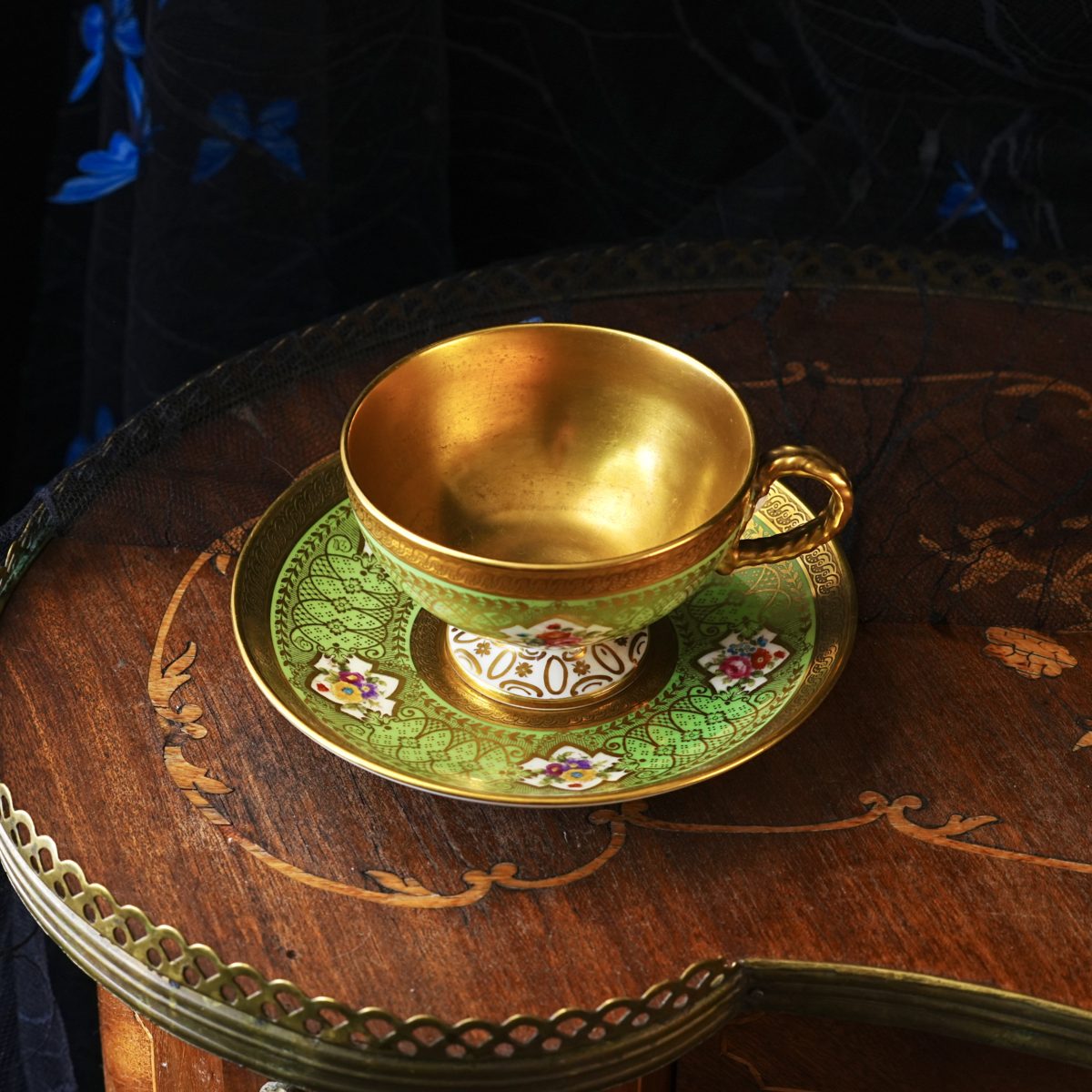
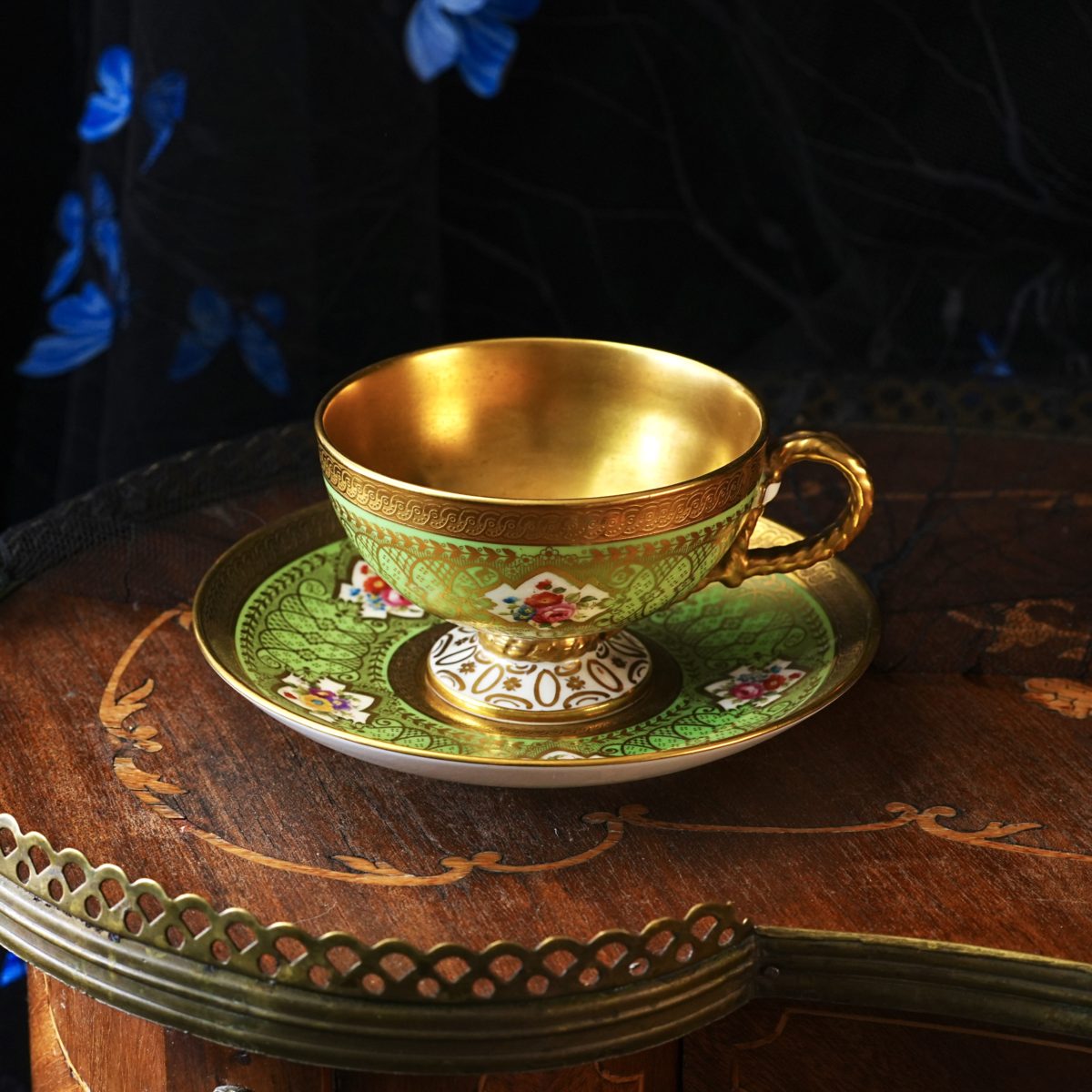
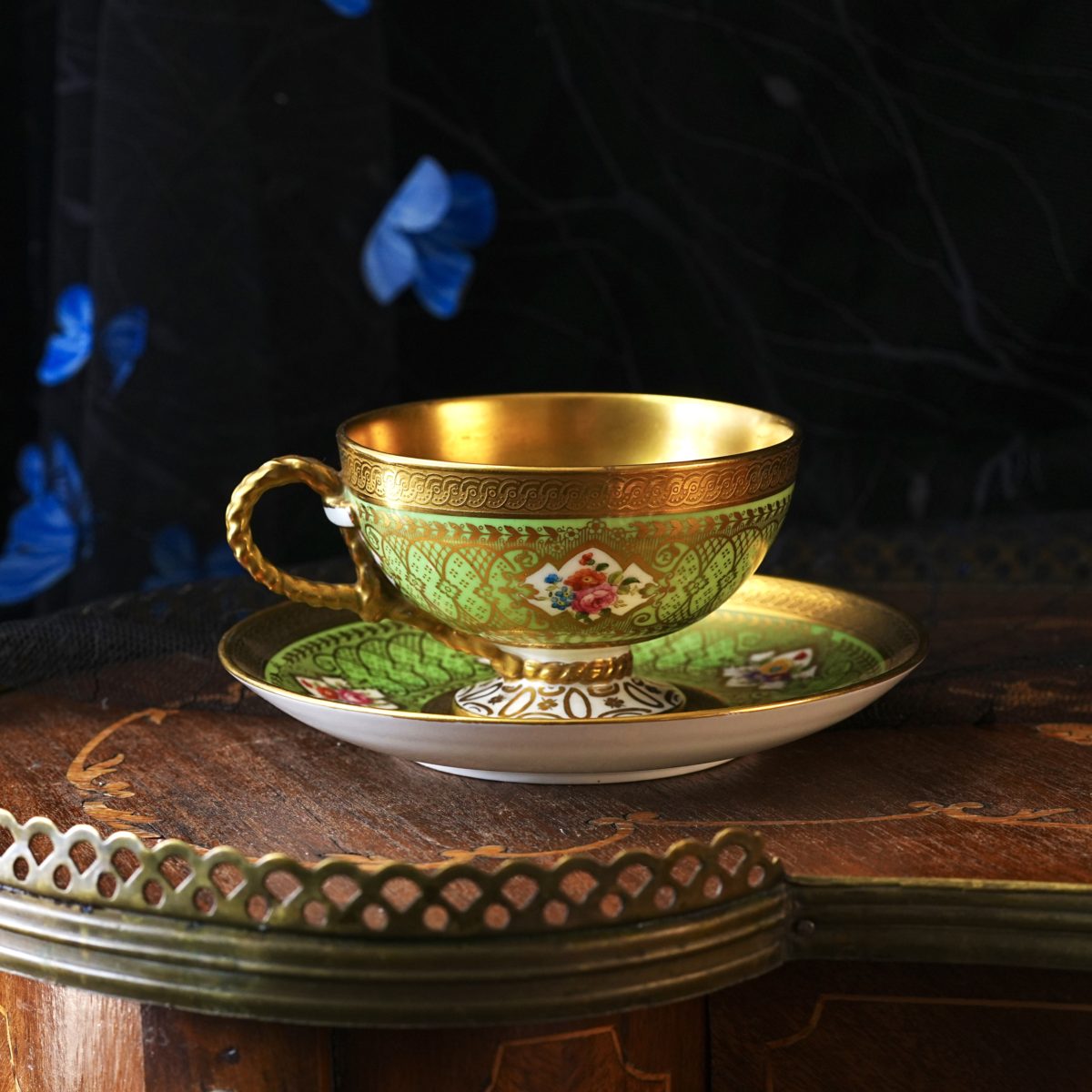
Pattern V/3926, the parent design, was worked on a Mazarin-blue ground. V/4441 is the same composition ordered up in green — and the archive's photographed example allowed us to check the identification point by point against our cup: the apple-green ground, the gilt arcading and leaf-tips laid over it like lace, the white reserves with their little hand-painted bouquets, the pedestal foot picked out in gold ovals, even the unusual twisted-rope handle. Item by item, they agree.
Attribution by mark tells you who. Attribution by pattern book tells you what — this design, this number, entered by this house in its own hand.
Where the cup outruns its own record
Then comes the interesting divergence. The example recorded in the archive keeps a white interior with gold scrollwork — handsome, and standard for the pattern. On our cup the interior is gilded solid, one unbroken field of burnished gold from rim to base, and the saucer's well is laid in gold to match. That is a richer state of the design than the archive itself shows, and we have not traced another example of it. We say that carefully — not traced is not the same as does not exist — but it moves the cup from “a recorded pattern” to “a recorded pattern, in a grander dress than the record.”
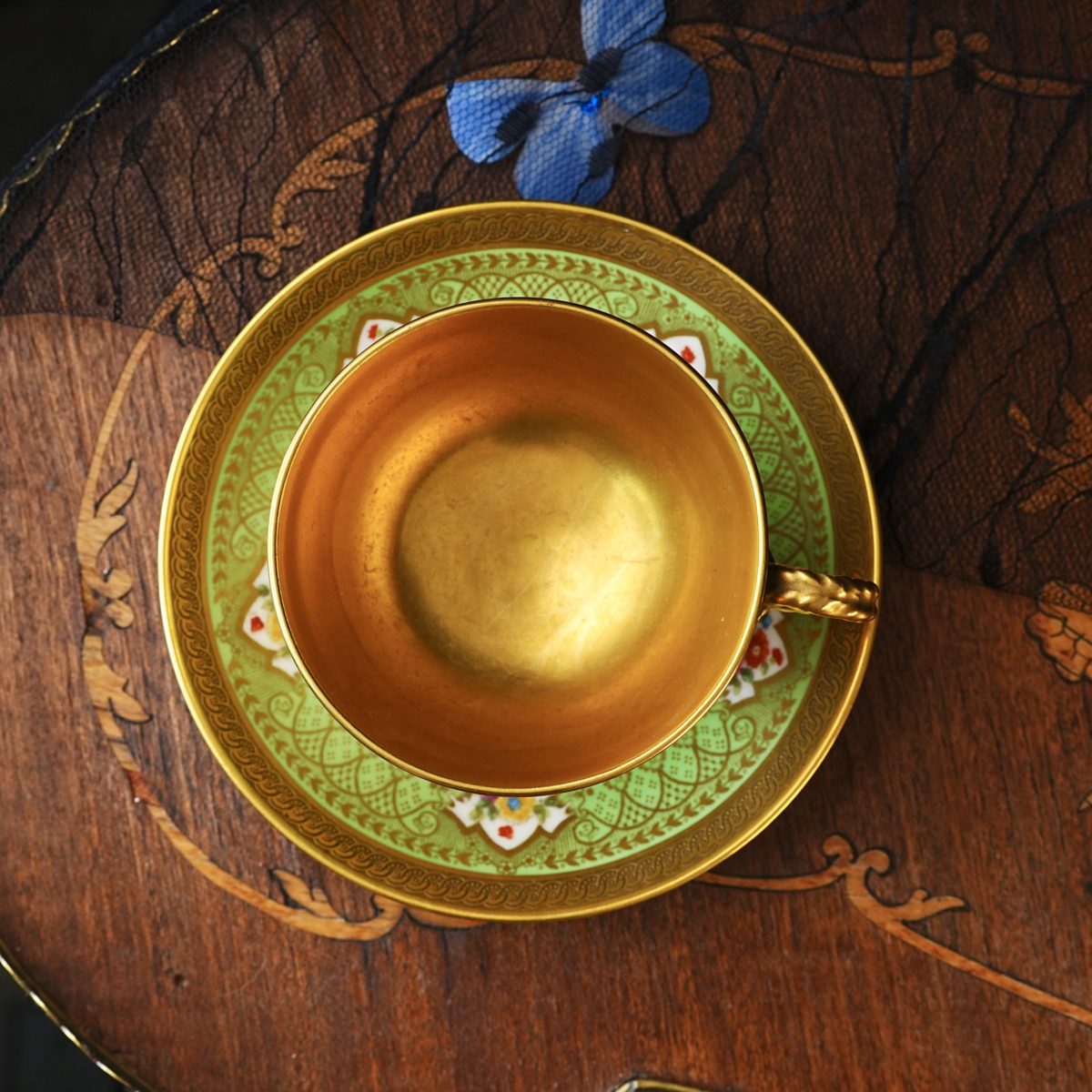
A solid-gilt interior was never a practical choice. It costs an extra passage through the gilding kiln, and once a metal spoon has scratched it there is no repairing it — which is why the treatment belongs almost exclusively to cabinet cups: pieces made in ones and twos to stand in a glazed cabinet and be looked at, not used. (Ours carries the fine surface scratches a gold bowl honestly earns in a century, with no wear through — someone, at some point, could not quite resist.)
A mark with a sixteen-year lifespan
The dating rests on the base. Cup and saucer both carry a black printed CAULDON Ld · England, and that little abbreviation is unusually generous: the firm only styled itself “Cauldon Ltd” from its incorporation in 1904 to its receivership in 1920. Sixteen years, hard limits on both ends — few English marks date a piece so tightly. Under the cup there is also a small tally in red, hand-painted: not a word, just the private count-mark of the gilder or paintress recording her piecework. Two people signed this cup, in effect — the company in black, and one worker in red.
The house behind the mark
Cauldon Place earned its self-regard. Job Ridgway built the works in 1802; his son John Ridgway held a royal appointment as Potter to Queen Victoria, and at the Great Exhibition of 1851 the firm took a first-class award, the jury ranking it among the first houses in England. Under the successor partnership of Brown-Westhead, Moore & Co. the works made a dessert service for the Prince of Wales in 1877, each piece hand-painted with a different hunting scene — and supplied dinner, dessert, tea and breakfast services to the Russian Czar, orders won in open competition against Sèvres and Dresden. Which casts one detail of our cup in a particular light: its green is the apple green that eighteenth-century Sèvres made famous as vert pomme. A house that had taken the Czar's table from Sèvres was not choosing that colour by accident.
Gold poured on in the debt years
Here is the layer of this cup's story we find hardest to put down. The sixteen years of the Cauldon Ltd mark were the firm's most beautiful and most desperate at once. In 1908 a trade correspondent from the Pottery Gazette toured Cauldon Place and wrote up its showroom as one of the finest in the district, its china close to perfection in body, glaze and decoration. The books tell the other half: a £40,000 debenture raised in 1906 against the works, the canal wharf and the land; October 1908, a month's notice served on every worker in the factory so that wages could be renegotiated one by one — the trade press taking care to report that the works were not closing, which tells you what people were saying; capital written down in 1912; receivership in 1920. The gold on this cup — and there is more gold on it than on anything else in our cabinet section — was fired in a house being chased by its debts. Luxury made in fat years is one thing. This is the other, rarer thing: a firm holding its standard up while the floor tilted.
The works passed to new ownership after 1920, and Cauldon bone china production came to its end in 1958, when the china side was sold on — so the supply of pieces like this one is closed, permanently.
Three golds on one cup
Part of what the 1908 correspondent was admiring is legible on this very object, because the cup carries three distinct gilding techniques, and telling them apart is a genuinely useful collector's skill:
- Acid-etched gold on the rim and border bands. The pattern is bitten into the glaze with acid before the gold goes on, so after burnishing, matt and mirror finishes alternate within a single layer of gold — turn the cup and the design surfaces and sinks. That two-textures-in-one-gold look is the fingerprint of acid etching; raised-paste gold sits proud enough to feel, and printed gold lies flat and even.
- Freehand-painted gold for the arcading and leaf-tips over the green — brushwork, with the tiny variations of a hand.
- Flat burnished gold across the bowl and the saucer's well — laid in one even field and polished to metal.
Add the bouquets — a rose, a cornflower, a scatter of forget-me-nots, each painted inside its drawn line — and you are looking at four different specialists' work on one teacup, counted out in red under the base by one of them. Our Cauldon entry in the Backstamp Guide covers the marks; the cup itself covers the rest.
The cup and its archive story are set out in full in the listing, photographed from every side.
See the cup → Shop on Etsy ↗Sources: the pattern identification is from the surviving Cauldon Place pattern books as photographed by the Ridgway Pattern Book project — entry V/4441 (“is as V/3926 only Vienneze Green grd.”), compared point by point with the cup in the shop; the fully gilded interior is a state we have not traced elsewhere, and that claim should be read with the usual caution. The 1904–1920 span of the “Cauldon Ltd” mark follows the standard Stoke-on-Trent mark chronologies. The house history — Job Ridgway's 1802 works, John Ridgway's appointment as Potter to Queen Victoria and the 1851 Great Exhibition award, the 1877 Prince of Wales service, the Russian imperial orders won against Sèvres and Dresden, the 1906 debenture, the October 1908 wage renegotiation, the 1912 capital reduction, the 1920 receivership and the 1958 end of Cauldon bone china — is drawn from the contemporary trade press (including the Pottery Gazette's 1908 visit) and published histories of the Cauldon Place works. Dates are as given in those records and should be read as the records' own.