Blue Light on a Lathe: What Guilloché Enamel Actually Is
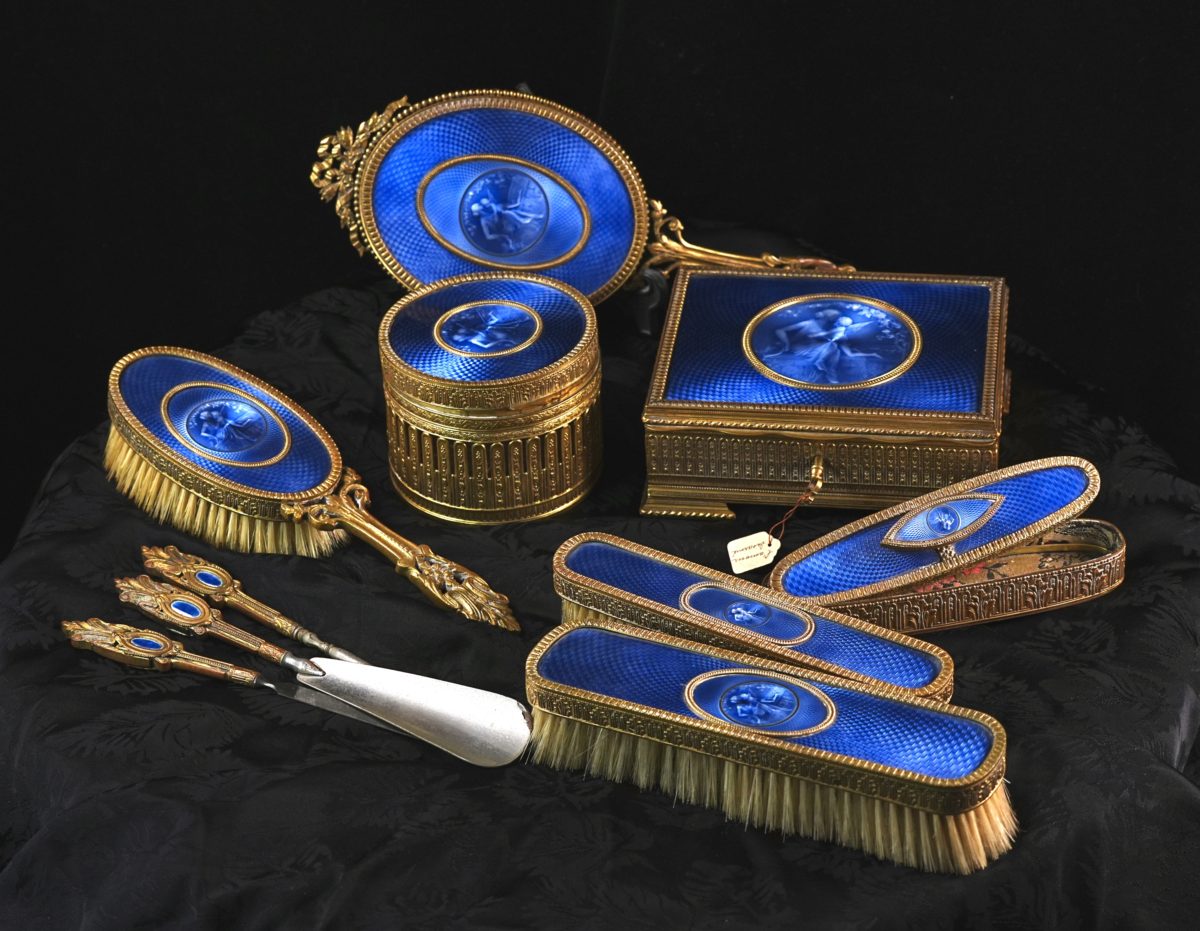
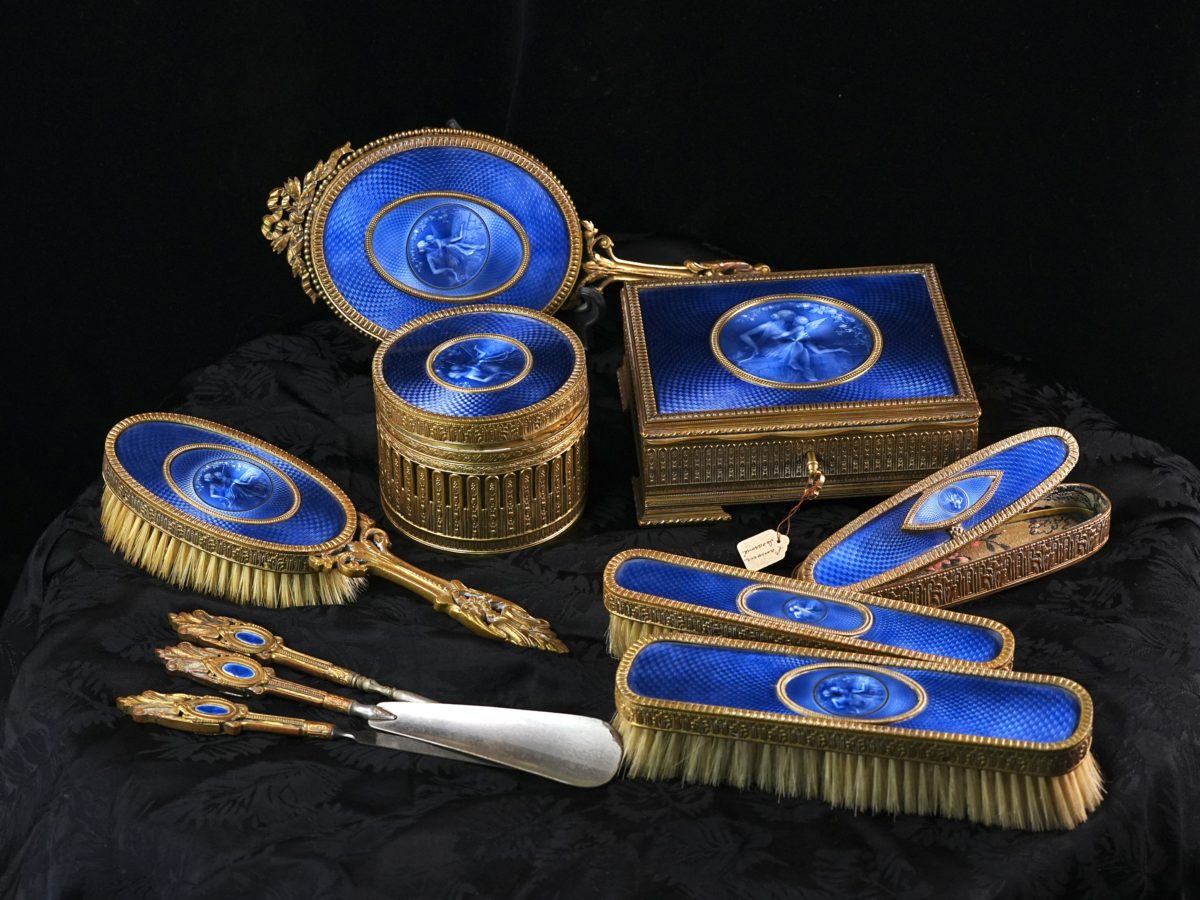
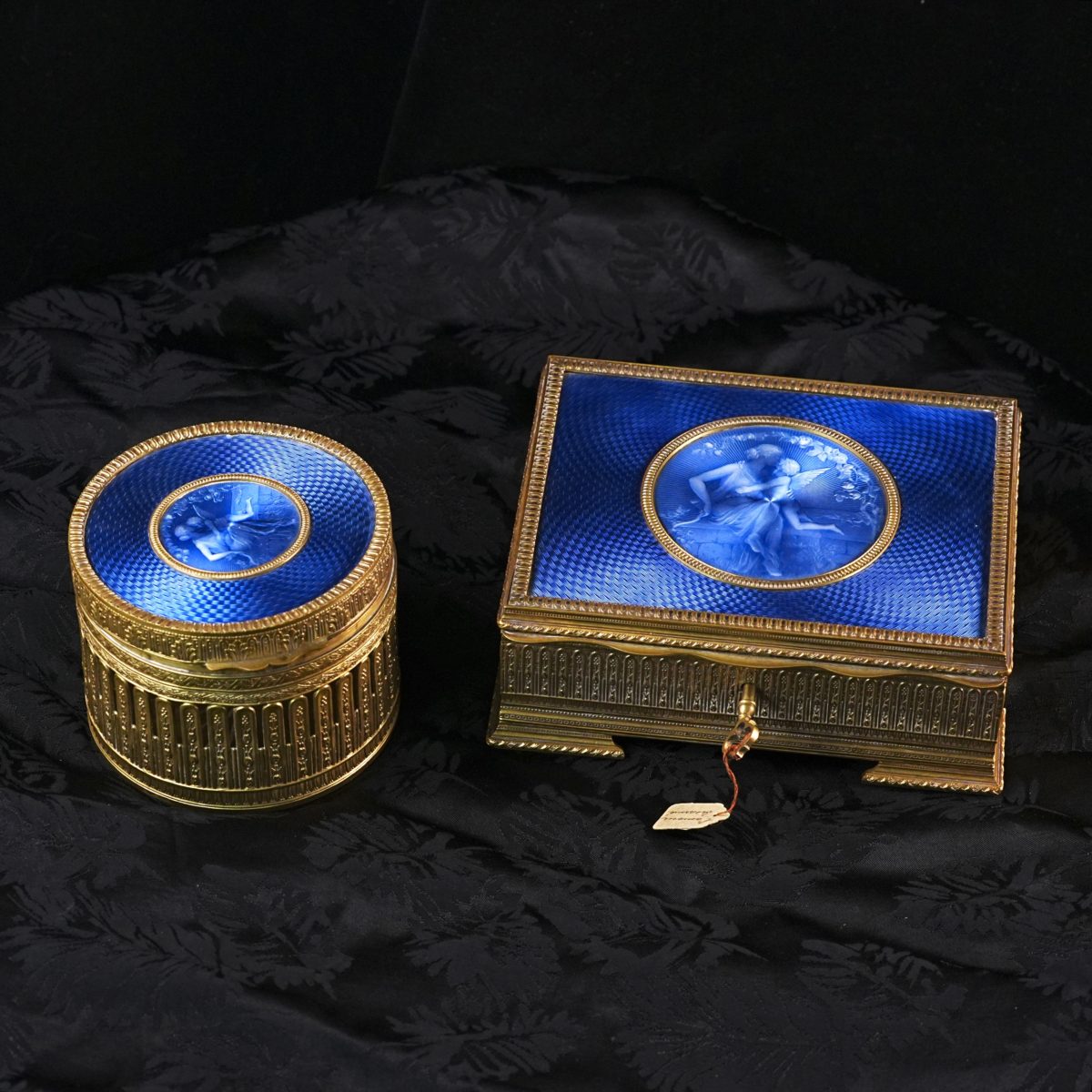
Tied to the brass key of a French jewellery casket in the shop, on a scrap of paper gone soft with age, someone has written three words in ink: L'Amour Désarmé — Love Disarmed. The tag hangs from the lock on a red thread, where it has evidently hung for a long time. It names the scene that repeats on every piece of the set the casket belongs to: Venus with her winged son Cupid gathered in her arms, his bow set aside. But before you can look properly at the scene, the background does something unusual. Tilt any piece under a lamp and the blue field around the medallion moves — a ripple crossing it like watered silk. That ripple has a name, and a machine behind it, and once you know how it is made you can never mistake the real thing again.
A drawing made by a machine
Guilloché starts as bare metal on a lathe — but not an ordinary lathe. A rose engine holds the work against a set of shaped cams called rosettes, so that as the piece turns, it also rocks. The cutting point stays still; the metal beneath it sways; and the line that results is not a circle but a wave. Shift the work a hair's breadth, cut again, and the next wave lands beside the first. Do this a few hundred times with a patience that is difficult to imagine and the surface fills with interlocking waves — barleycorn, basketweave, moiré, sunburst — each too regular for a hand, too fluid for a stamp.
On its own, engine-turned metal is handsome but quiet — watchmakers have decorated movements with it for centuries. The Belle Époque's contribution was to stop there only halfway: flood the turned surface with transparent coloured enamel — powdered glass, essentially — and fire it until it fuses. Now light passes through the colour, strikes the engraved waves beneath, and comes back bent. The pattern seems to float below the surface; the colour deepens in the troughs and brightens on the crests; and the whole field shifts as your hand moves. Nothing about it is flat, because nothing about it is on the surface — the drawing is in the metal, and the glass above it works like a lens.
This is the technique Fabergé used on the Imperial Easter eggs, and the reason his enamels seem lit from inside. The workshops of Paris used it on humbler things — watch cases, boxes, buttons, and dressing-table sets like this one — but the optics are the same, and so is the lathe.
How to tell it from a print
Because the effect was admired, it was imitated — there are later pieces where the wavy pattern is simply printed on the surface and varnished or enamelled over. The difference is easy to see once you know where to look:
- Tilt it. True guilloché moves — the moiré ripples and re-forms as the angle changes, because you are watching light refract through glass onto cut metal. A printed pattern stays put. It can be pretty; it cannot ripple.
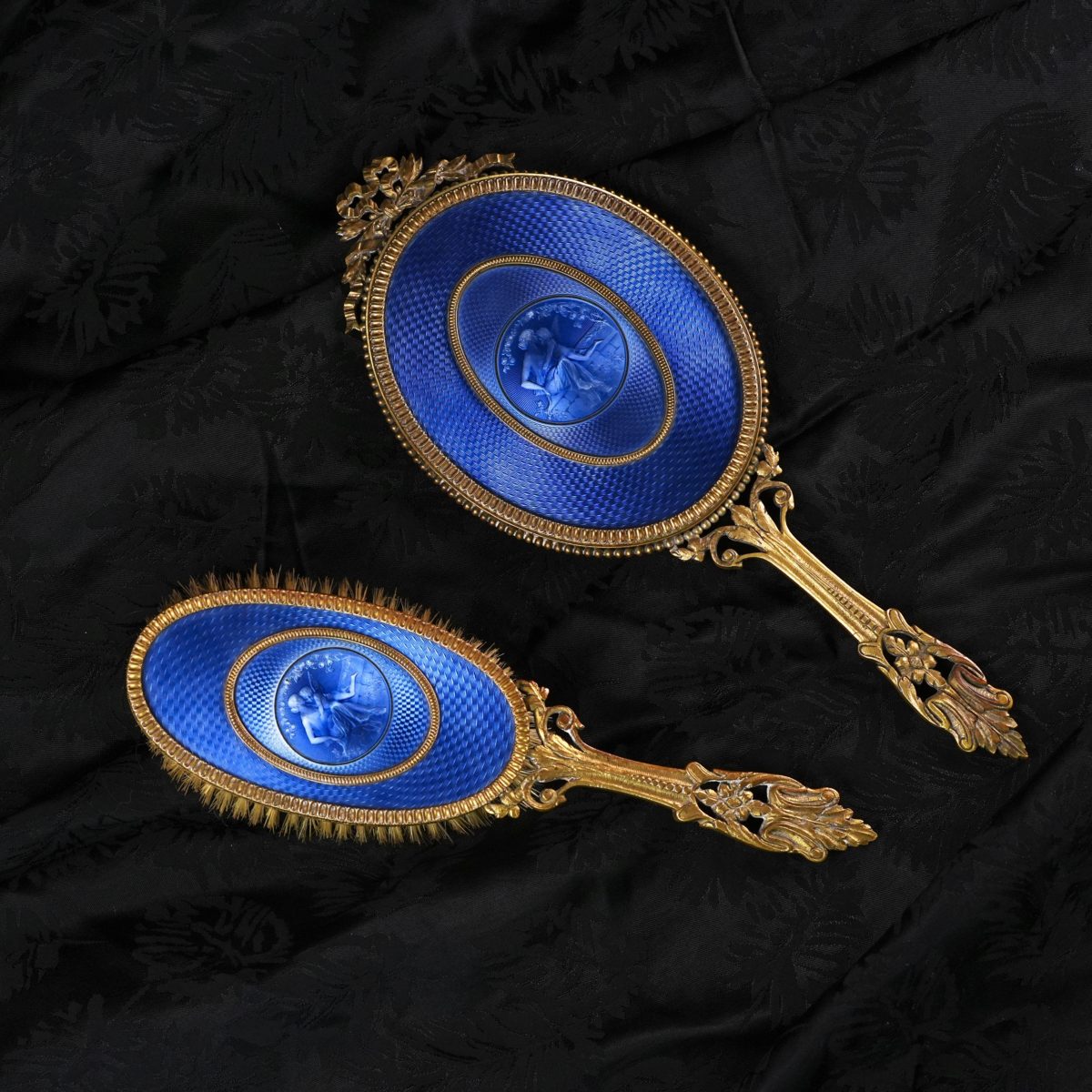
- Look for the gear-change. On honest work the turning is composed like the object: on this set, a fine basketweave fills the broad fields, and directly behind each medallion the pattern shifts to a sunburst, rays running outward so the scene sits in its own halo. A transfer print rarely bothers with that kind of choreography.
- Follow a single line. Under a loupe, an engine-turned line has walls — it is a groove, with enamel pooled into it. A printed line is a shadow lying level with its neighbours.
On the set photographed here the test is almost unfair: the waves run true across every piece, the sunbursts centre exactly on their medallions, and the blue pools visibly darker in the troughs of the cutting. It is the true lathe work, and it does not photograph the way it behaves in the hand — the camera fixes one state of a surface that in life refuses to hold still.
The scene in the medallions
The medallions themselves are a second technique. The figures are built up en grisaille — white and palest-blue enamel layered stroke over stroke on the dark ground, fired between layers, until Venus and Cupid stand out of the blue like a cameo. The subject was among the most loved in French art — Boucher and Watteau both painted versions of Love Disarmed, and examples of the theme are held in the Louvre and the British Museum. Passion, for once, persuaded to put the bow down: it is hard to think of a better subject for the lid of a jewellery box.
The quiet date on the base
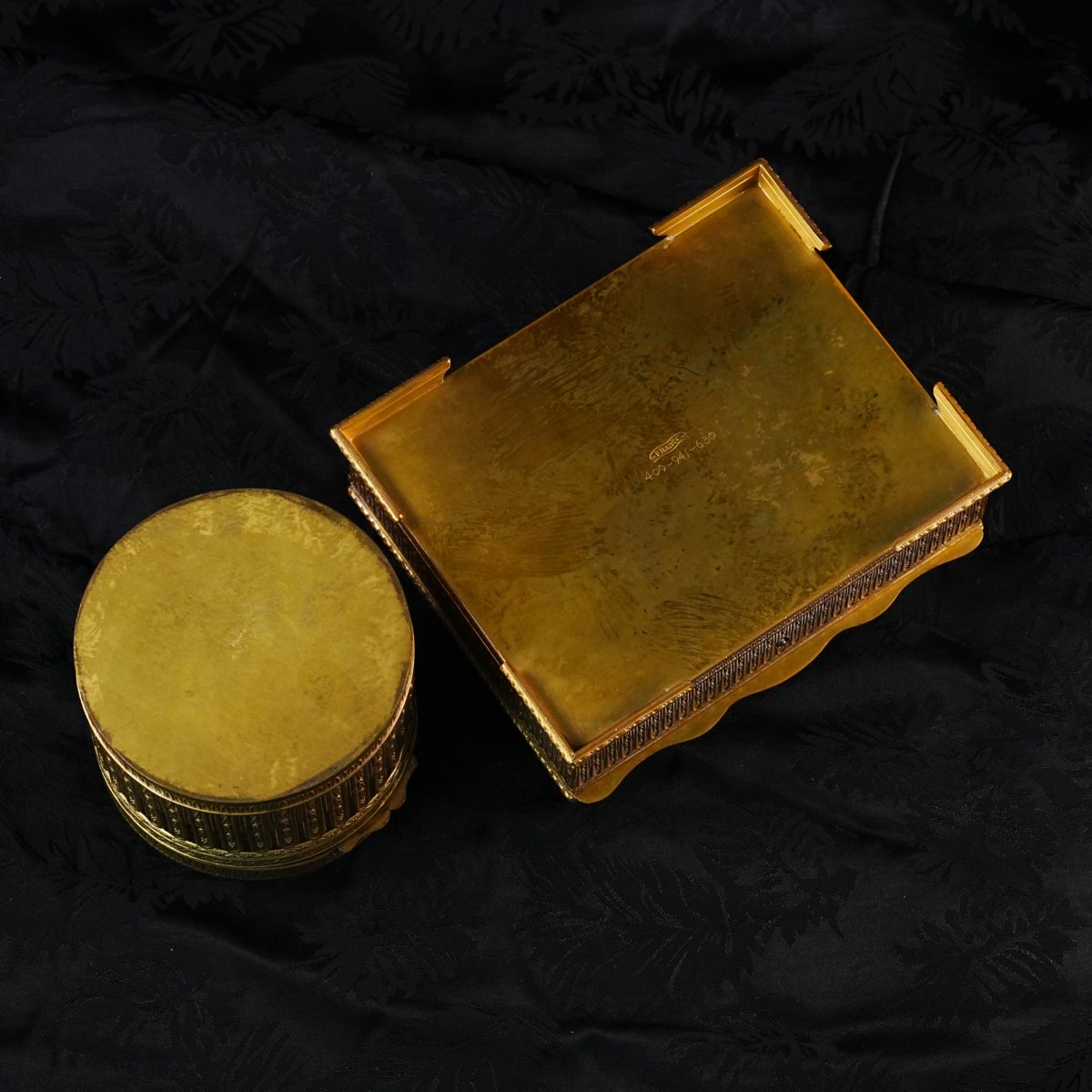
Turn the casket over and the base carries an impressed FRANCE in a banner, with a production number, 409-941-630. A bare country name looks like the least interesting mark an object can carry, but it is doing quiet work: goods bound for the English-speaking market began to be struck with their country of origin in the early 1890s, after tariff law — the American McKinley Tariff of 1891 chief among them — required imports to declare where they came from. A plain FRANCE, with no “Made in” wording, sits naturally in that first export generation — which agrees with everything else about the set: the neoclassical casting, the Art Nouveau handles just arriving, the Belle Époque's particular way of being lavish and orderly at once. We read the mark and the style together, as always — our guide to dating English china explains the same country-wording logic on porcelain, where it works identically.
Why ten pieces matter more than one
Vanity sets led hard lives. They sat out on dressing tables for decades, moved house, were divided among daughters, lost their brushes to wear and their steel to rust; the casket keys — small, separate, easy to mislay — usually went first, and paper tags essentially never survive. Sets were broken up and sold piecemeal because single pieces were easier to price. So most guilloché that reaches the market today is a stray: one brush, one mirror, one jar.
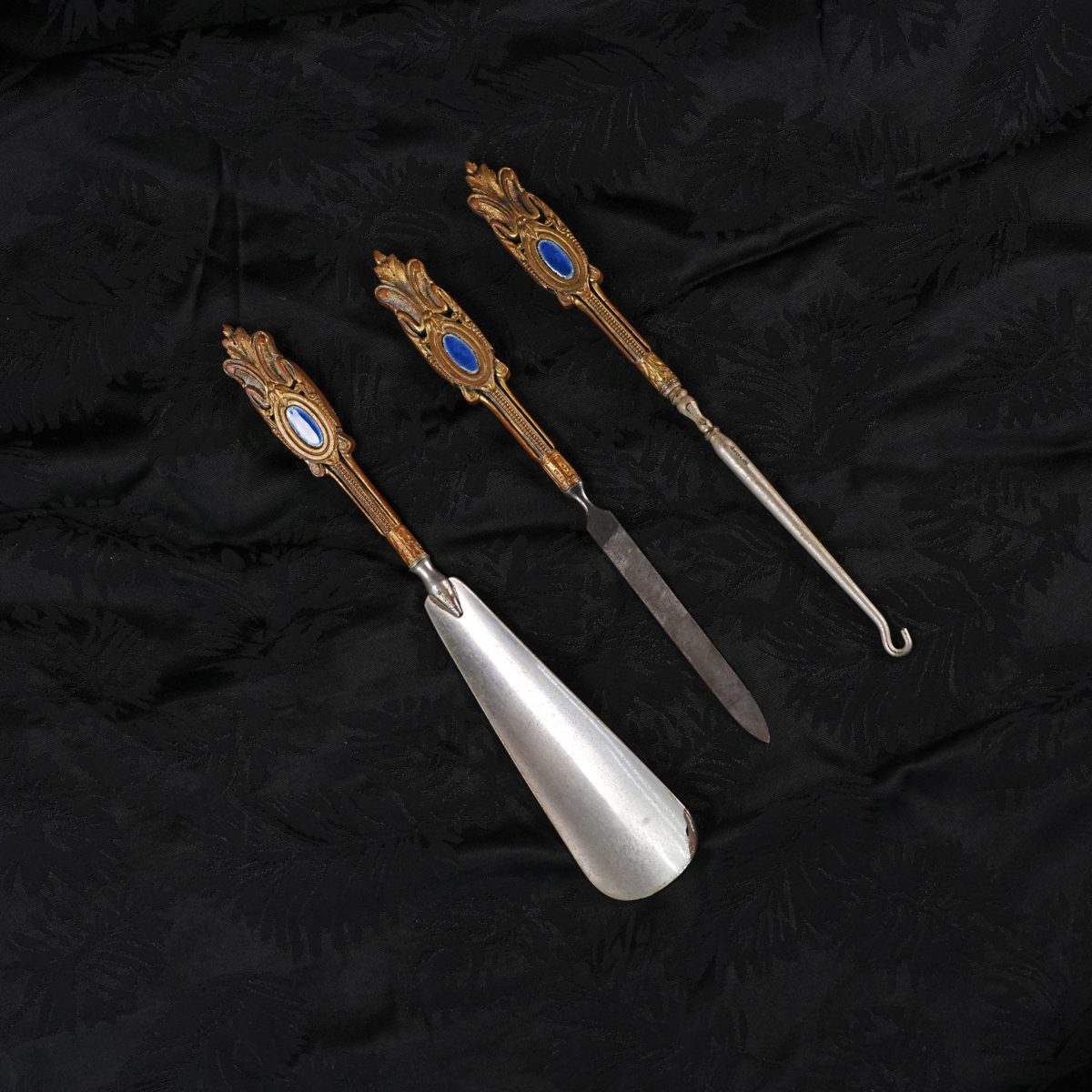
This one kept everything. Ten pieces in the same blue: hand mirror with bevelled glass, hair brush, two clothes brushes, a powder jar that opens to its interior mirror and glass liner, the jewellery casket with its working lock, shoe horn, nail file, button hook, and a trinket lid — every brush still holding its natural bristles, the casket still lined in its floral silk brocade, the key still turning the lock, the tag still on the key. The steel pieces show the light surface oxidation steel honestly acquires in a hundred and thirty years, and we would be more suspicious of them if they did not. Completeness like this is not a detail of condition; it is the difference between owning a fragment of a dressing table and owning the dressing table's whole idea.
A rose engine drawing waves in bronze; glass melted over the drawing; a goddess built out of white enamel, thirty strokes deep; and a three-word title in fading ink, tied on with red thread by someone who wanted the next owner to know what they were looking at. We are, for the moment, that owner — and now you know what you are looking at too.
The set is in the shop, photographed from every side — and the moiré is best believed in person.
See the full set → Shop on Etsy ↗This account is written from direct examination of the set in the shop — the engine-turning, the en grisaille medallions, the impressed FRANCE banner mark and production number are all photographed in the listing — together with the standard accounts of rose-engine turning and transparent enamelling as practised in French workshops and, most famously, by Fabergé. The L'Amour Désarmé subject and its treatments by Boucher and Watteau, with versions held in the Louvre and the British Museum, are matters of published record. The dating rests on the plain FRANCE export mark of the early 1890s read together with the set's style, and should be taken as approximate in the usual way: c. 1890s, Belle Époque.