Why This Teacup Is Called a Corset
The cup below is Aynsley bone china, made near the middle of the last century — its base says as much. What the base does not say, anywhere, is the name the trade knows it by. Look at the silhouette: a wide, flared rim; a body drawn in sharply at the waist; a small pedestal foot; a scrolled handle riding high. Dealers call this shape the corset — and once you have heard the word, it is hard to see the cup any other way.
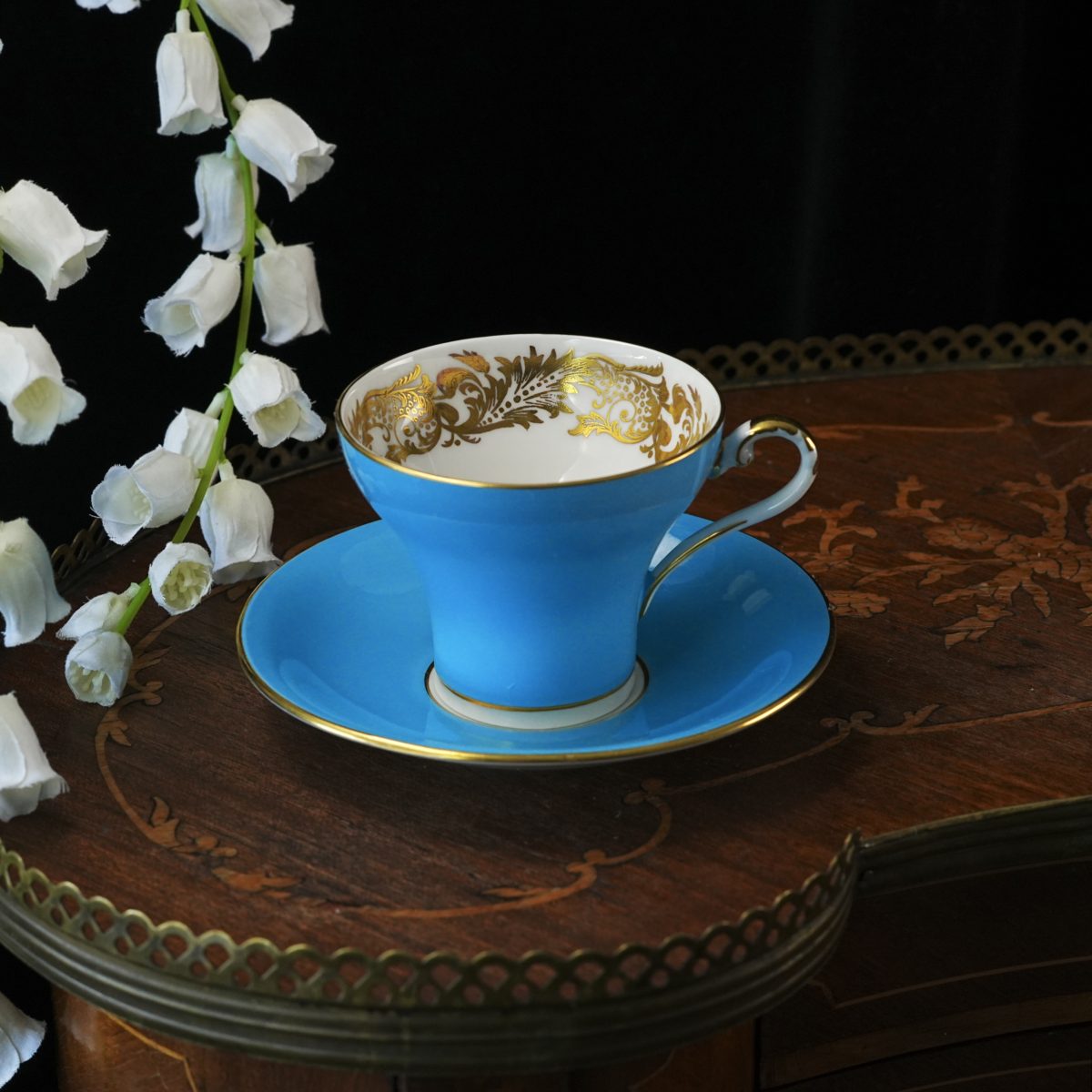
Who first called it that is a fair question, and one I cannot fully answer. Shape names have a way of starting life on one side of the shop counter and ending up on the other — coined among salesmen and collectors, then adopted by the factories themselves. However it began, the name has stuck: the trade uses it everywhere, and today's Aynsley catalogue still sells Corset teacups under exactly that name. The fashion echo was surely the point. This is a cup built the way an Edwardian dressmaker built a silhouette — cinched, flared, and meant to be admired from across the room.
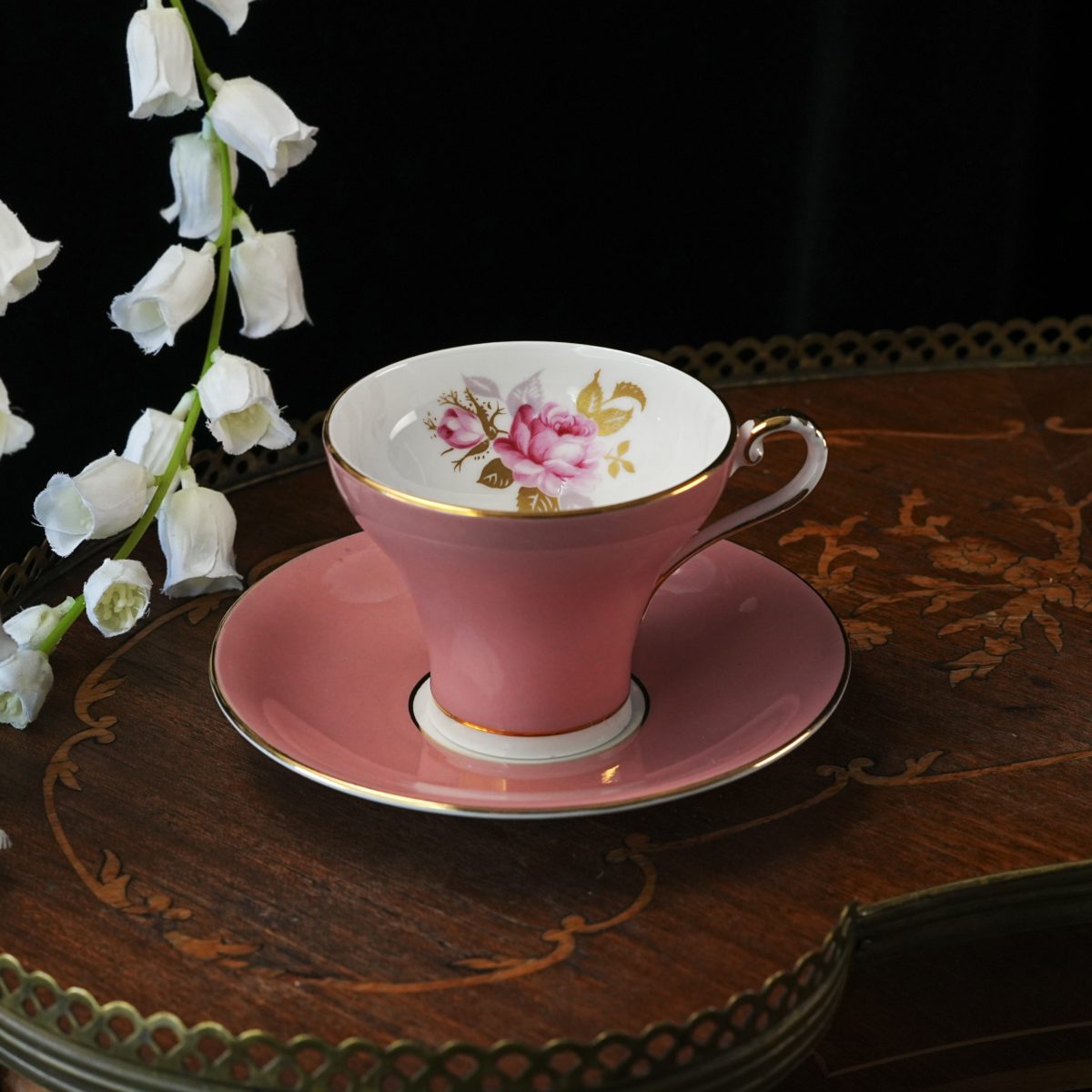
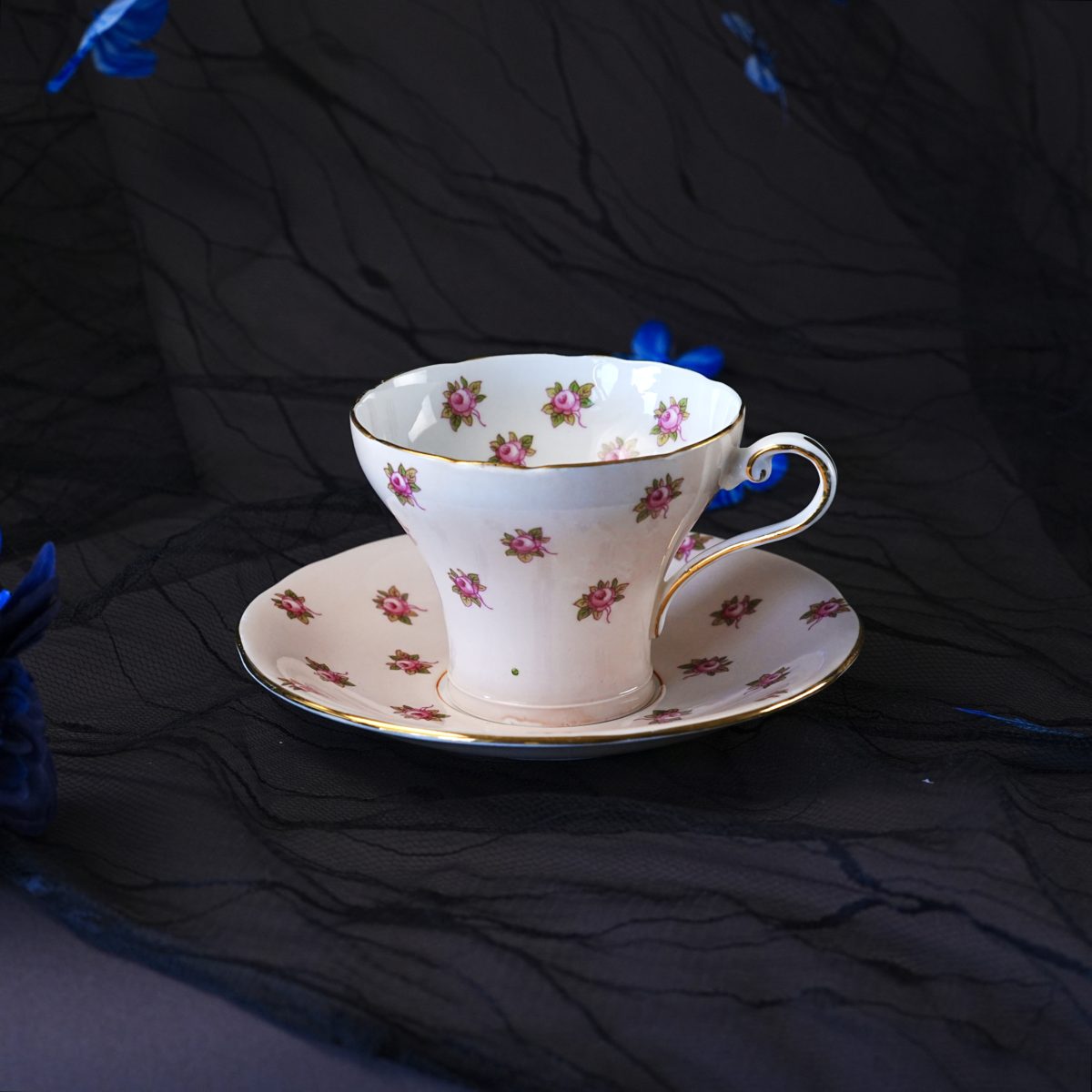
Aynsley made the corset a house speciality in the middle of the twentieth century, usually dressed in a single strong glaze colour with something hidden inside the bowl for the drinker to discover. We currently have three, and together they show how much wardrobe one skeleton can carry: the turquoise corset above, a dusty-pink corset with a single hand-painted cabbage rose waiting at the bottom of the cup, and a pale pink corset sprigged all over with small rosebuds. Same waist, same flare, three different characters.
And the corset is only the first word in a language. Nearly every English cup began life as a named, modelled design, but the name was recorded only in the factory's own books and in the working vocabulary of the people who sold and loved them — a second name, worn invisibly. I handle cups like these every week, and it still took me years to begin hearing it; I learned the language the way most shop lessons are learned, slowly, and one small mistake at a time. What follows is the part I wish someone had told me at the beginning: where the names came from, what they can quietly tell you about age and value, and how to begin hearing them on your own shelf.
Two ledgers, one cup
Picture the office of a Staffordshire pottery a century ago. Somewhere in it — as best I understand these things — sat two great record books. One held the patterns — the decorations, entered as numbers or names, painted up in trial pages so the decorating shop could reproduce them. The other held the shapes: the models themselves, each with its own name, its own moulds, its own costs and its own quirks in the kiln. The two systems were free to combine. A single pattern might be issued on several shapes over the years; a successful shape could carry hundreds of patterns across its life. There is a reason for the imbalance: a pattern was as light as paint, while a shape was cut into plaster and steel, and had to earn back its moulds over decades. The pattern, you might say, is the water; the shape is the riverbed it runs in.
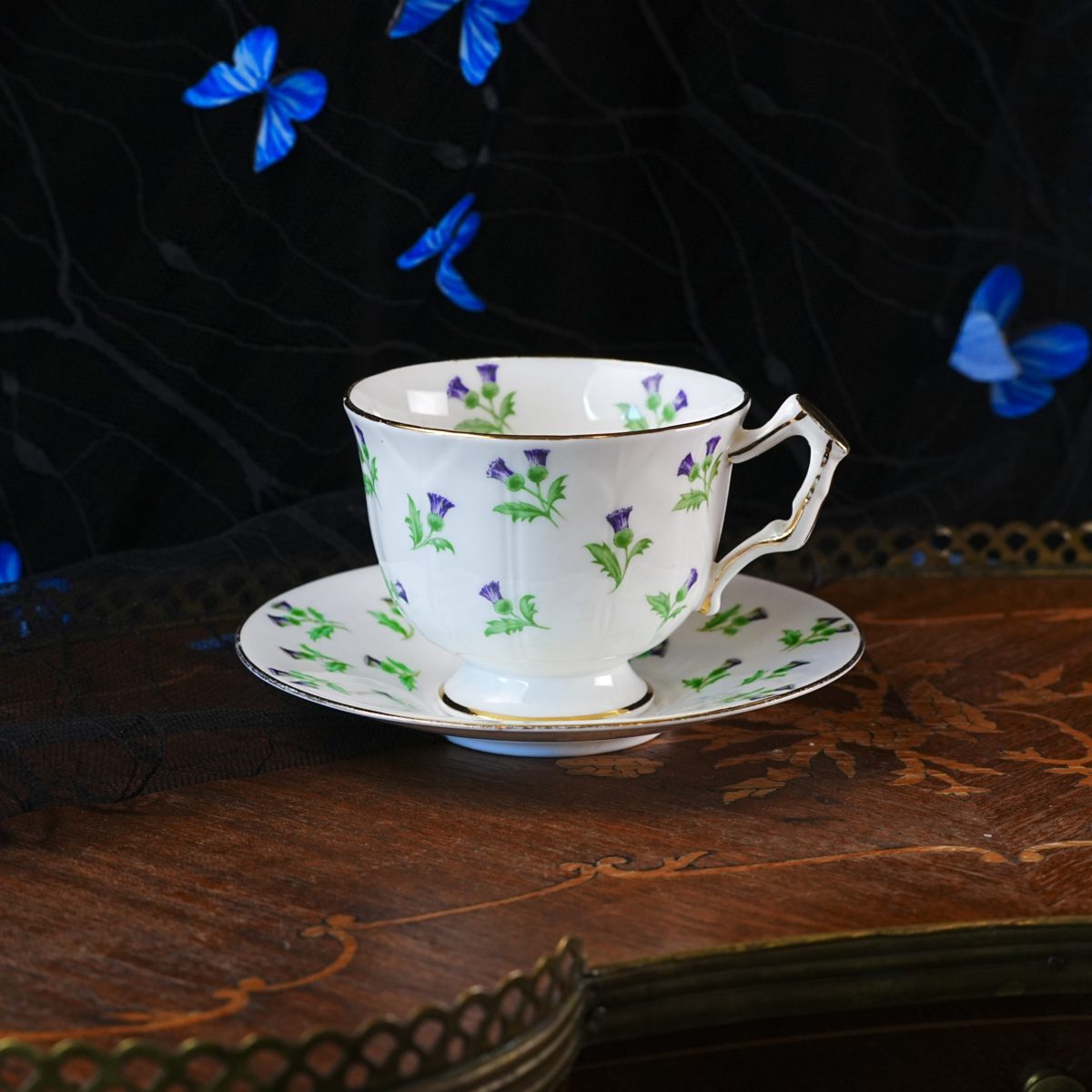
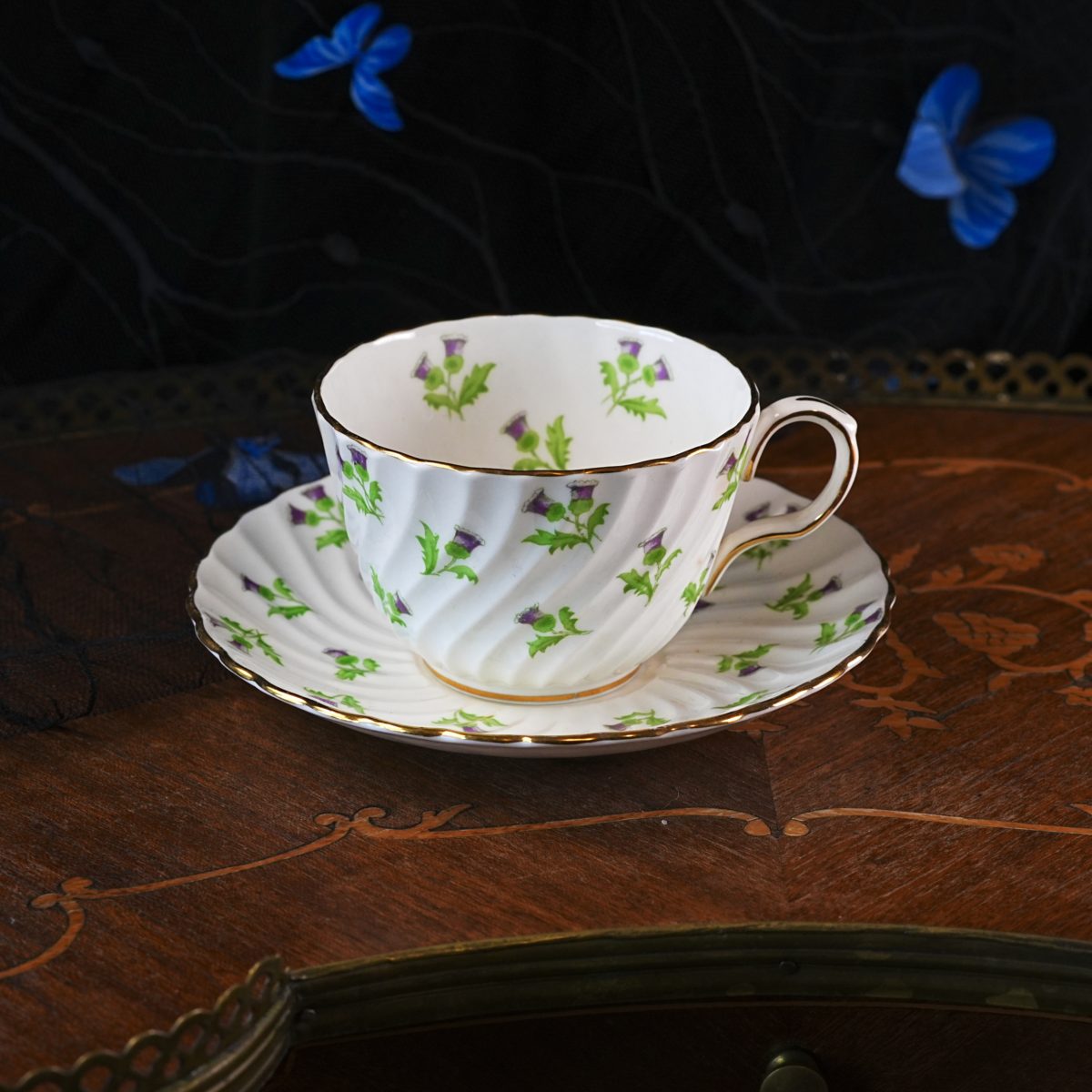
Two cups in the shop taught me this better than any reference book could. Both are Aynsley, and both carry the same pencilled number under the glaze — 15287, the factory's Scots Thistle pattern — and the same hand-tinted purple thistles. One is spiral-moulded, the flutes winding from rim to foot so the thistles seem caught in a turning wind; the other is straight-fluted, with an angular handle that belongs to the nineteen-thirties. Matching only the flowers, I would once have called them the same cup. The factory never did: the number says what is painted, and the shape says what it is painted on. I keep the two side by side now, as a small lesson to myself.
Who names a shape?
Behind every shape name there was, originally, a modeller — and the story I find myself retelling most often belongs to a man I had never heard of either, until I went looking. In March 1896 the Wileman factory in Longton (later Shelley) registered a new teaware shape of fluted panels and scalloped edges, designed by a sculptor named Rowland Morris and worked up into roughly a hundred pieces with the modeller Maxime Avoine. The factory called the shape Dainty.
It became one of the most successful cup shapes English bone china has produced. Dainty stayed in continuous production from 1896 until the day Shelley closed its doors in 1966 — a run of seventy years, through two wars and every change of taste in between. Morris saw almost none of it. He died in November 1898, two years into the run, and a journal of the day noted even then that his name had already faded from the design, the credit passing — as it nearly always did — to the manufacturer.
The shape outlived its designer by sixty-eight years. The name it wears is the factory's; his is a footnote in the registration papers.
I try to remember that whenever a shape name sounds like pure marketing. Somewhere under the pretty word there was a modelled form, a registration entry, a set of moulds, and usually a person.
When a shape goes wrong
Because a cup has a job to do, shape is engineering as much as fashion — and the cautionary tale the trade loves best to tell is Shelley again, thirty years after Dainty. In 1930 the firm's young art director Eric Slater, trained under the design reformer Gordon Forsyth, launched a family of aggressively modern shapes: Vogue and Mode, conical cups with solid triangular handles, as pure a piece of Art Deco geometry as English china ever attempted.
They were admired, and they sold — and then the complaints arrived. Buyers objected, as the Victoria & Albert Museum's records of the shape note, that the wide conical mouth let the tea go cold too quickly, that a finger could not pass through the solid handle, and that the cup could not even be hung from a hook in the pantry. Slater answered with the Regent shape of 1932 — still boldly conical, but with an open, rounded handle a hand could truly hold — and it went on to become one of Shelley's most popular designs. The lesson seems to have taken: modern was welcome, but the shape still had to hold tea, hands and hooks.
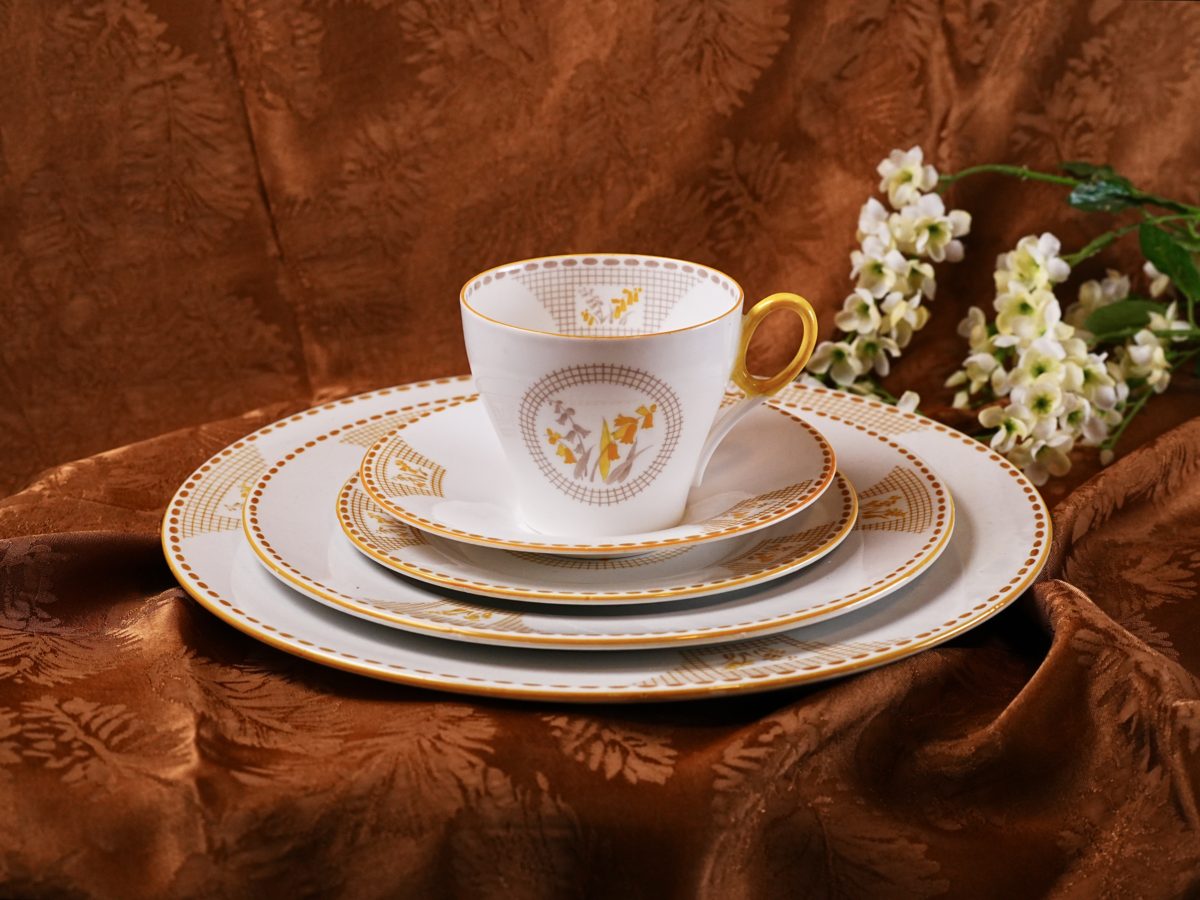
Collectors have since reversed the verdict entirely. Precisely because Vogue and Mode were awkward and short-lived, surviving trios are now among the most sought-after Shelley of all — the failed handle became the prize. The market, it turns out, forgives a shape almost anything once it becomes scarce.
A short field glossary
A few names I find myself reaching for most often, all drawn from cups that have passed through this shop. Every factory kept its own christening-book, so this is the barest beginning — but it is enough to start a conversation:
- Corset — flared rim, cinched waist, pedestal foot. Aynsley's mid-century favourite, and the easiest name to learn because the silhouette explains itself.
- Coffee can — the oldest shape word in common use: a plain straight-sided cylinder, the standard coffee form of the Regency years around 1800. We currently have a hand-painted pair in the old taste and a Wedgwood pair that quotes it.
- Dainty — Shelley's fluted, scallop-edged classic of 1896; seventy years in production, so the shape alone cannot date a piece and the backstamp must do the work.
- Queen Anne — Shelley again, from the 1920s: a gently octagonal cup, instantly recognisable from above.
- Gainsborough, Avon, Hampton, Countess, Lyric — a sample of Royal Albert's large stable of named shapes: the tulip-formed Gainsborough, the low wide-rimmed Avon, the sugar-bowl-round Hampton, the tall Countess, the mid-flare Lyric. Royal Albert reissued its big patterns across several of these, which is why two “identical” cups of the same pattern can sit so differently in the hand.
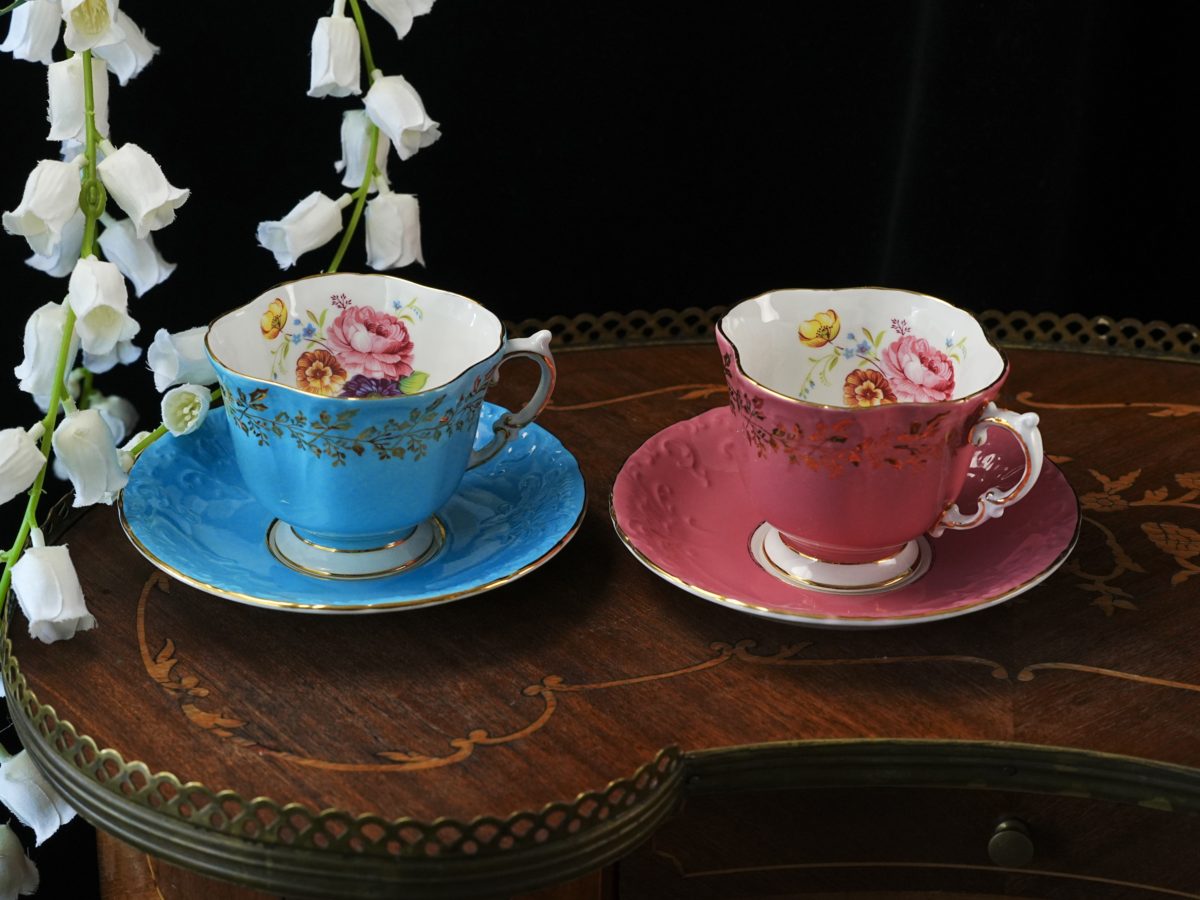
- Panelled square — the squared, four-facet rim Aynsley collectors sometimes call the Athens shape. Said to be harder to fire than a round cup, and noticeably scarcer on the market; we have a matched pair in two colours at the moment.
What a shape can tell you
Is any of this worth your while? I think so, for three practical reasons.
- Shapes date pieces. A shape cannot exist before it was modelled, so its introduction sets a hard earliest date: a Regent cup cannot be older than 1932, a Vogue belongs to the early 1930s. When a backstamp is generic or worn, the shape is often the better witness.
- Shapes move prices. The same pattern on two shapes sells at two prices — a scarce or fashionable shape carries a premium the pattern alone does not explain. Our two thistle cups wear the same number, and they will most likely never sell for the same price.
- Shapes prevent bad matches. If you are replacing a broken cup from a family service, match the shape as carefully as the pattern, or the new cup will sit wrong beside its sisters on the shelf — a heartbreak we see often enough that it seems worth saying plainly.
Mostly, though, I think the names simply make looking better. Once you know the corset from the can, a cabinet of china stops being a wall of flowers and becomes a row of characters — each one modelled by someone, registered somewhere, and named, even if the name never made it onto the base.
Every cup in this piece — the corsets, the thistle pair, the panelled squares, the coffee cans — is in the shop now, each one a named shape you can hold.
Browse the collection Shop on Etsy ↗Sources: the Dainty shape's March 1896 registration, Rowland Morris and Maxime Avoine, Morris's death in 1898 and the contemporary note on his faded credit, with the Queen Anne date, from Watkins, Harvey & Senft, Shelley Potteries; the Vogue shape's conical cups, solid triangular handles and recorded customer complaints, and the Regent shape of 1932 and its popularity, from the Victoria & Albert Museum collection records (Vogue, Regent); Royal Albert shape names and descriptions from The Vintage Seeker; the current Aynsley catalogue's use of the Corset name from the Aynsley store. Pattern numbers, shapes and dates on the shop's own pieces recorded from the objects themselves.