The mark on the base is half the story. Here is how we read and date the makers that pass most often through the shop — and how you can, too.
Turn almost any piece of antique china over and it will try to tell you who made it and roughly when. Before chasing a single maker, four clues are worth reading on every base.
01
The country wording
A bare “England” (or no country at all) tends to be earlier; “Made in England” became common from about 1900–1910; and “Bone China” as a printed phrase is largely a 20th-century habit. The American McKinley Tariff Act of 1891 required imports to name their country of origin in English — which is why so much English and European china of this era is marked at all.
02
Printed vs. impressed
A mark pressed into the clay is usually a factory or body mark; a printed (transfer) mark carries the decoration and pattern detail. Many pieces have both, and reading them together tells you more than either alone.
03
Registration marks
A diamond-shaped “Rd” device dates a design to 1842–1883; “Rd No.” followed by a number is 1884 onward, and the number itself roughly dates when the design was registered.
04
Pattern & shape numbers
Hand-painted or printed numbers identify the decoration and shape, not the year — but they let you match, attribute and place a piece with confidence.
One warning: marks were freely borrowed, and grand “antique” dates were sometimes invented for prestige — Coalport's “A.D. 1750” and Royal Chelsea's little anchor are the classic examples. Read the whole mark, not one flourish.
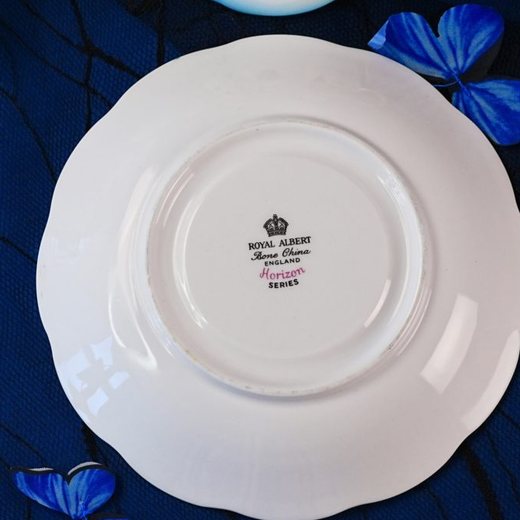
Crown over “Royal Albert”, usually with “Bone China” / “England”An actual Royal Albert crown mark from the shop
Royal Albert grew out of Thomas C. Wild & Sons of Longton, who named their Albert Works for the prince consort. The crowned “Royal Albert Crown China” marks belong to the earlier 20th century; the familiar crown over “Royal Albert / Bone China / England” is the long-running mid-century mark.
A named pattern in the mark (most famously Old Country Roses, introduced 1962) signals a later, post-war piece.
“Made in England” and “Bone China” together point to mid-century or after; an earlier “Crown China” wording points to the 1920s–30s.
We
Wedgwood
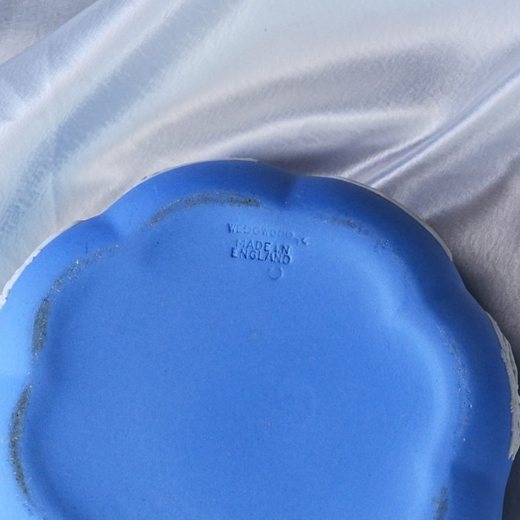
Impressed or printed “WEDGWOOD” (one word, no apostrophe)An impressed WEDGWOOD mark from the shop
Founded by Josiah Wedgwood in 1759 and still trading, Wedgwood is one of the most marked names in ceramics. The plain impressed WEDGWOOD is the body mark; printed marks add the pattern and, often, the country wording.
Spelled WEDGWOOD — not “Wedgwood & Co.” or “Wedgwood & Sons”, which are different, unrelated Staffordshire firms.
“Made in England” and “Bone China” indicate a 20th-century piece; 19th-century wares often carry impressed three-letter date codes.
RD
Royal Doulton
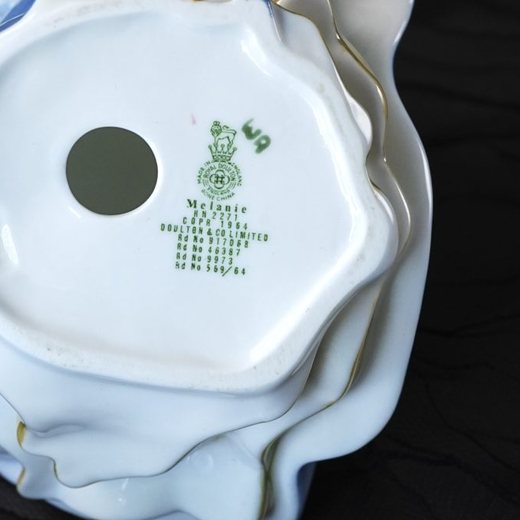
Lion on a crown, over “Royal Doulton” — with HN numbers on figuresA Royal Doulton lion-and-crown mark with its HN number
Doulton received its royal warrant in 1901 and the lion-and-crown mark followed. For collectors, the great gift is the HN number on figurines — a sequential catalogue begun in 1913 and named for the colourist Harry Nixon.
Because HN numbers were issued roughly in order, the number dates a model's introduction — a low HN is early, a high HN later.
“Made in England” and “Bone China”, plus pattern or series names, place tableware in the mid-to-late 20th century.
Ay
Aynsley
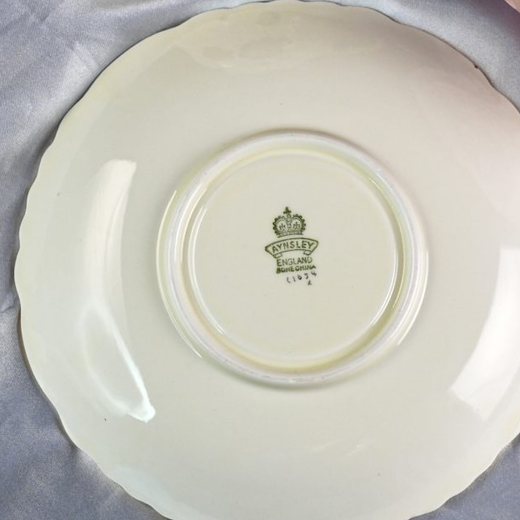
Crown-and-banner mark; later marks add “Est 1775”An Aynsley crown mark from the shop
John Aynsley & Sons of Longton (established 1775) made some of England's most painterly bone china. The printed crown-and-banner mark is the constant; the details around it carry the date clues.
Marks adding “Est 1775” or “Fine English Bone China” are later 20th-century forms.
Hand-painted, artist-signed cabinet pieces (fruit, orchids, gilt) are an Aynsley speciality; the shape and pattern numbers help match and place them.
Sh
Shelley
“Shelley” in a script signature within a shield
The firm of Wileman & Co. traded as “Foley” and “Late Foley” before adopting the family name. The famous script “Shelley” in a shield dates from about 1925 onward.
A script-Shelley mark = post-1925; earlier pieces read “Foley” or “Late Foley.”
Registered shape names — Dainty, Queen Anne, Regent, Vincent — and pattern numbers help identify the form and decoration.
Co
Coalport
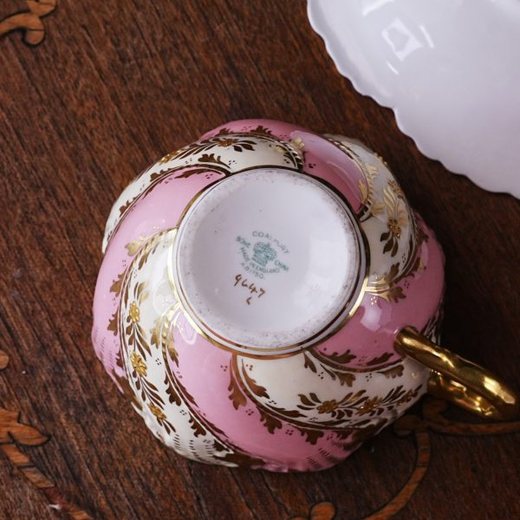
Crowned mark with “Coalport” and the decorative “A.D. 1750”A Coalport crown mark from the shop
Coalport was founded by John Rose in Shropshire around 1795. The crowned “Coalport A.D. 1750” mark is a piece of marketing romance — the “1750” is not a date of manufacture, but a nod to an earlier local pottery.
Ignore “A.D. 1750” for dating; read the wording instead — “Bone China” and “Made in England” place a piece in the 20th century.
Coalport is prized for jewelled gilding — raised, individually applied gold dots — and for richly gilt cabinet cups.
Pa
Paragon
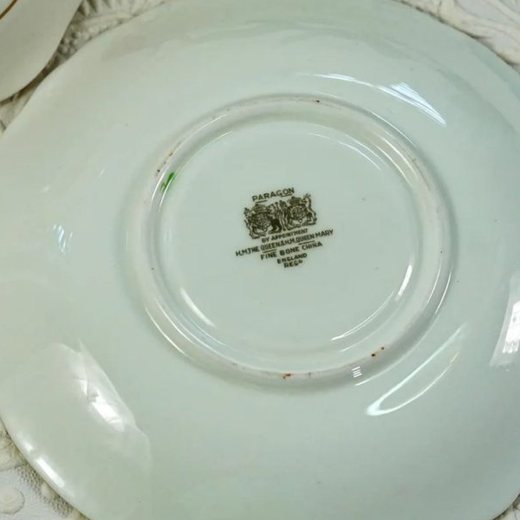
Star device, often with a royal warrant inscriptionA Paragon double-warrant mark from the shop
Paragon (from the earlier Star China Co. of Longton) built its reputation on royal commissions, and its marks wear that history openly.
A double royal warrant — “By Appointment to H.M. The Queen & H.M. Queen Mary” — dates a piece to roughly 1933–1953; after Queen Mary's death in 1953 the wording changed.
Patterns are often named (e.g., commemorative and “bride” pieces) and finished with generous gilt.
RW
Royal Worcester
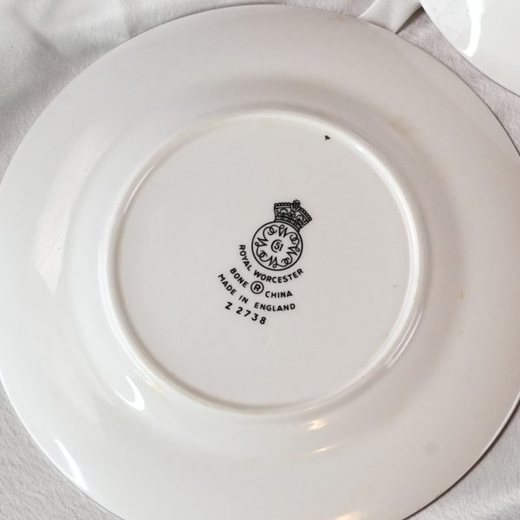
Crowned roundel with interlaced “W”; dot-and-mark date systemA Royal Worcester crowned mark from the shop
One of England's oldest porcelain names, Royal Worcester (in its modern form from 1862) ran one of the most precise dating systems in the trade.
Around the printed crown mark, a sequence of dots, stars and symbols can often pin a piece to the exact year of decoration.
“Bone China” / “Made in England” wording and pattern names support the dot-code date.
Wi
Royal Winton (Grimwades)
“Royal Winton” over “Grimwades / England”
Grimwades Ltd of Stoke adopted the “Royal Winton” name in 1929 and became the great name in chintz — all-over printed floral tableware.
Chintz patterns are named (Summertime, Hazel, Julia, and many more); the pattern name plus the mark wording places most pieces in the 1930s–50s.
Well-matched chintz, with the print running cleanly over handles and rims, is a sign of quality.
RC
Royal Chelsea
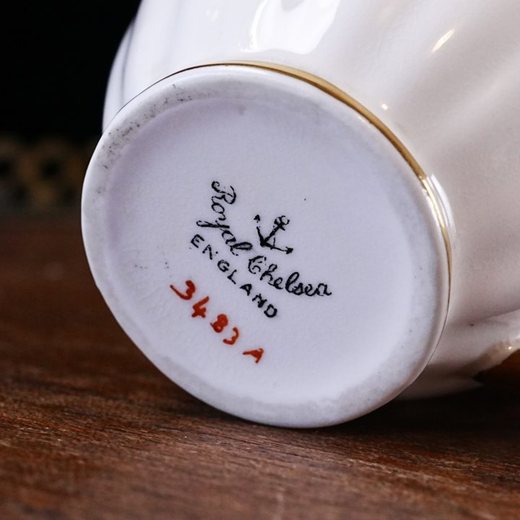
A small anchor — an homage, not the 18th-century Chelsea factoryThe little Royal Chelsea anchor from the shop
Despite the regal name and the little anchor, Royal Chelsea has no link to the celebrated 18th-century Chelsea works. It was made by the Plant family's New Chelsea Porcelain Co. of Longton, roughly 1943 to the early 1960s, chiefly for the North American export market.
The decoration is identified by pattern numbers (such as 4947 A), not names.
The heaviest, most burnished gilding belongs to the export era of the 1940s–50s. We tell the fuller story in our Royal Chelsea journal.
Go
W. H. Goss
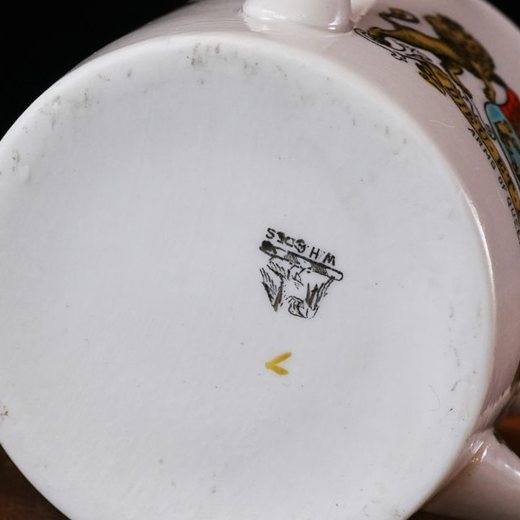
Goshawk crest over “W. H. Goss”A W. H. Goss goshawk crest from the shop
William Henry Goss of Stoke is best known for finely potted heraldic and crested “Goss china” — small souvenir pieces carrying town and family arms, hugely popular from the late 19th century into the 1930s.
The printed goshawk crest with “W. H. Goss / England” is the maker's mark; the applied coat of arms identifies the place or family, not the date.
Early Goss is thinly potted, ivory-toned parian; later, mass-market pieces are heavier.
Me
Meissen
Crossed swords in underglaze blue — one of the oldest marks in the world
Meissen, the first true porcelain factory in Europe (Saxony, 1710), adopted its crossed swords in underglaze blue in the 1720s, and it has guarded the mark ever since.
Cancellation strokes ground through the swords mean the factory judged the piece a second; clean, uncancelled swords mean first quality (Erste Wahl).
An export word such as “Germany” (without “Made in”) points to roughly 1891–1918; an impressed model number names the subject. See our Meissen Golden Oriole journal for a worked example.
Jp
Japanese & Asian marks
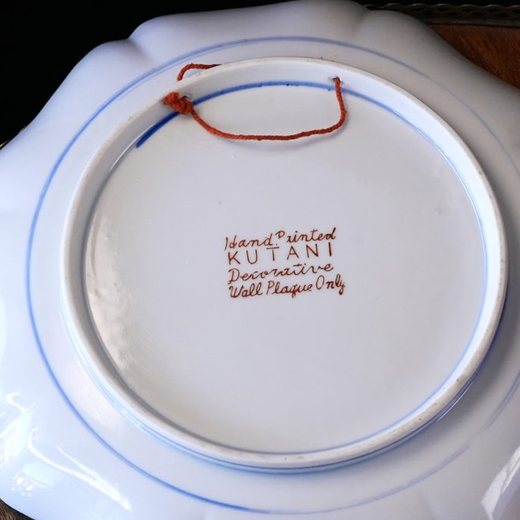
Hand-painted character marks — kiln names and auspicious phrasesA hand-painted Kutani-ware mark from the shop
Arita and Imari porcelain, Kutani ware and their cousins usually carry marks painted in red, gold or underglaze blue rather than printed. The characters may name a kiln, a studio or an auspicious phrase — and often are not a date at all.
Read the palette and potting as much as the mark: underglaze cobalt blue, the iron-red-and-gold Imari palette, hand-painted brushwork and foot-rim finish all help place a piece by style and period.
Signed studio and kiln pieces (for example Arita / Hizen wares) are attributed by mark, hand and decoration together.
Fg
Figurine & collectible makers
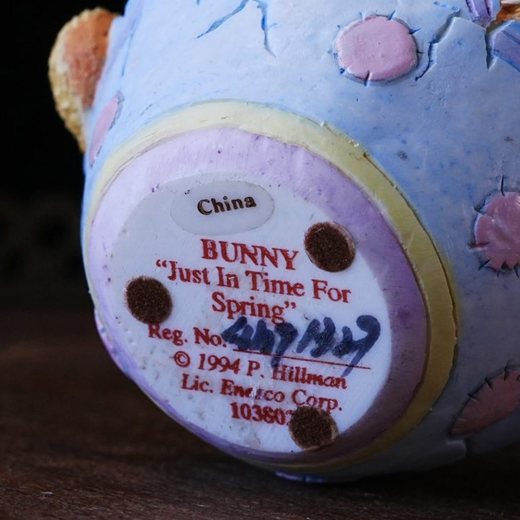
Printed or foil base marks, often with a model name and yearA collectible base mark (Cherished Teddies) from the shop
Sculptural and collectible figures carry their own conventions. Royal Doulton's HN numbers and Royal Worcester's modelled figures sit at the fine-art end; modern collectible lines are usually marked clearly on the base.
Cherished Teddies (Enesco), Boyds Bears and Fitz & Floyd typically carry a printed or foil mark with the line name, a model/style name and often a copyright year.
For unmarked studio pieces (Murano glass, some continental porcelain), attribution is by style, technique and form — which is exactly the sort of detective work we enjoy.
No makers match that search — try a shorter word, or clear the box to see all fourteen.
Not sure what you're holding? Email a clear photo of the base — we're always glad to help read a mark.
A general reference compiled from standard ceramic-mark references and from the pieces in our own collection. Marks vary within every factory and were sometimes copied; we research and date each piece individually, and date ranges here are guides rather than guarantees.