The Bird in the Canopy: Meissen's Golden Oriole
In a European summer, the golden oriole is a bird you are far more likely to hear than to see. Its fluting, liquid call — or-iii-ole — carries clean across the treetops, and yet the bird itself, brilliant gold though it is, dissolves into the dappled light of the canopy and refuses to be found.
This is one of those birds. And it is the small miracle of the piece in front of us that someone, nearly three centuries ago, decided to make it hold still — to fix that flash of yellow in the leaves, permanently, in porcelain. The bird on this tree stump never flies off mid-glimpse. It simply waits, mid-song, for as long as you care to look.
A bird more often heard than seen
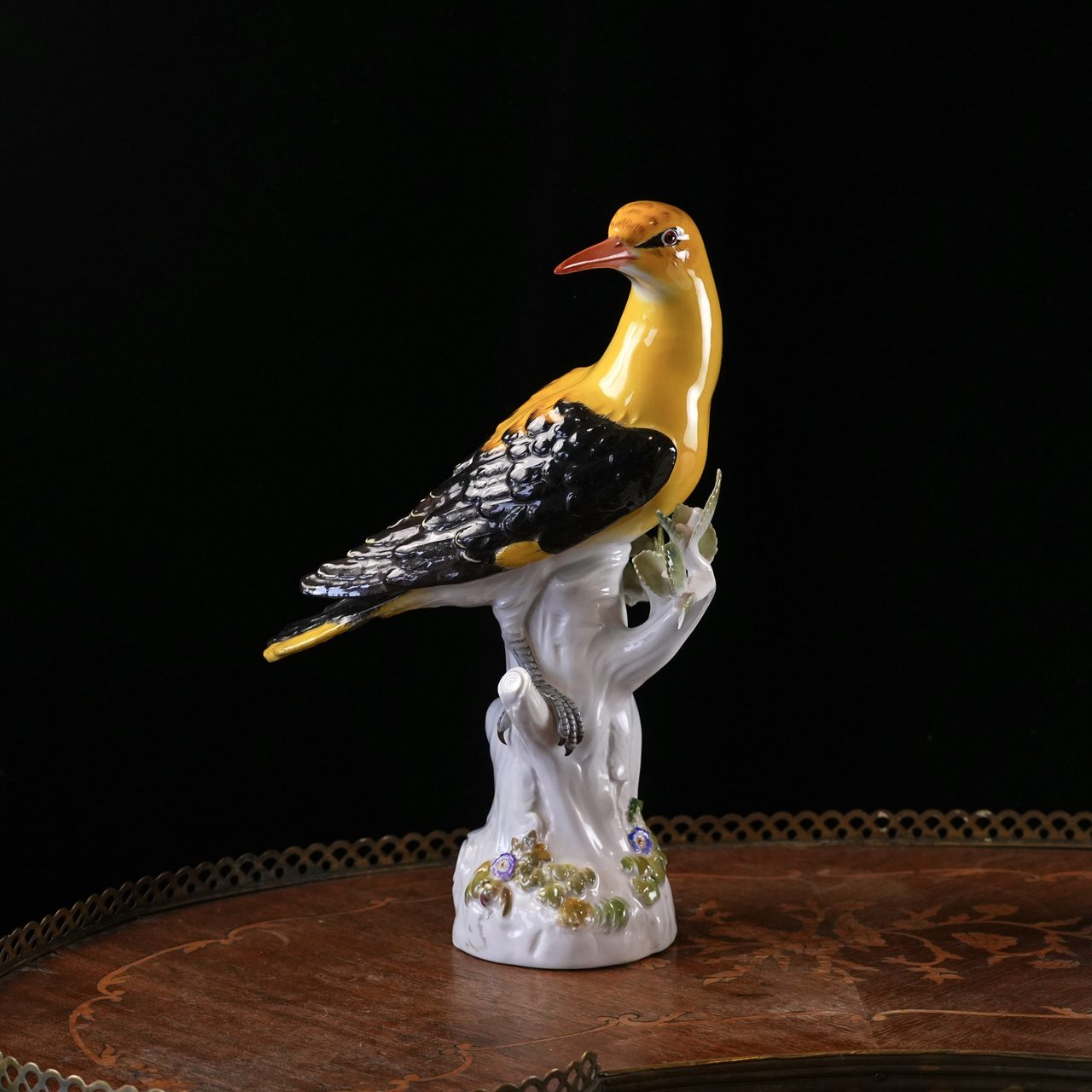
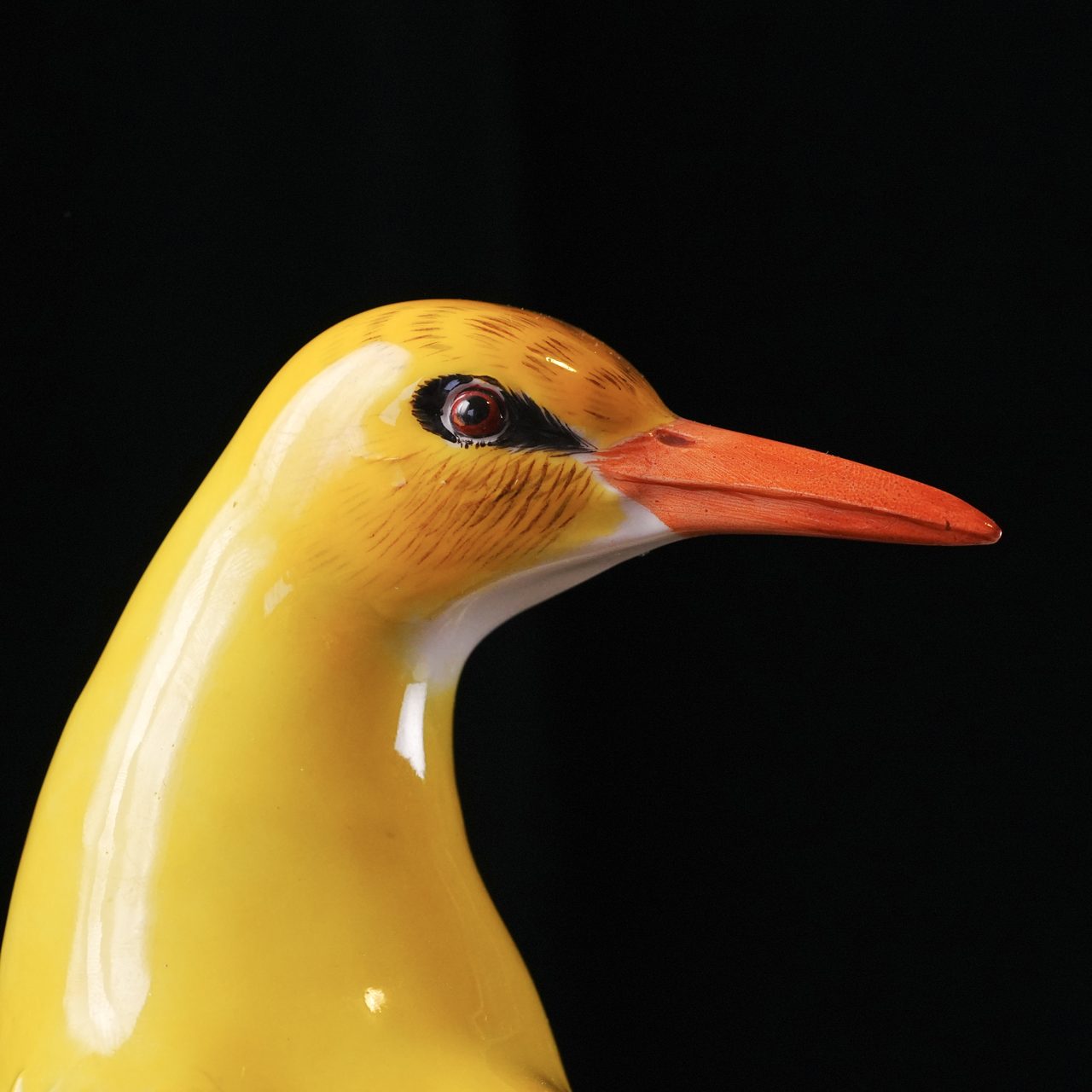
The subject is the Eurasian golden oriole, Oriolus oriolus — the only member of the old-world oriole family that breeds across temperate Europe. The male is unmistakable: a body of pure golden-yellow set against jet-black wings and tail, with a coral-red beak and a dark slash through the eye. The female, by contrast, is a modest olive-green. It is a summer visitor only, arriving from wintering grounds in central and southern Africa to nest in open broadleaf woods, riverside poplars and old orchards, and slipping away again by late summer.
Even the word carries the colour. “Oriole” descends, through old French, from the Latin aureolus — “golden” — a name people gave the bird simply for looking like a living coin of gold among the leaves. In European folklore its flute-song is a herald of warm weather and good fortune, a small annual promise that summer has truly arrived. A creature this bright, this musical and this maddeningly hard to see was almost designed to tempt an artist into pinning it down.
The first porcelain in Europe
To understand how a German factory came to immortalise an English-hedgerow bird, you have to go back to the obsession that started it all. For two centuries, Europe had been unable to reproduce the hard, white, translucent porcelain arriving from China and Japan; it was so coveted it was called “white gold.” The riddle was finally cracked around 1708–1710 in Saxony, by the alchemist Johann Friedrich Böttger and the scholar Ehrenfried Walther von Tschirnhaus, working under the relentless patronage of Augustus the Strong, Elector of Saxony and King of Poland.
In 1710 Augustus founded the Meissen manufactory in the cliff-top Albrechtsburg castle, and Europe had its first true porcelain. To guard the prize against the imitators that sprang up almost at once, the factory adopted, from about 1722, a mark painted in underglaze blue: two crossed swords, lifted from the arms of Saxony. It is still in use today, and is counted among the oldest trademarks in the world.
A king's menagerie in porcelain
Augustus did nothing by halves. Around 1730 he conceived a fantasy of staggering ambition for his Japanese Palace in Dresden: an entire indoor menagerie rendered in porcelain — hundreds of near-life-size animals and birds, to be modelled from the living creatures in his own collection. The job fell, from 1731, to a young sculptor named Johann Joachim Kändler, who would become the greatest porcelain modeller of the eighteenth century and very nearly invent the porcelain figure as an art form.
Kändler studied real birds — jays, kingfishers, magpies, bitterns, hawks — and modelled them with a vigour porcelain had never seen before. The golden oriole was among them. The grand scheme was never finished; Augustus died in 1733 and the count of life-size beasts fell short of the dream. But the smaller, perfected bird models entered the factory's permanent repertoire. The oriole was refined by Kändler's associate Johann Gottlieb Ehder around 1740–41 and entered in the records as model number 820 — the very number still impressed into the base of this bird. Eighteenth-century examples from that menagerie now sit in the world's great museums, the Metropolitan Museum of Art among them.
Kändler did not decorate porcelain. He sculpted with it — and taught a factory to keep sculpting long after he was gone.
How a model outlives its maker
Here is the quiet wonder of a piece like this one. Meissen never retired its great early models. The moulds, the model numbers and the painters' conventions were handed down, workshop to workshop, for generations — so that a bird designed in the 1730s could still be cast, by hand, more than a century and a half later, by craftspeople working in the same tradition.
That is exactly what this oriole is: not an eighteenth-century original, but a faithful later casting of Kändler and Ehder's model 820, made when Meissen's pre-war workshops were at the very height of their craft. Its marks place it firmly between roughly 1891 and the First World War — late Victorian to Edwardian, comfortably over a century old. It is a genuine antique that carries an even older design in its bones.
Reading the bird
Spend a moment with the modelling and the lineage shows. The wings are built up feather by feather, the primaries separated and the central shaft of each one defined; at the shoulder, the amber warms into black in carefully layered strokes rather than a flat painted line. The head is finished in fine brushwork — individual plume markings in brown and amber, a single sharp red eye, the orange-red beak tapering cleanly to its point. Look down and the feet grip the stump with separately articulated toes.
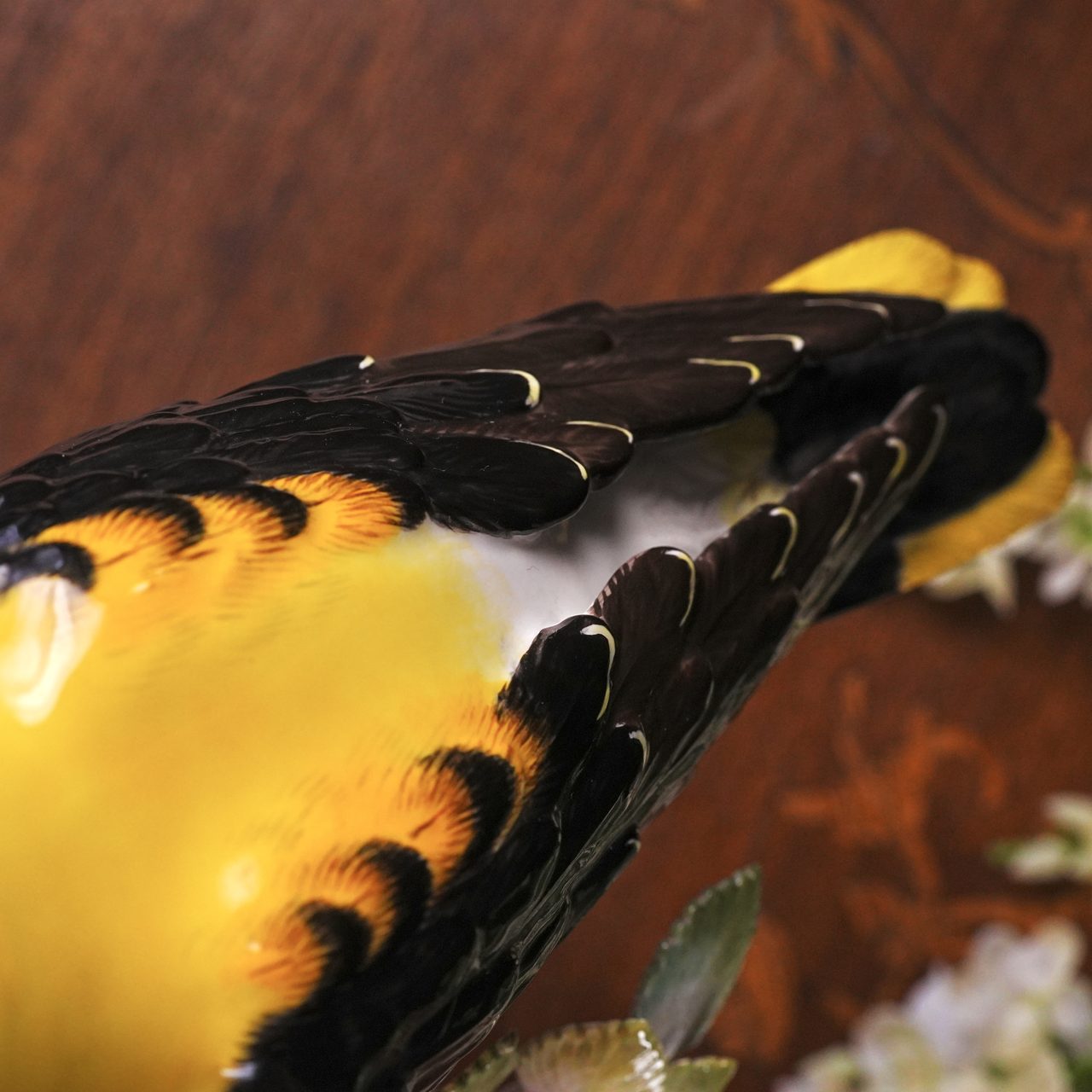
Then there is the stagecraft of the base. Out of the applied green foliage spring tiny flowers in purple, blue and yellow — each leaf and each blossom moulded on its own and fixed to the stump before firing. It is fussy, fragile, deliberate work, and it is the part that most readily betrays a careless reproduction. Here it survives, vivid and intact.
Reading the marks
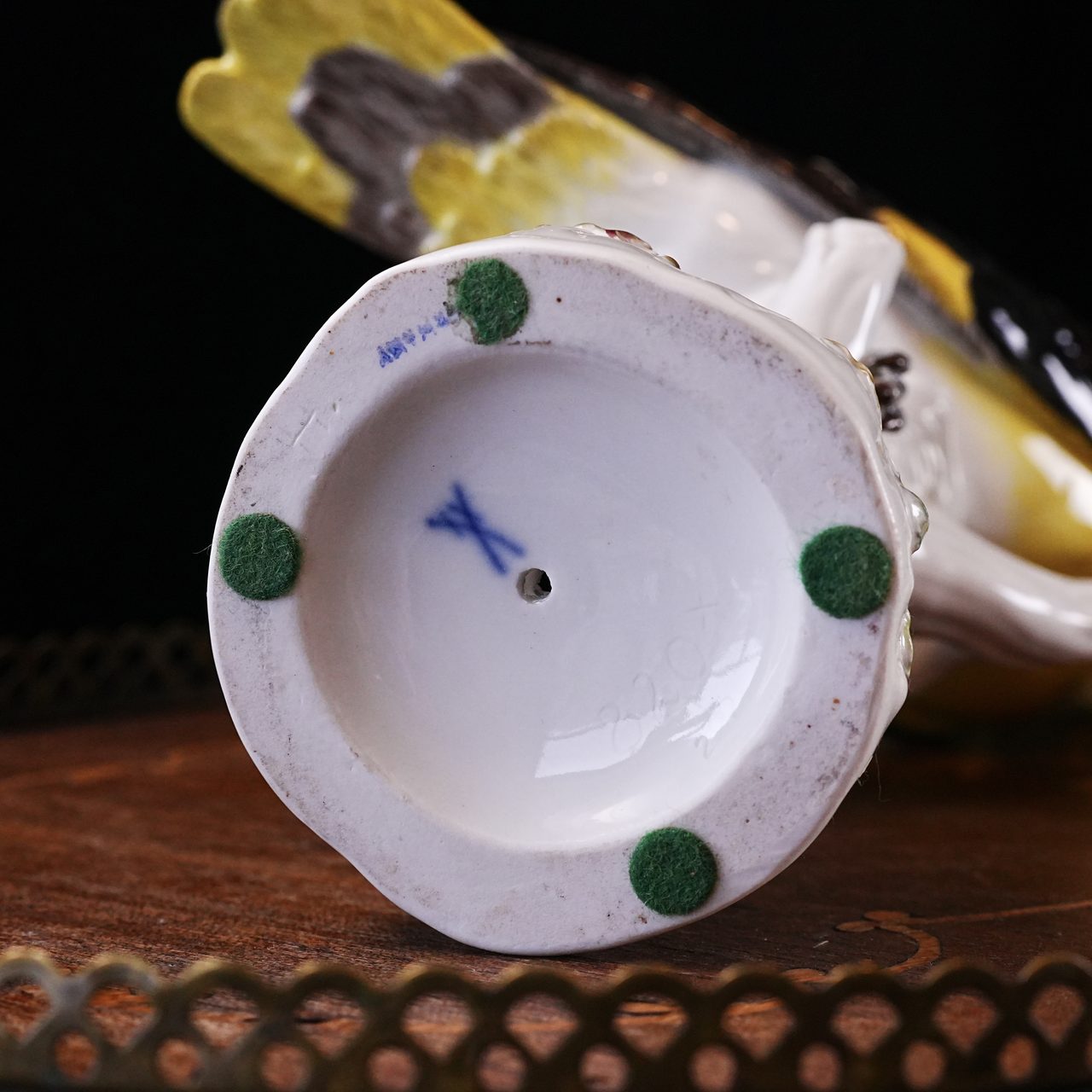
Turn the bird over and it tells you, almost to the decade, when it was made. The underside is where a Meissen piece signs and dates itself, if you know the shorthand:
- The crossed swords, hand-painted in underglaze cobalt blue — Meissen's mark since the 1720s, and proof of the maker.
- The word “Germany,” on its own, without “Made in.” This is an export clue. The American McKinley Tariff Act of 1890 (in force from 1891) required imported goods to be marked with their country of origin in English; the bare “Germany” form belongs to the window from 1891 until about the First World War, before the longer “Made in Germany” wording took over. That single word does most of the dating.
- No grinding strokes through the swords. When Meissen judged a piece a second, it ground or scratched cancellation lines across the mark. Clean, uncancelled swords mean this was passed as first quality — Erste Wahl.
- An impressed model number, 820, naming the subject within the factory's own catalogue, and an impressed painter's number, 290, recording the individual decorator responsible — an internal accountability that genuine Meissen kept meticulously, and that forgers rarely trouble to imitate.
Read together, those four marks do something rather lovely: they turn a pretty ornament into a dated, attributable, first-quality document of the factory that invented European porcelain.
The honest scars of age
A piece like this earns its keep partly by being truthful about its age, so it is worth saying plainly: this bird carries the small wounds of more than a century. Two of the applied leaves are broken, and the very tip of one talon has a chip of about a millimetre. The applied leaves, flowers and talons are always the first casualties on a figure of this age — they are the most delicate things on it — which is precisely why so much of the surviving detail here is remarkable rather than ordinary. The bird itself, its enamel, the stump and the remaining blossoms are intact and bright, with no cracks and no repairs. We note every flaw, because the marks of a real life are part of what makes an antique honest.
This particular oriole is in the shop now — one model number, very nearly three centuries of history. Come and see it, or browse the rest of the collection.
See the Golden Oriole on Etsy ↗ Browse the collectionSources: Meissen history, Böttger and the crossed-swords mark from the German Patent and Trade Mark Office and Britannica; Kändler and the Japanese Palace menagerie from the Victoria & Albert Museum, The Metropolitan Museum of Art and Britannica; the McKinley Tariff Act and country-of-origin marks from Gotheborg; golden-oriole natural history from Wikipedia; model number, painter's mark and condition recorded from the piece itself.