John Aynsley founded the firm at Longton, in the Staffordshire Potteries, in 1775 — one of the oldest names still working in English bone china. His grandson raised the grand Portland Works on Sutherland Road in 1861, and from there Aynsley built a reputation for some of the most painterly bone china in the district: hand-painted fruit and orchids, richly gilt cabinet cups, and delicate florals. The little crowned mark on the base changed in small, datable ways across that long life. Here is how to read it.
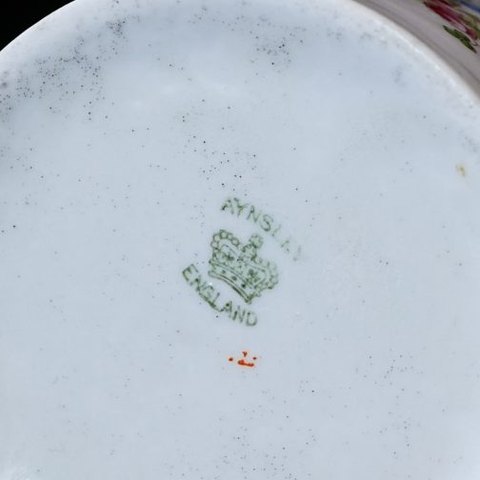
The plain crown
Aynsley's crowned mark appears from about 1885 — a green crown above an arched scroll or the name itself. In its earliest common form it reads simply “AYNSLEY” over “ENGLAND,” with no “Bone China” and no “Est. 1775.” The single word “England” (rather than “Made in England”) points to the years from the 1891 tariff onward, when imports were first required to name their country.
This bare crown-and-name form runs until “Bone China” is added to the mark in the mid-1930s. Our example carries its own date: a mug made for the 1911 coronation of George V.
Spot it: crown + AYNSLEY + ENGLAND only — no “Bone China.”
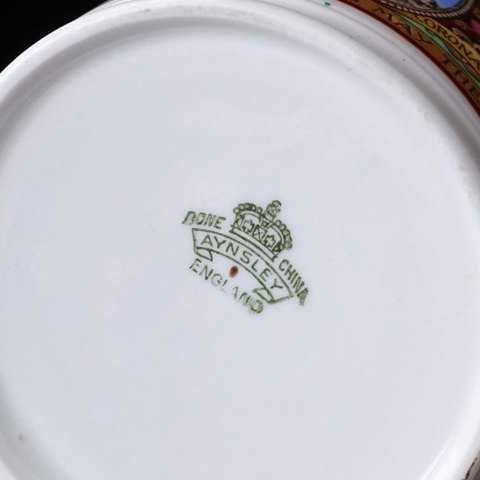
“Bone China” joins the mark
In the mid-1930s the words “BONE CHINA” are added to the crown-and-scroll mark, with “AYNSLEY” on the scroll and “ENGLAND” beneath. Mark guides date this “Bone China” form — the one that still carries no “Est. 1775” — to roughly 1934–1939.
Our example sits squarely in that window and carries its own date: a mug made for the 1937 coronation of George VI. A dated commemorative like this is the firmest anchor a mark can have.
Spot it: crown and AYNSLEY scroll with “Bone China” added, but no “Est. 1775.”
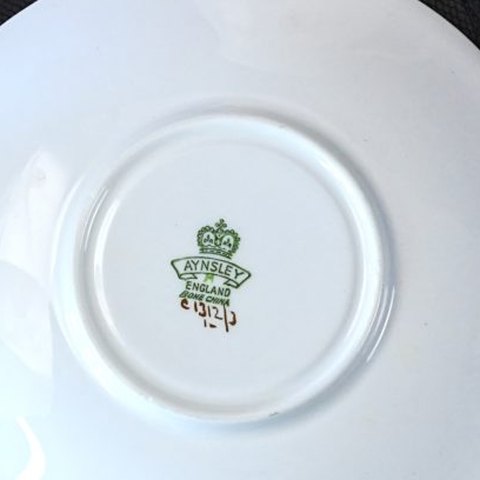
The everyday numbered mark
Most Aynsley pieces were never given a pattern name, only a number — often hand-inked in red, green or orange near the foot, such as C1312/D. A pattern number that begins with a letter is itself a clue: it points to post-1900. This green “Bone China” mark with a hand-written number is the everyday form on the long run of Aynsley's hand-tinted florals and cabinet cups.
It belongs to the same broad period as the mark above — a reminder that Aynsley ran several marks side by side, so wording alone dates a piece only loosely.
Spot it: green “Bone China” mark plus a hand-written, letter-prefixed pattern number.
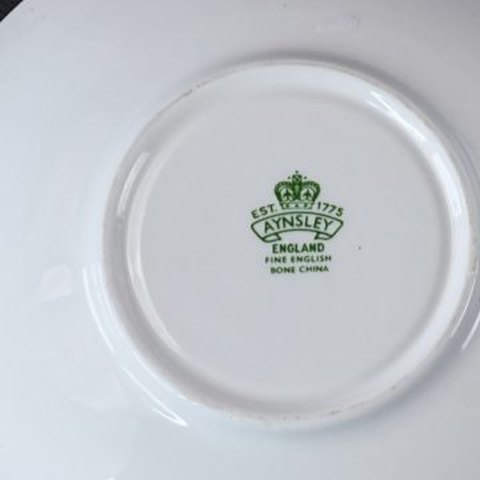
“Est. 1775” is added
From about 1939 the mark gains “EST. 1775” flanking the crown — the year the firm was founded, a piece of heritage branding rather than a date of manufacture. The fuller wording “Fine English Bone China” (in place of a plain “Bone China”) is a later, mid-century refinement of the same mark.
So “Est. 1775” tells you the piece is 1939 or later; the fuller “Fine English Bone China” wording nudges it toward mid-century and after.
Spot it: “Est. 1775” beside the crown; often “Fine English Bone China.”
Dating an Aynsley mark at a glance
- “England” alone, no “Bone China” — earliest form, before about 1934.
- “Bone China” added (crown over the AYNSLEY scroll), no “Est. 1775” — roughly 1934–1939.
- “Est. 1775” beside the crown — from about 1939 onward.
- “Fine English Bone China” (the fuller wording) — a later, mid-century form.
- A pattern number that begins with a letter (C…) — post-1900.
- A number that, added to 1924, gives a year — Aynsley's 1924–1950 dating system.
- Green printed mark — before about 2000; blue — after.
Every mark above was photographed from a piece that came through Rabbit Hole. Come across an Aynsley mark we haven't shown yet? We add to this record as new pieces arrive.
Browse the collection Back to all makersMarks read from pieces in our own collection, cross-checked against standard Aynsley mark references. Aynsley used several overlapping marks; date ranges here are guides, and a dated commemorative always outranks a rule of thumb.