Paragon began at Longton, in the Staffordshire Potteries, around the turn of the twentieth century as the Star China Company, and took the name Paragon China in 1919. It made fine bone-china teaware and, above all, some of the most collected royal commemoratives in England. That royal connection is a gift to the dater: from 1933 Paragon's mark carries the arms of its royal warrants, and the wording changes each time a warrant does — so the base of a Paragon piece often tells you its decade at a glance. Here is how the mark evolved, oldest to newest.
The star
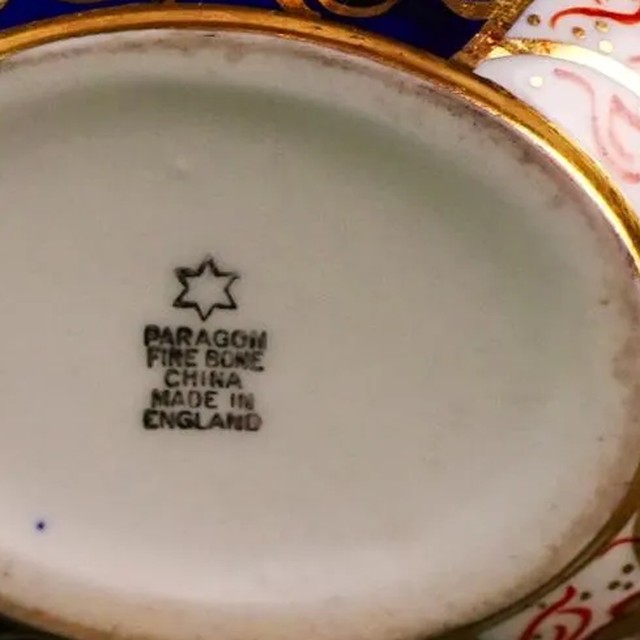
Paragon began at Longton as the Star China Company, around the turn of the twentieth century, and took the name Paragon China in 1919. Its earliest marks keep the old firm's emblem — a six-point star — set above “PARAGON” with, from about 1908, “Made in England.”
A star mark with no royal arms belongs to the years before the first royal warrant of 1933 — broadly the 1920s to early 1930s. This richly gilt Imari set carries exactly that early star.
Spot it: a six-point star over “PARAGON,” and no royal arms — before 1933.
The royal arms arrive
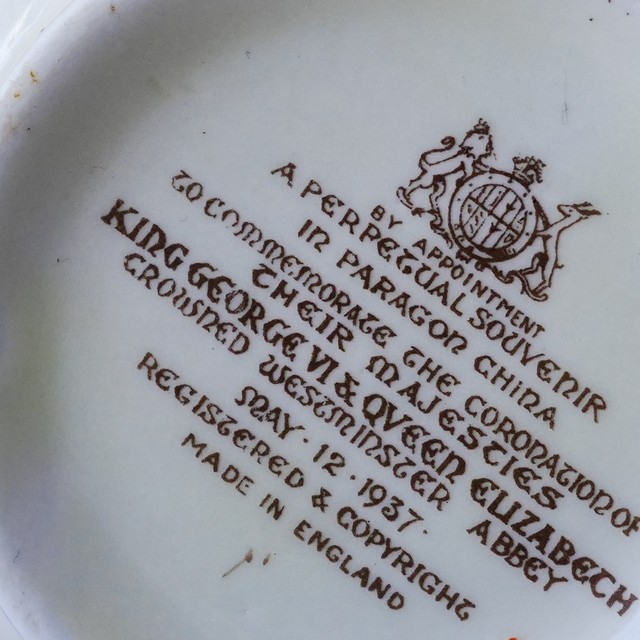
Before 1933 Paragon's mark was built on a star — a nod to the old Star China Company. In April 1933 Queen Mary granted Paragon a Royal Warrant, and from then the mark carries the royal arms and the words “By Appointment.”
This loving cup, dated May 12 1937 for the coronation of George VI, shows that early warrant mark — royal arms, “By Appointment,” and the older wording “Paragon China” rather than “Fine Bone China.” A dated commemorative like this is the firmest anchor a mark can have.
Spot it: royal arms + “By Appointment”; the wording “Paragon China”; often a dated dedication.
Two warrants, two coats of arms
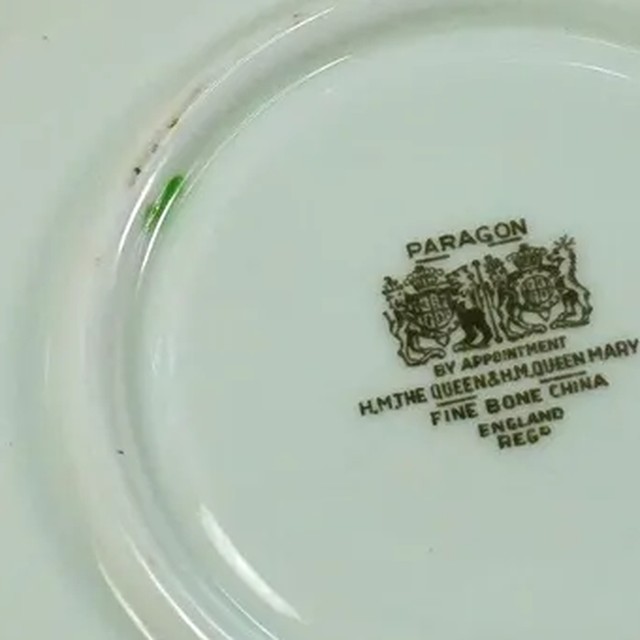
In 1938 Queen Elizabeth (later the Queen Mother) added her warrant to Queen Mary's, and from 1939 to 1949 the mark shows two coats of arms and reads “By Appointment to H.M. The Queen & H.M. Queen Mary.”
This decade-long “double warrant” is one of the most precisely datable marks in all of English china — if you see the two queens named together, you have a ten-year window. The body wording is now “Fine Bone China.”
Spot it: two royal arms side by side; “H.M. The Queen & H.M. Queen Mary” = 1939–1949.
Back to a single warrant
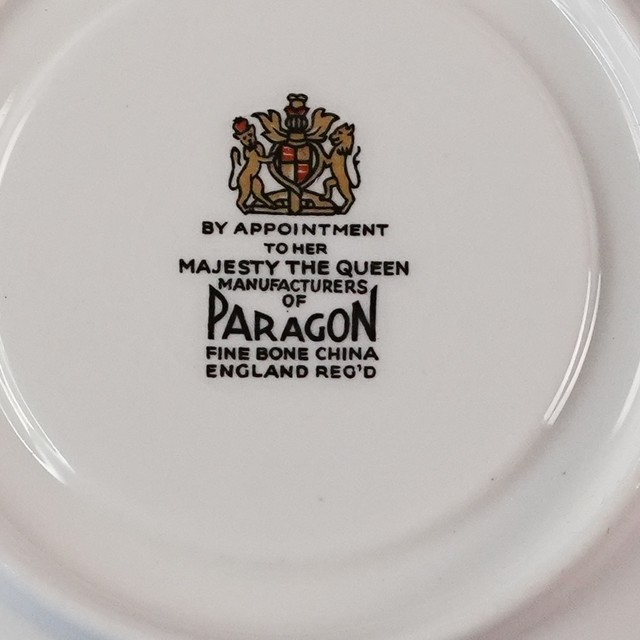
After the double-warrant decade the mark returns to a single royal arms, reading “By Appointment to Her Majesty The Queen — Manufacturers of Paragon.” On post-war pieces “The Queen” is Elizabeth II, whose warrant Paragon received in 1955.
Clean printing and “Fine Bone China / England Reg'd” place these from the 1950s onward. (A single reigning-queen warrant was also briefly held just before the double one, so the everyday post-war pieces are the Elizabeth II ones.)
Spot it: one royal arms; “By Appointment to Her Majesty The Queen, Manufacturers of Paragon.”
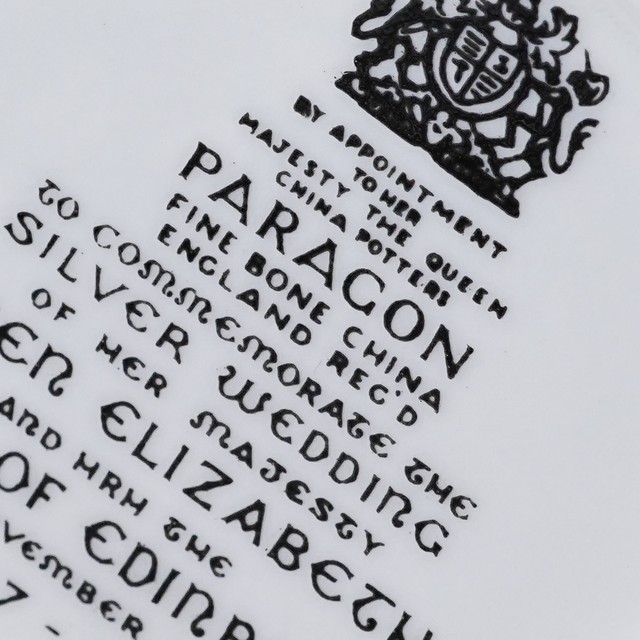
Royal commemoratives to the end
Paragon kept making royal commemoratives throughout its life. This silver-wedding loving cup carries the Elizabeth II warrant, the wording “China Potters / Paragon / Fine Bone China,” and a full dated dedication — the Silver Wedding of Queen Elizabeth II and the Duke of Edinburgh, “November 20, 1947–1972.”
As ever with Paragon, the dedication itself does the dating: another firmly dated piece to anchor the later mark.
Spot it: royal arms + “China Potters / Paragon”; a dated dedication you can simply read.
Dating a Paragon mark at a glance
- A star motif, no royal arms — earliest, before 1933 (Star China origins; renamed Paragon 1919).
- Royal arms + “By Appointment” + “Paragon China” — from April 1933 (Queen Mary's warrant).
- Two royal arms, “H.M. The Queen & H.M. Queen Mary” — 1939–1949, the double warrant.
- One royal arms, “By Appointment to Her Majesty The Queen, Manufacturers of Paragon,” “Fine Bone China” — post-war, Elizabeth II (warrant 1955).
- A dated dedication — a coronation, jubilee or wedding — read it straight off; the surest anchor of all.
- “Paragon” under Royal Albert / Royal Doulton — the name was used until about 1991.
Every mark above was photographed from a piece that came through Rabbit Hole. Come across a Paragon mark we haven't shown yet? We add to this record as new pieces arrive.
Browse the collection Back to all makersMarks read from pieces in our own collection, cross-checked against standard Paragon mark references. Date ranges here are guides; a dated dedication or a named royal warrant always outranks a rule of thumb.