Royal Albert was the china of the Longton firm of Thomas C. Wild & Sons, in the heart of the Staffordshire Potteries. The Wild family built the Royal Albert name in the early years of the twentieth century, and by the 1920s it was one of the best-known makers of English bone-china teaware — the rose-strewn cups and saucers that filled British cabinets for the rest of the century. The little printed mark on the base changed in small, datable ways as the firm grew, and those changes are one of the easiest ways to place a piece. Here is the whole arc, oldest to newest — including the one thing about mark colour that trips up most people.
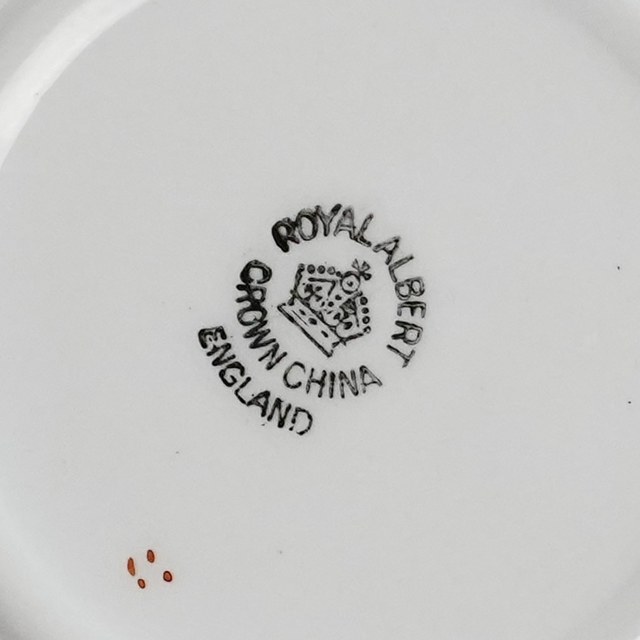
The early marks & “Crown China”
Thomas C. Wild used a run of early marks — a crown with initials or a pattern name — from about 1896, and first printed the “Royal Albert” name around 1905, after the firm's Diamond Jubilee wares earned a royal warrant. The initials “T.C.W.” belong to roughly 1907–1925; the firm became “& Sons” in 1917.
Once “T.C.W.” was dropped (about 1925–27), the distinctive “ROYAL ALBERT / CROWN CHINA / ENGLAND” mark runs until 1935 — so “Crown China” is a reliable sign of a pre-1935 piece.
Spot it: the words “CROWN CHINA.” If it also says “T.C.W.,” earlier still.
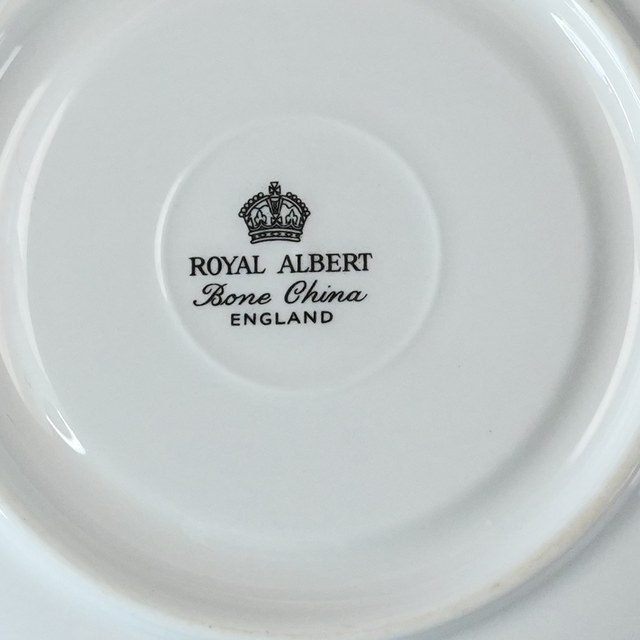
1935: “Bone China” replaces “Crown China”
In 1935 the firm dropped “Crown China” and took up the “Bone China” theme — on many marks literally swapping the word “Bone” for “Crown.” The result is the mark most people picture: a hand-drawn crown over “ROYAL ALBERT,” with “Bone China” in script and “ENGLAND” beneath.
In its plainest form it carries nothing else, and this crown-and-name mark ran for decades — so on its own it dates a piece only broadly, to 1935 or after.
Spot it: hand-drawn crown, “Bone China / England,” and nothing else.
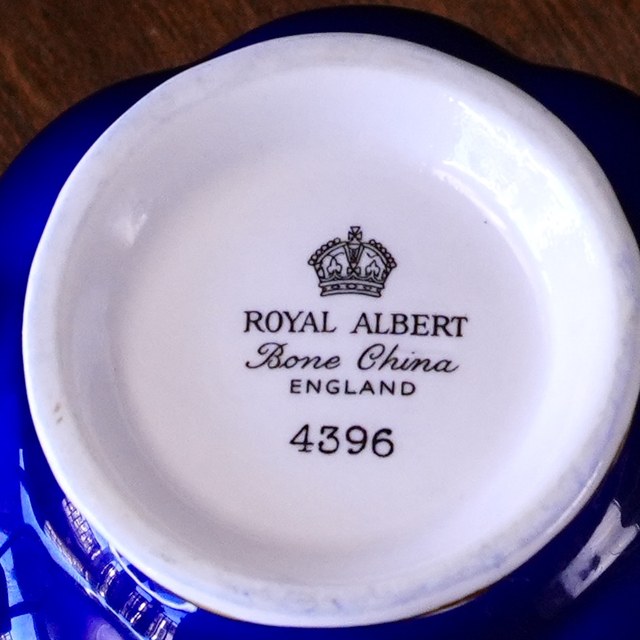
The crown with a pattern number
On earlier bone-china pieces the only addition is a pattern number — here 4396 — inked below the crown, with no named series. Royal Albert catalogued a great many patterns by number long before it began printing range names on the base.
A crown mark carrying just a number, and no “… Series” line, generally points to the earlier stretch of the bone-china run — broadly the later 1930s into the 1950s.
Spot it: a bare three- or four-digit number under the crown, no series name.
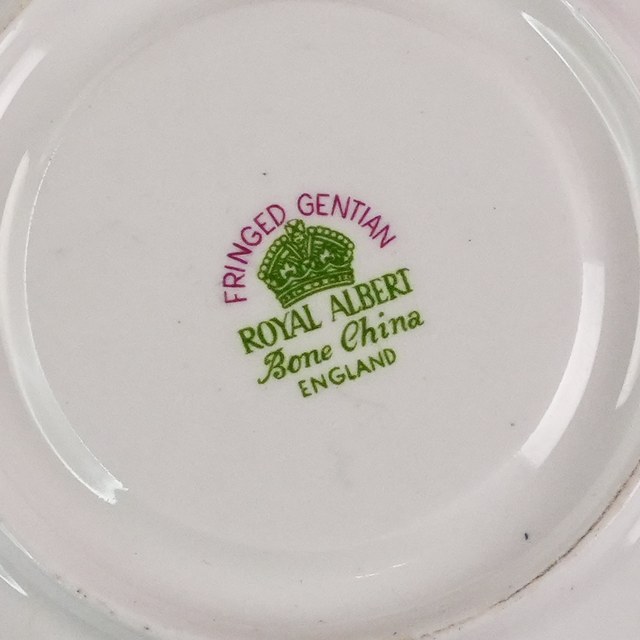
The colour of the mark is not a date
This is the one to remember. Royal Albert printed the same mark in a colour chosen to suit the pattern — green for a green floral like Fringed Gentian, sepia or gold for a cobalt-and-gold pattern, red or pink for the fruit ranges. The colour was a decorating choice, not a date.
So a green mark and a brown mark can come off the line the same year. Read the wording — “Crown China” versus “Bone China,” a series name, a copyright date — not the ink colour.
Spot it: mark colour matches the pattern's palette — never use it to date a piece.
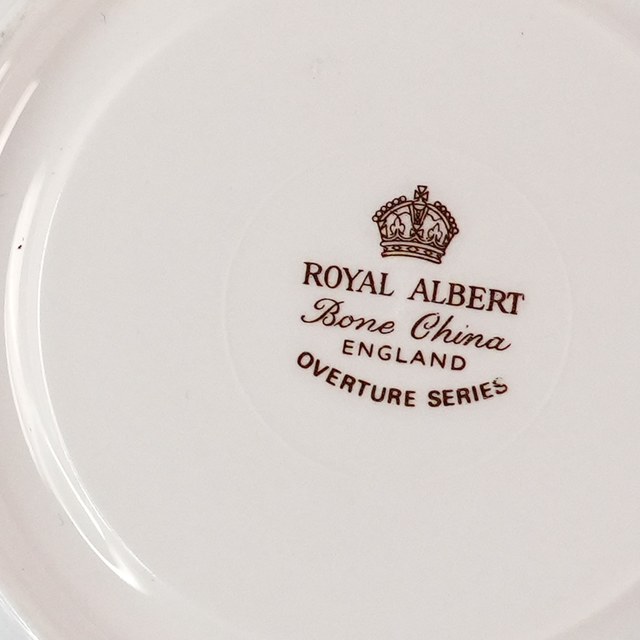
The named “Series” mark
Through the mid-century Royal Albert increasingly sold in named collections, and the base began to say which one — “OVERTURE SERIES,” “Horizon Series,” “Cameo Series” — printed under the crown, often with the individual pattern name beneath.
A crown mark that also carries a named “… Series” belongs to this later period, broadly the 1950s and 1960s. The crown alone no longer dates the piece; the series name does the finer work.
Spot it: the familiar crown plus a named “… SERIES” line.
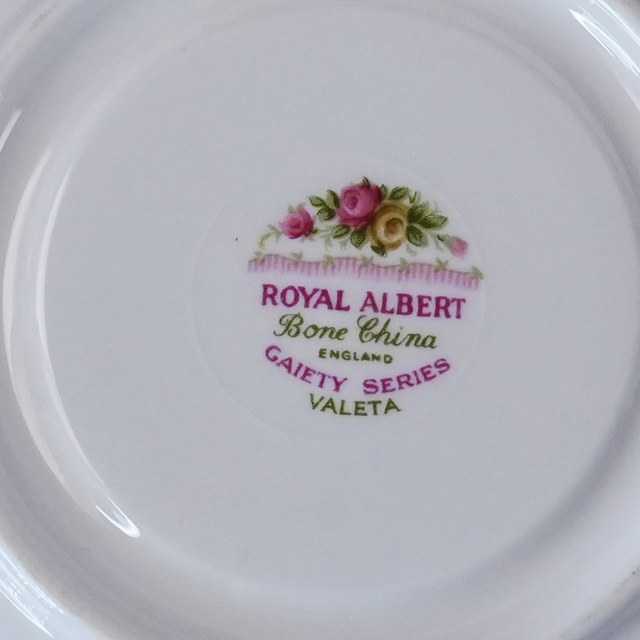
The colour pictorial mark
On many named ranges the drawn crown gives way to a small printed picture — a spray of roses, a cluster of fruit — above “ROYAL ALBERT / Bone China / England” and the series and pattern names. The Gaiety Series (here Valeta) dates to the 1950s.
These colour pictorial marks run for decades alongside the crown marks rather than simply replacing them, so the safest anchor is the individual range's own introduction date.
Spot it: a printed colour picture above the wording, with a series and pattern name.
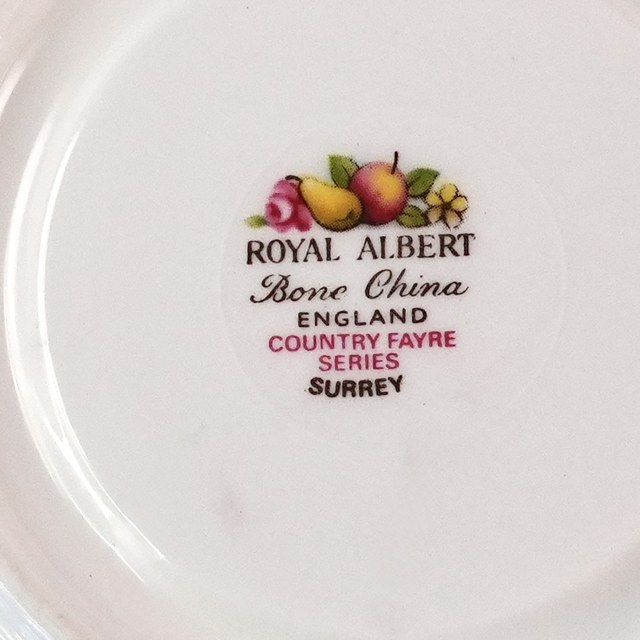
Country Fayre, 1977
The Country Fayre range, marked with its little cluster of fruit and a county name (“Surrey,” “Kent”), was introduced in 1977 — one of the firmest late dates a Royal Albert mark can give you.
By this point the numbered mid-century catalogue had given way almost entirely to named ranges carried on the base, printed in the pattern's own colours.
Spot it: the fruit device with “COUNTRY FAYRE SERIES” and a county name — 1977 or after.
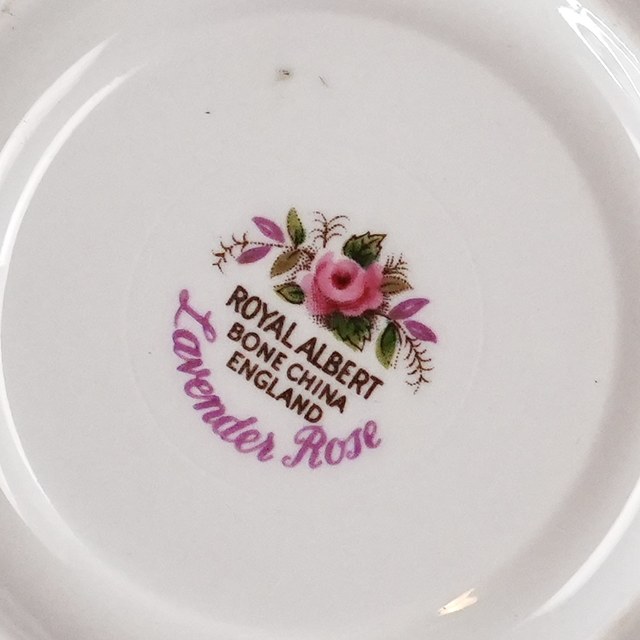
The upright block mark
Some later ranges drop the crown altogether for an upright block of type — “ROYAL ALBERT / BONE CHINA / ENGLAND” — with a small floral device and the pattern name in script beneath, here Lavender Rose. These simpler printed marks belong to the later twentieth century; without a series name or date they are hard to pin more precisely, so we place them by feel rather than a fixed year.
Spot it: no crown — an upright “BONE CHINA / ENGLAND” block with a script pattern name.
Dating a Royal Albert mark at a glance
- “CROWN CHINA” (not “Bone China”) — before 1935; with “T.C.W.” initials, before about 1925.
- Hand-drawn crown, “Bone China / England,” plain or with a bare pattern number, no series — earlier bone china, roughly 1935 into the 1950s.
- Crown plus a named “… SERIES” — mid-century, broadly 1950s–60s.
- A printed colour picture (roses, fruit) with a series and pattern name — from the 1950s (Gaiety) through the 1970s (Country Fayre, 1977) and beyond.
- The colour of the mark — matches the pattern, not the date. Ignore it for dating.
- A copyright date — 1980s or later. “Made in England” — about 2000–2002. No “England” at all — made offshore, after 2002.
- “Old Country Roses” — first issued 1962; its own early mark helps date within the pattern.
Every mark above was photographed from a piece that came through Rabbit Hole. Come across a Royal Albert mark we haven't shown yet? We add to this record as new pieces arrive.
Browse the collection Back to all makersMarks read from pieces in our own collection, cross-checked against standard Royal Albert mark references. Royal Albert used several overlapping marks and coloured them to suit each pattern; date ranges here are guides, and a dated or datable range always outranks a rule of thumb.