Josiah Wedgwood founded his firm in Staffordshire in 1759, and it is still working today — one of the most consistently marked names in all of ceramics. Wedgwood pressed its name into the raw clay, and later printed it, in ways that changed on a schedule; more than almost any other maker, the mark on the base can place a Wedgwood piece to a decade, and sometimes to a single year. Here is how the mark evolved, oldest to newest.
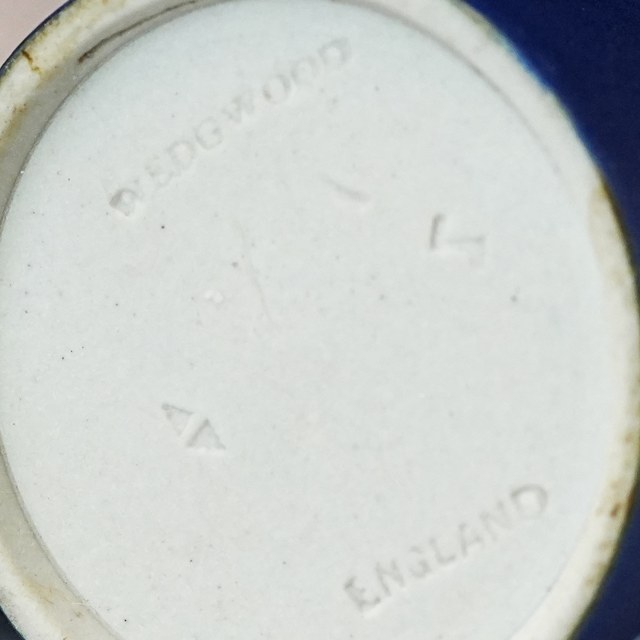
The impressed name, with “England”
Wedgwood pressed the single word WEDGWOOD into the clay from the eighteenth century. From 1891 the mark adds “ENGLAND,” required by the American McKinley Tariff, which made imported goods name their country of origin.
A piece impressed “WEDGWOOD / ENGLAND” with no “Made in” sits in the window between 1891 and 1908 — here on a pair of deep “Portland blue” jasper souvenirs.
Spot it: impressed “WEDGWOOD” + “ENGLAND,” with no “Made in.”
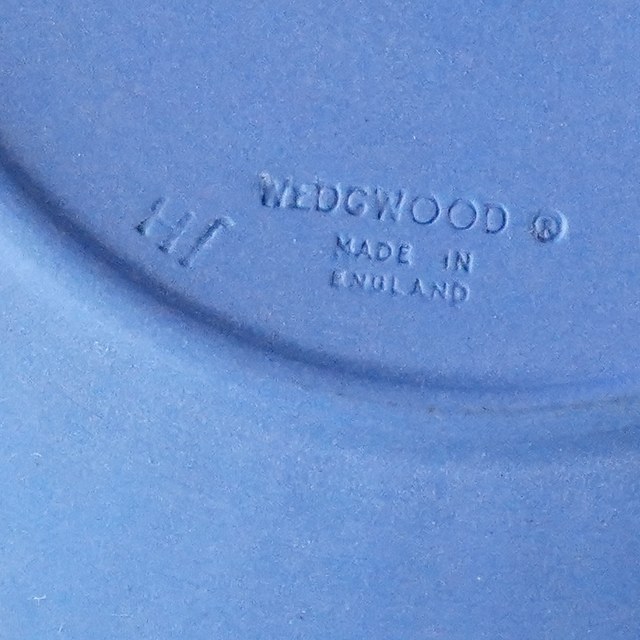
“Made in England” replaces “England”
From about 1908 the wording “MADE IN ENGLAND” replaces the single “England” across the range, and on jasperware this three-line impressed mark then runs through the twentieth century.
The wording alone opens the date at 1908; the details narrow it. This tray also carries the ® registered-trademark symbol, which points to the mid-twentieth century rather than the Edwardian years.
Spot it: impressed “WEDGWOOD / MADE IN ENGLAND.” A ® symbol pushes it to mid-century or later.
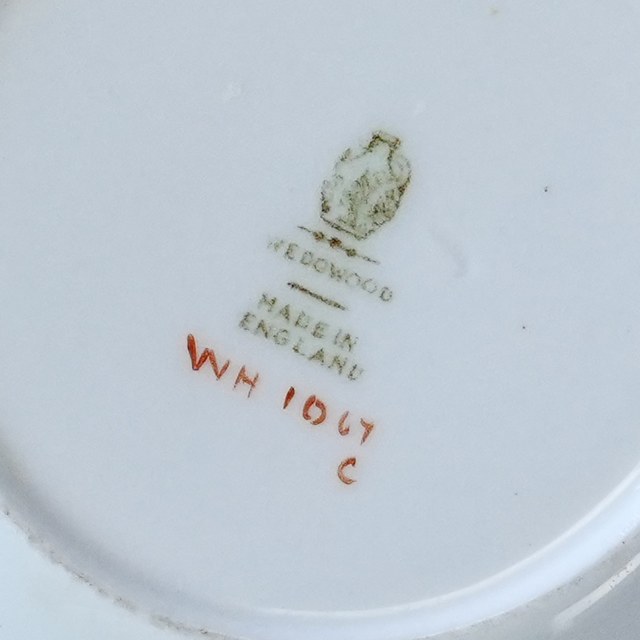
The printed Portland Vase, on bone china
On bone china — not jasper — Wedgwood prints its trademark, the Portland Vase, above “WEDGWOOD / MADE IN ENGLAND.” Wedgwood first made bone china in 1878 and relaunched it in the 1920s.
A hand-painted pattern number inked beside the mark — here WH1047C, in red — is the sign of an earlier-to-mid-century, hand-decorated piece, catalogued by number rather than a printed pattern name.
Spot it: a printed urn (the Portland Vase) with a hand-painted pattern number.
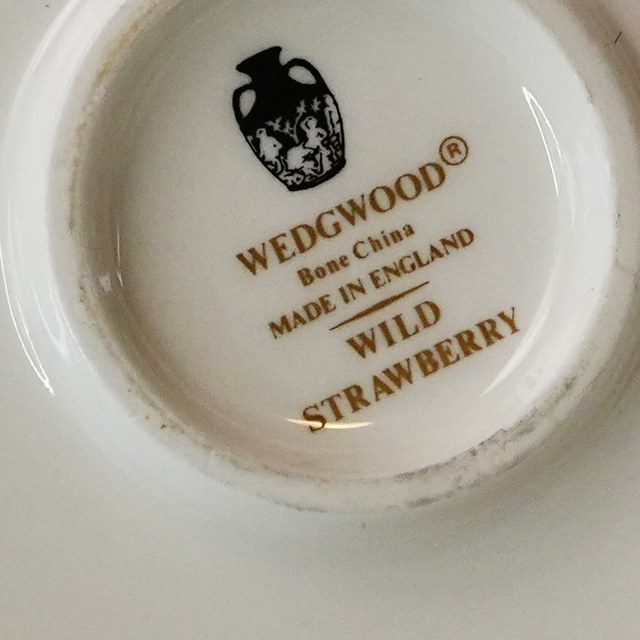
The modern bone-china vase mark
The later printed mark keeps the Portland Vase but adds the ® symbol and prints the pattern name in full — here WILD STRAWBERRY, a pattern introduced in 1965. Crisp gold printing and “Bone China / Made in England” place it in the second half of the century.
Spot it: Portland Vase + ®, a printed pattern name, “Bone China / Made in England.”
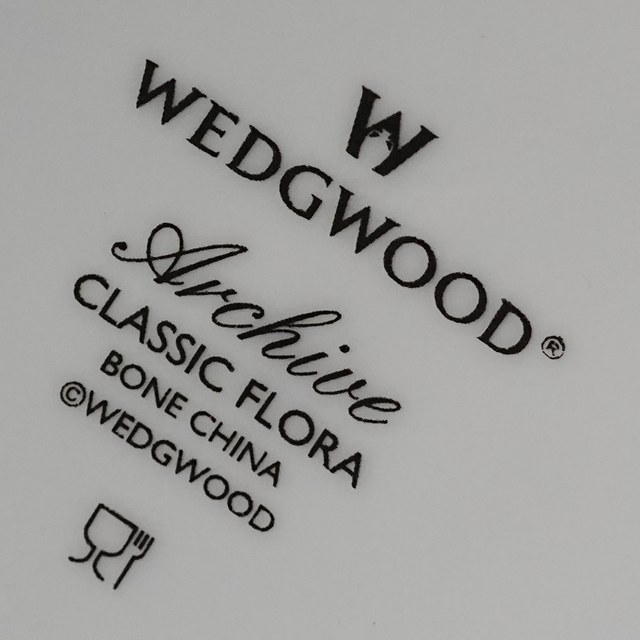
The modern “W” logo
The most recent marks drop the vase for a squared “W” monogram over “WEDGWOOD,” often with a collection name (here Archive), “BONE CHINA,” a “©WEDGWOOD” copyright line, and little dishwasher and microwave care symbols.
The copyright line and the care symbols are the giveaways: both belong to the late twentieth century and after.
Spot it: the boxed “W” logo, a “©WEDGWOOD” line, and printed care symbols.
Dating a Wedgwood mark at a glance
- Impressed “WEDGWOOD,” no country — before 1891 (and earlier).
- “WEDGWOOD” + “ENGLAND,” no “Made in” — c.1891–1908.
- “WEDGWOOD” + “MADE IN ENGLAND” — from 1908.
- A three-letter impressed code — c.1860–1930; the last letter gives the year.
- Printed Portland Vase on bone china — from 1878; a hand-painted pattern number points to the earlier–mid twentieth century.
- Portland Vase + ® + a printed pattern name — later twentieth century.
- A boxed “W” logo, “©WEDGWOOD” and care symbols — 1990s onward.
- “Wedgwood & Co.” or “& Sons” — a different firm, not Josiah Wedgwood.
Every mark above was photographed from a piece that came through Rabbit Hole. Come across a Wedgwood mark we haven't shown yet? We add to this record as new pieces arrive.
Browse the collection Back to all makersMarks read from pieces in our own collection, cross-checked against standard Wedgwood mark references. Date ranges here are guides; an impressed date code, when present and legible, always outranks a rule of thumb.