The Word Nobody Could Own: How Foley Became Shelley
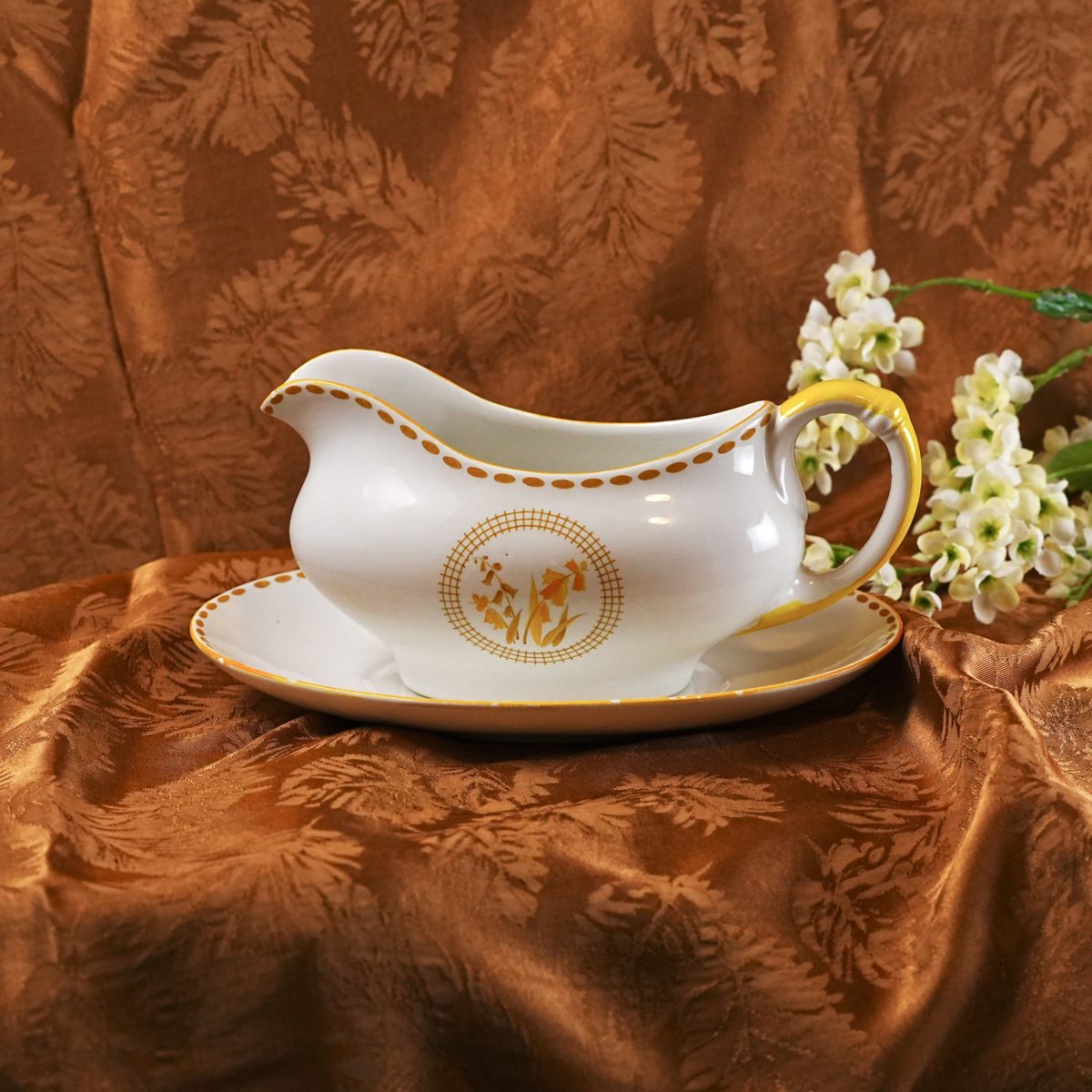
Two English teacups sit side by side on the shelf. They were made from much the same clay, in the same small district of Staffordshire, only a few years apart — and for a time their makers marked them with the very same word. One, though, is signed Foley, and the other Shelley. The reason for that difference is a modest but well-documented episode in the history of the Potteries, and it seems worth setting down carefully, because it is often told in passing and not always told straight.
A name that belonged to a place
The first thing to understand is that Foley was not, in origin, a maker's name at all. It was a place — a district of the Potteries between Fenton and Longton — and the firms that worked there took the local name, as firms tend to. This matters, because a place-name is shared ground: more than one reputable pottery in the Foley marked its wares “Foley China,” and each had a fair claim to do so.
Two of those firms are relevant here. The older thread is Wileman & Co. The generally accepted account runs roughly like this: around 1860 Henry Wileman established a china works in the Foley; a former Dresden-works man, Joseph Ball Shelley, joined the business in the early 1860s, first as a salesman and then as a partner, so that it traded as Wileman & Co. His son Percy Shelley entered the firm in 1881 and, by 1896, had become its sole proprietor, remaining at its head for close to fifty years. The second firm was E. Brain & Co., which worked nearby at the Foley China Works and likewise marked its china “Foley.”
The acclaimed years of Foley Art China
By the 1890s, Wileman's “Foley Art China” was among the more admired porcelain of its day. Under the art director Frederick Rhead the firm produced notable Art Nouveau ranges — the marbled Intarsio wares are the most often cited — and in 1899 the magazine The Artist gave the work a feature, “Some Beautiful English Pottery.” Liberty of London retailed it. With the name carrying that much goodwill, it is not difficult to see why the firm might have wished to secure exclusive rights to it. Around 1910, Percy Shelley set out to do so.
The 1910 trademark attempt, and the ruling
Percy Shelley applied to register “Foley” as Wileman & Co.'s trade name. E. Brain & Co., which used the name with equal justification, objected, and the matter was contested. The outcome, as reported consistently in the collector literature, was that no single firm could claim exclusive use of “Foley,” since it was a shared place-name rather than the property of any one maker. Wileman & Co. did not obtain the exclusive right it had sought.
We have not seen the full text of the judgment, and would rather not dramatise it beyond what the sources support. What is clear is its effect. Refused sole use of a name held in common, the firm turned instead to one it could hold on its own — the family's surname.
A place-name could be used by anyone in the district; a surname could not. That distinction is the quiet hinge of the whole story.
“Late Foley”: the transition
The change was made gradually, and with evident care for the reputation already built. From about 1910 the china began to be marked Shelley, the surname set within a shield. For roughly the next six years — commonly given as 1910 to 1916 — the mark also carried the words “Late Foley” above the shield: in effect a plain statement that this was the same pottery formerly trading as Foley. The company itself continued as “Wileman & Co.” on paper until the end of 1924; the Shelley name was formally registered on 1 January 1925, when the firm became Shelleys. These dates are those given in the standard collector chronologies, and the surviving marks are consistent with them.
Two names, two histories
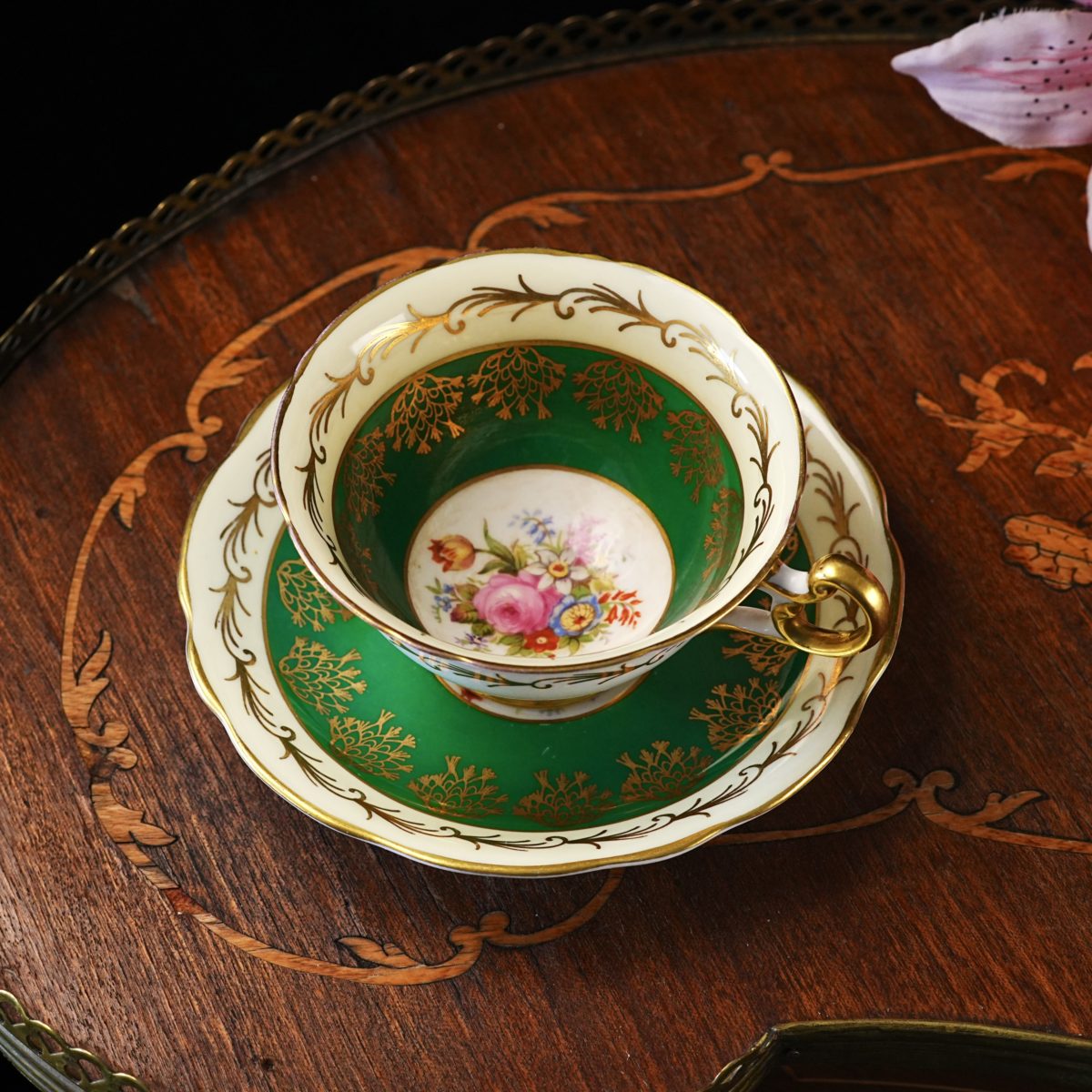
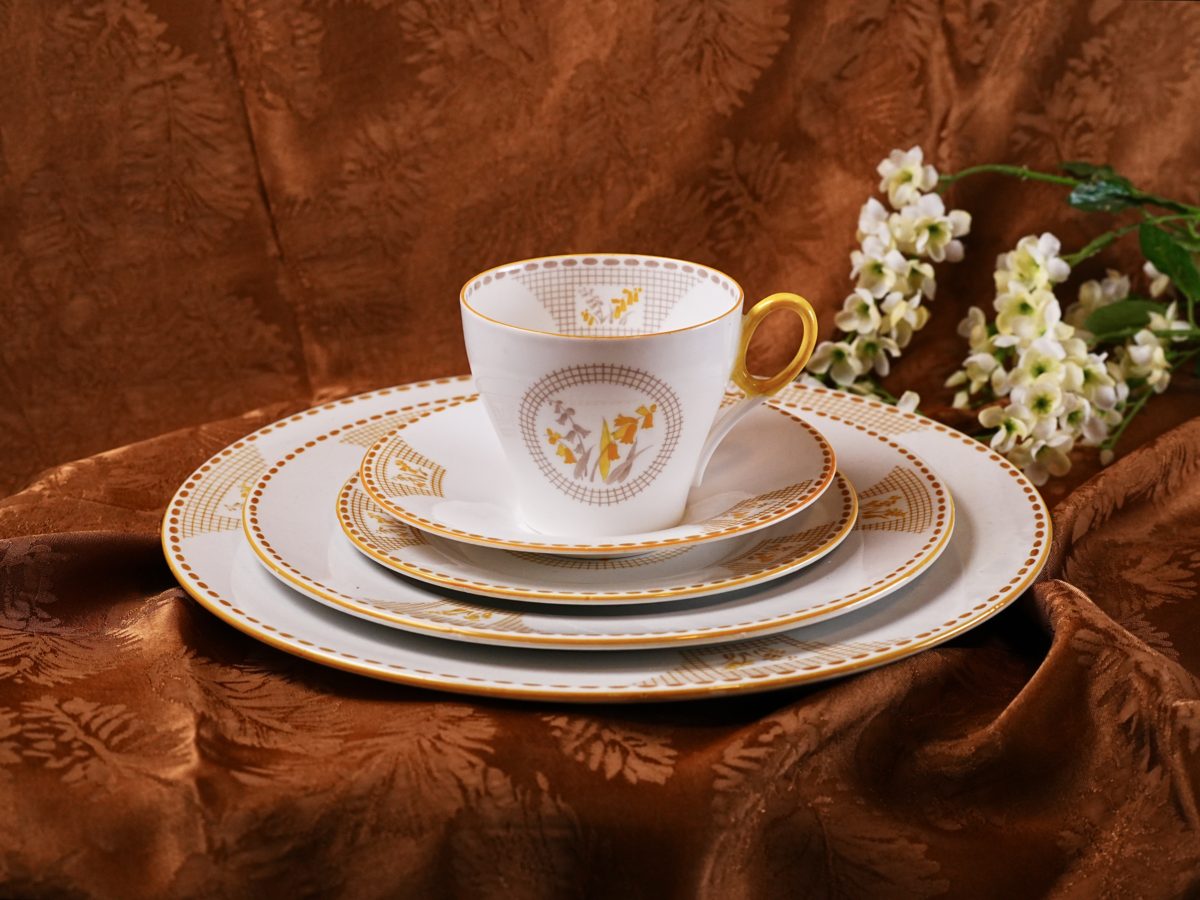
The later histories of the two firms diverged. E. Brain & Co. retained “Foley China” and continued as a respected maker; the emerald-and-gold cup above belongs to that line. Shelley, now trading under the family name, became one of the most widely collected English bone-china marks of the twentieth century — particularly for the Art Deco shapes (Vogue, Mode, Regent, Queen Anne) associated with the designer Eric Slater, and for the fluted Dainty shape. The firm continued until it was absorbed by Allied English Potteries in 1966.
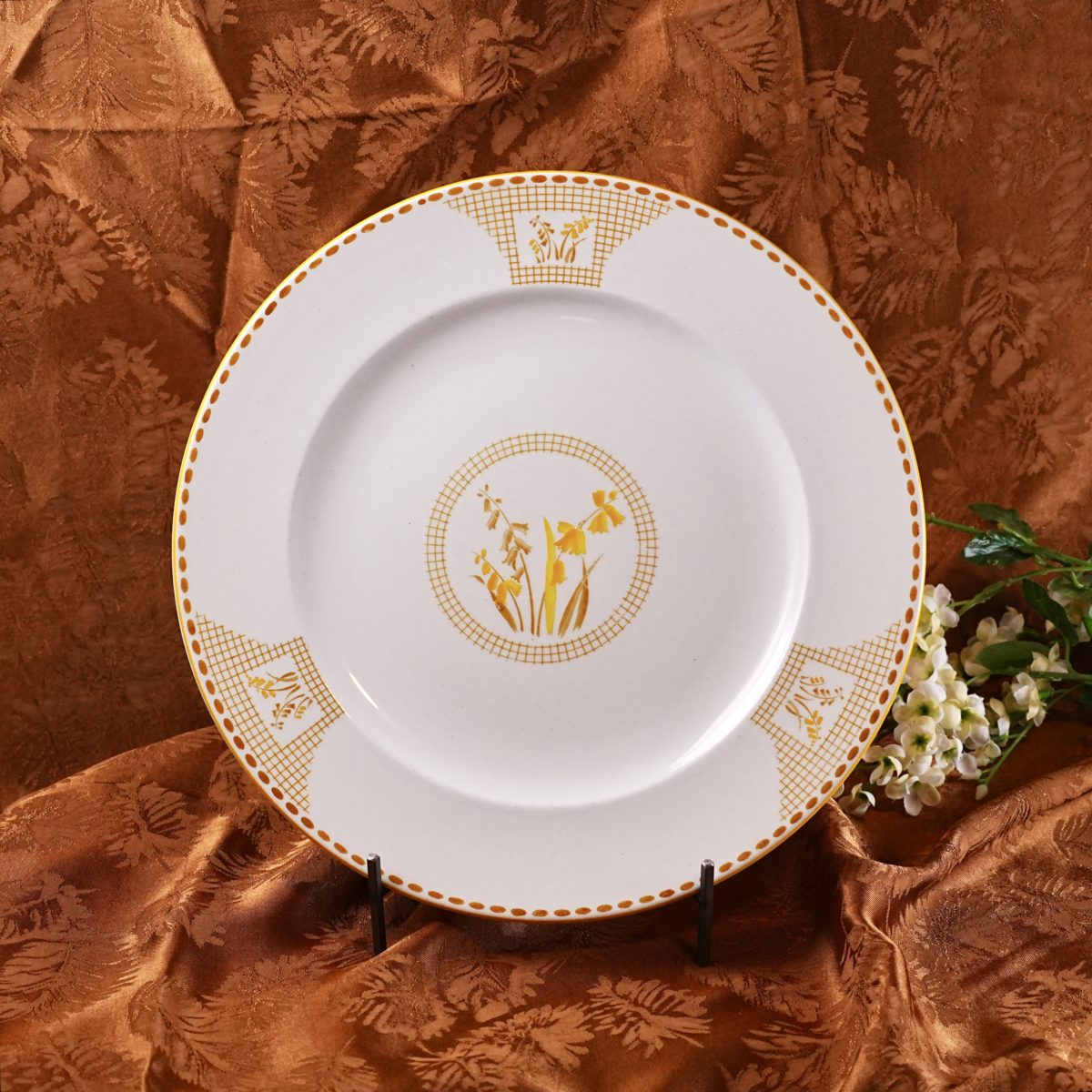
Shelley's output was never only Art Deco, and it is easy to give that impression by showing the modern shapes alone. The firm worked in a broad range of styles, from close all-over chintz to restrained gilt borders — a reminder that the name on the base tells you the maker, not the look.
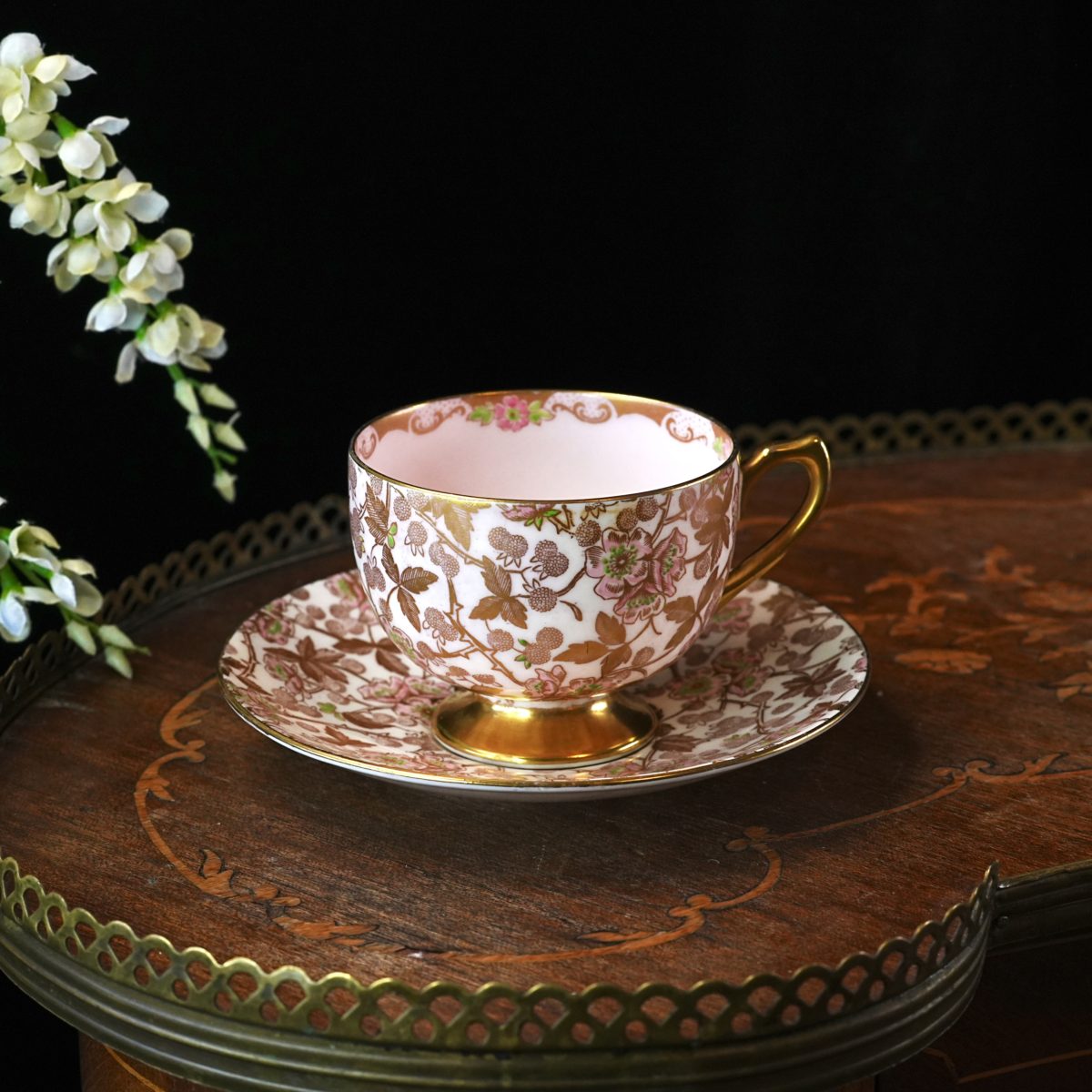
It is tempting to read a neat irony into this: that the word Percy Shelley could not register faded, while the name he fell back on became famous. We would put it more cautiously. The surname did prove the more durable asset, but Shelley's later standing owed at least as much to its designs and its craftsmanship as to the name on the base. The coincidence is worth noticing rather than overstating.
Reading it on the base
For anyone examining a piece, the sequence is legible in the marks:
- “Late Foley” above a Shelley shield indicates the transitional period, usually dated about 1910–1916 — the most precisely datable of the Shelley marks.
- A Shelley shield without that line is 1910 onward; the flowing script “Shelley” signature belongs to the later decades.
- “Foley China” with E. Brain's marks — a lion is common — denotes the other firm, not Wileman/Shelley: the same word, a different maker.
As always, a mark is best read alongside the body, the pattern and the shape; dating from the mark alone can mislead. Our Backstamp & Pattern Guide, including the Shelley entry, sets out the fuller picture.
We keep examples of both houses partly for this reason. Set side by side, the E. Brain “Foley” cup and the Shelley trio make the history legible in a way words alone do not: two makers, once sharing a single name, whose paths divided over a word that belonged, in the end, to a place rather than to either of them.
Both firms are represented in the shop — the Foley that kept the name, and the Shelley that took its own. You are welcome to compare their marks.
Browse the collection Shop on Etsy ↗This account draws on published collector histories and is offered as a careful summary rather than a legal record. Sources: the 1910 attempt to register “Foley,” the E. Brain objection and the refusal of an exclusive claim, and the “Late Foley” 1910–1916 transition mark, from the Shelley China Club and the Shelley history chronology; the Wileman and Shelley family timeline, Foley Art China, Frederick Rhead and the 1925 renaming from Wikipedia and WorthPoint; E. Brain & Co.'s continued use of “Foley China” noted in the same sources and recorded from the marks on the shop's own pieces. Dates are those given in the standard chronologies and should be read as approximate.