Pat. 1871: The Spoon That Brought Japan to American Silver
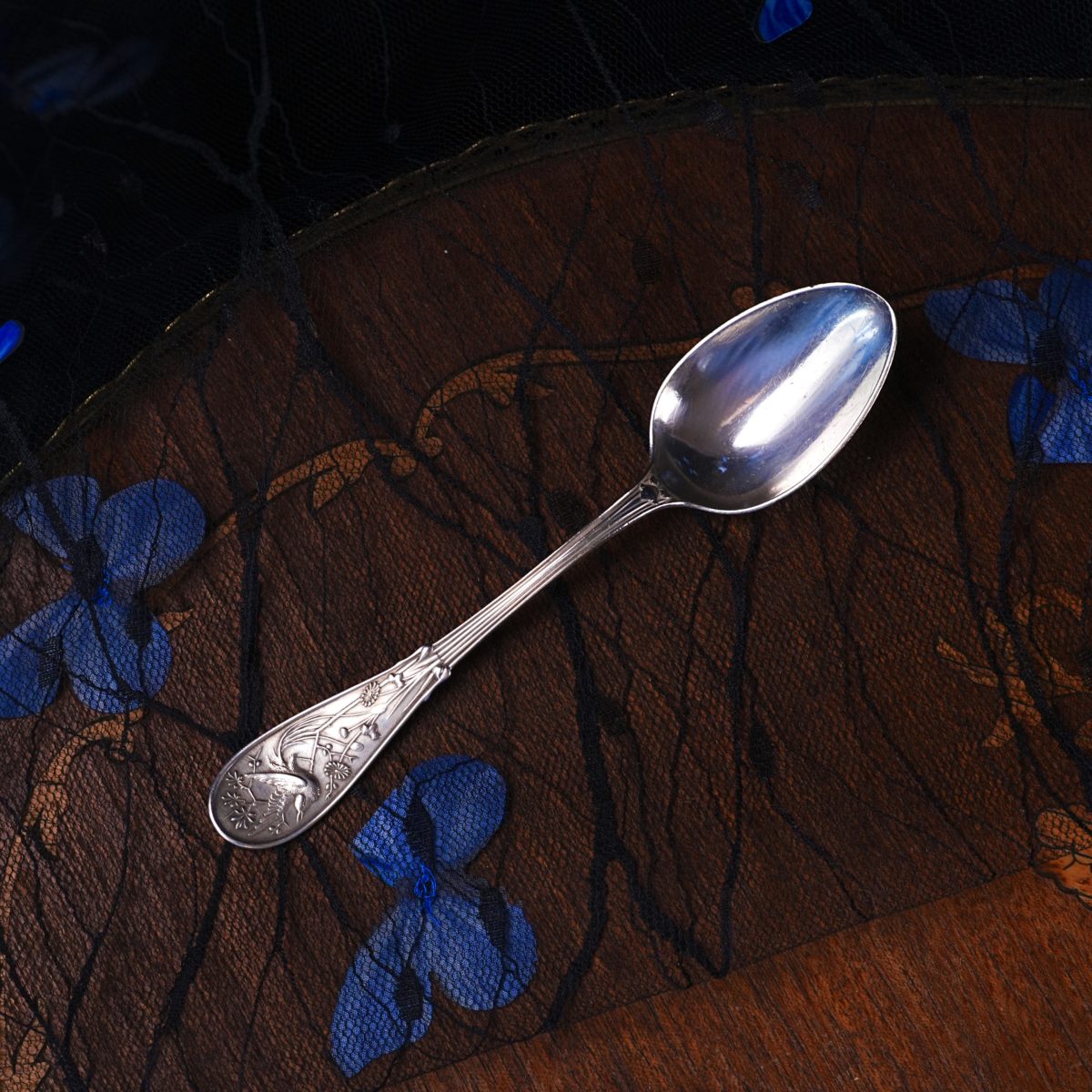
Three lines are stamped on the back of this handle: TIFFANY & CO. / STERLING / PAT. 1871. The first tells you who made it, the second what it is made of, and the third — three characters and a date — carries the whole story. It is a maker's shorthand for one of the more remarkable moments in American design: the year a New York silver house looked at Japan and decided to start again from scratch.
1867: the year America met Japan
To understand the spoon, start in Paris. At the 1867 Exposition Universelle, the Meiji government sent Japan's lacquer, porcelain, woodblock prints, textiles and armour to Europe in force — for many visitors the first time they had seen such things en masse. Among the crowd was Edward Chandler Moore (1827–1891), soon to be Tiffany & Co.'s chief silver designer, a post he would hold from 1868 until his death. He walked through that exhibition and, in a sense, never quite came home.
Moore began buying Japanese and East Asian objects in quantity, not to copy them but to take them apart: to study how they were composed. Where European ornament was symmetrical, filled edge to edge and drawn from pattern books, the Japanese work he collected was asymmetrical, full of deliberate empty space, and drawn from life — a single bird, a spray of blossom, placed off-centre and allowed to breathe. It was a completely different grammar, and Moore set about learning to speak it.
1871: a new grammar on a spoon handle
In 1871 he patented the result. Tiffany's “Japanese” pattern is generally described as the first Japonisme flatware made in America — birds and branches scattered across a handle at a moment when American silver still meant Greek key borders and rococo scrolls. Accounts of the day called it “entirely different from anything in American silver at that time,” and the trade agreed: Moore's Japanese-inspired work took gold at Paris in 1867, a prize at the Philadelphia Centennial in 1876, and the grand prize at Paris again in 1878.
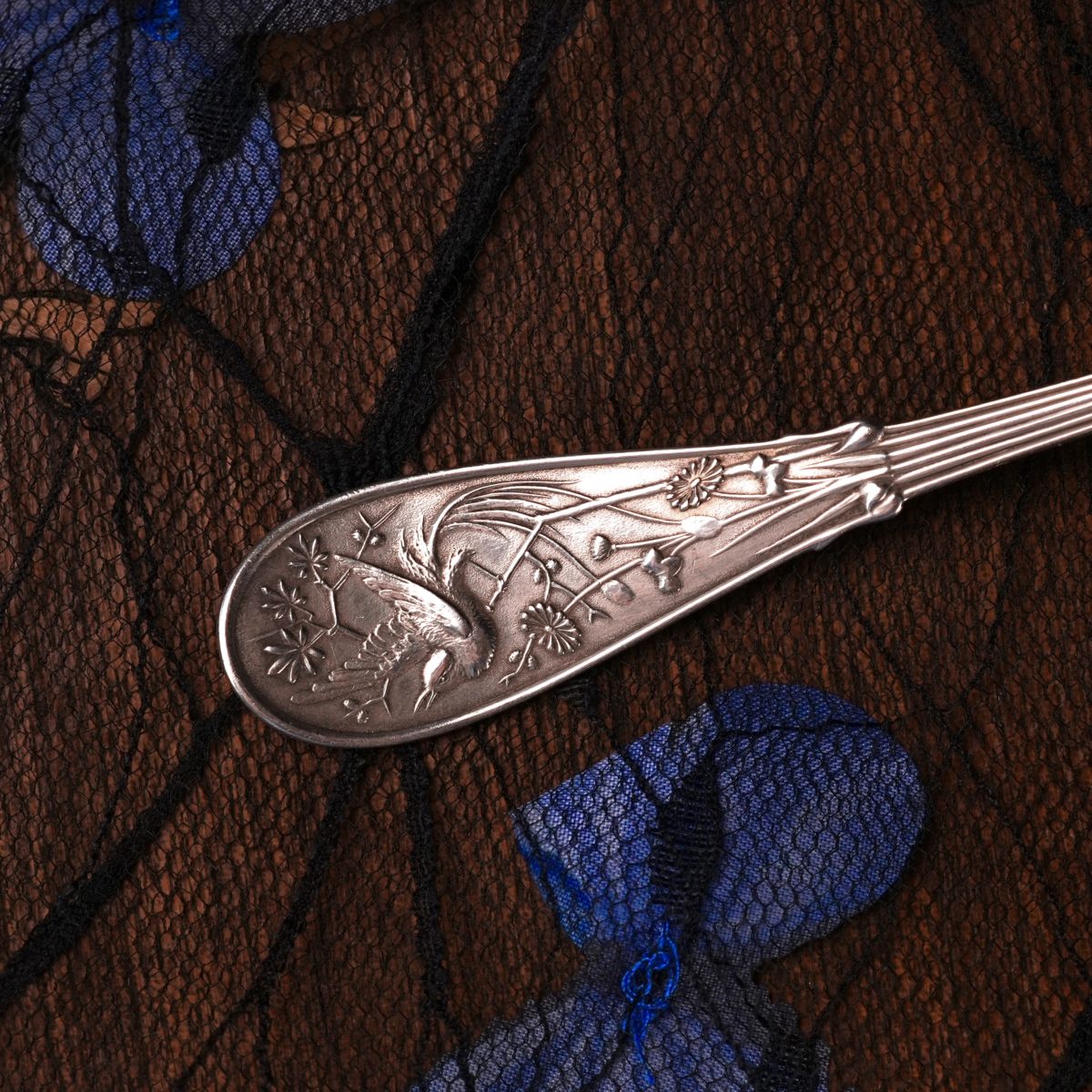
Look closely at this handle and the borrowed grammar is right there. A wading bird stands among grasses and scattered blossom; the design is weighted to one side and left open on the other, exactly as a Japanese painter would balance a scroll — and nothing like the mirror-image symmetry of Western pattern. The bowl, meanwhile, is left completely plain. All the artistry goes to the handle, where you would actually hold it.
Eight birds, and scarcely two alike
The pattern has a peculiarity collectors prize: the pieces do not match. Moore designed some eight different birds — and a range of plants for the reverse, adapted from Japanese flower studies — and had them combined more or less at random across a service, so that hardly two pieces in a set carry the same design. It was an extravagant way to make flatware, since industrial silver depended on repeating a single die, and it is the reason collectors today still hunt individual pieces by which bird they wear. This one is decorated on both faces, front and back — another quiet luxury, since most silver is ornamented only on the side that shows.
The birth certificate
Here is where that little stamp earns its keep. Tiffany made the Japanese pattern from 1871 until around the turn of the century, then reissued it in 1956 under a new name, Audubon — for the birds — and it is still sold today. The two look very nearly the same. What separates them is the mark: the nineteenth-century originals carry the Pat. 1871 stamp, and the modern reissues do not. It is, in effect, the object's birth certificate, and among dealers it is the single detail that decides which century a piece belongs to.
The silver itself quietly agrees. At six and a quarter inches this is teaspoon length, yet it weighs about a third more than a standard sterling teaspoon of the same size — the extra simply metal. Moore's Tiffany did not economise on silver, and collectors note that the early pieces sit noticeably heavier in the hand than the later reissue. We mention it not as proof on its own, but because it points the same way as the stamp.
The bowl is plain, the handle is a Japanese painting, and a three-character stamp on the back tells you it is a hundred and fifty years old. Few teaspoons work so hard.
The man whose spoon this is
It is worth knowing who Edward Moore was, because it changes how this modest spoon feels in the hand. He was not only Tiffany's designer; he was one of the great collectors of the age, amassing thousands of objects — Japanese, Chinese, ancient Greek and Roman, Islamic — explicitly to educate and inspire American craftsmen. When he died in 1891, his family gave more than two thousand of those objects, and some five hundred books, to the Metropolitan Museum of Art. That gift became a founding core of the Museum's decorative arts holdings; his Islamic material alone remains among the most important the Met has ever received. In 2024 the Museum devoted a full exhibition to him, Collecting Inspiration: Edward C. Moore at Tiffany & Co.
So this is a mass-produced teaspoon — and it came from the workshop, and the mind, of a man who helped build one of the world's great museum collections. The taste that shaped the Met's decorative arts galleries is the same taste that placed this bird on this handle.
A crane, still standing
That 1867 exhibition in Paris sent a shock through Western art that took years to play out: the same wave of enthusiasm for Japanese prints and objects would sweep up Whistler and Monet, and later Van Gogh, and feed directly into Art Nouveau — whose American champion was Louis Comfort Tiffany, the founder's son. Moore was simply among the first to act on it, and almost certainly the first to bring it to the American table. He turned a moment of looking into a pattern you could hold at breakfast.
A hundred and fifty years later, the crane is still standing in the grasses on the back of this handle, off-centre, unhurried, exactly where he set it — and the small stamp beside it still quietly insists on the date.
This spoon — original Japanese pattern, Pat. 1871 — is in the shop now, alongside other pieces where East met West.
See the Tiffany spoon Browse the collectionSources: the Japanese pattern's 1871 patent, its standing as the first Japonisme flatware made in America, the eight bird species and reverse flower designs, and the 1956 reissue as Audubon, from dealer and auction records including Antique Cupboard, Leland Little and Spoon Planet; Edward C. Moore's biography, his collecting, the 1891 bequest to the Metropolitan Museum and the 2024 exhibition from The Metropolitan Museum of Art and Apollo Magazine. The maker's marks, dimensions and weight were recorded from the piece itself.