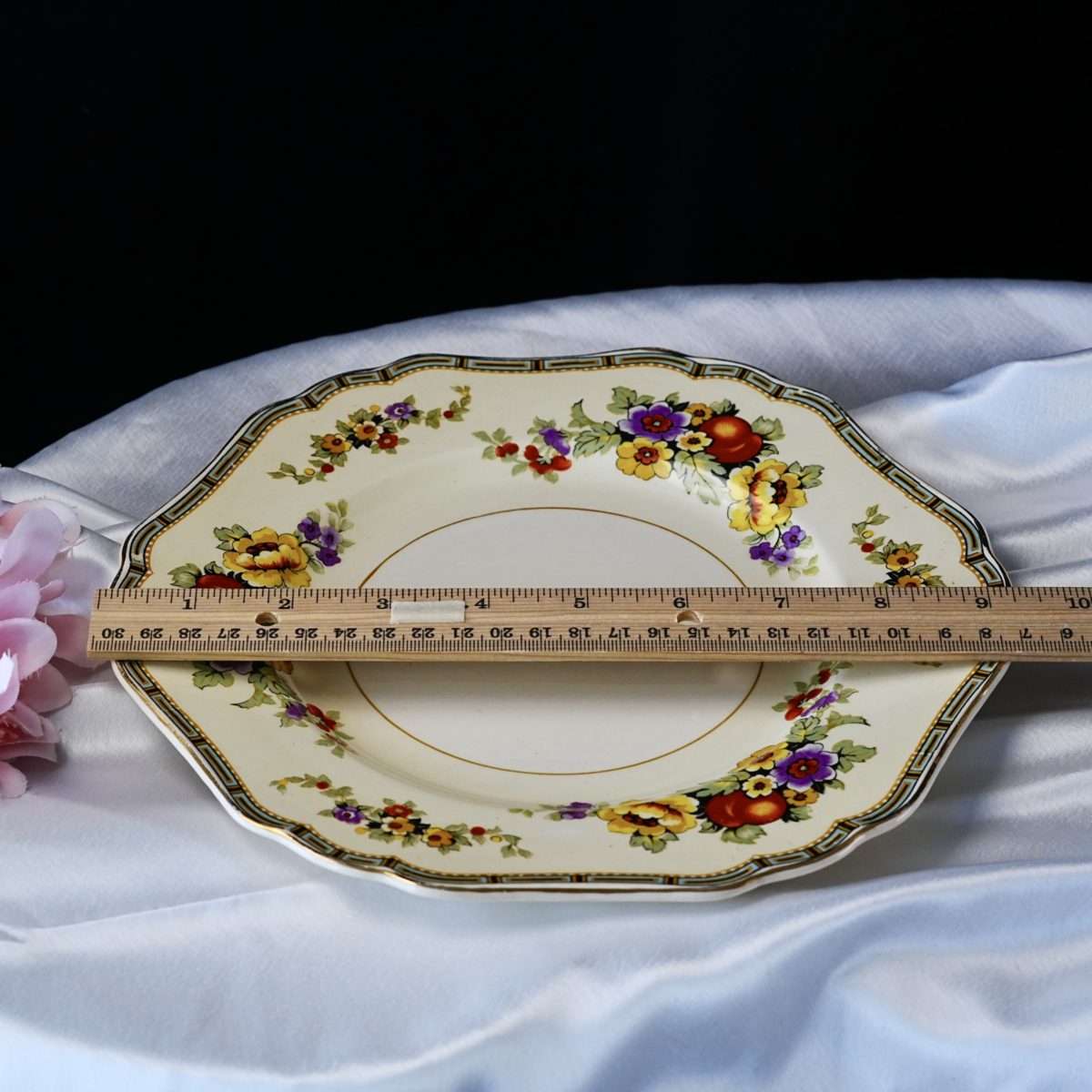
Vintage John Maddock & Sons Minerva Plate – Royal Ivory, Floral & Fruit Bouquets, Greek Key Border, Art Deco Square, England 1930s
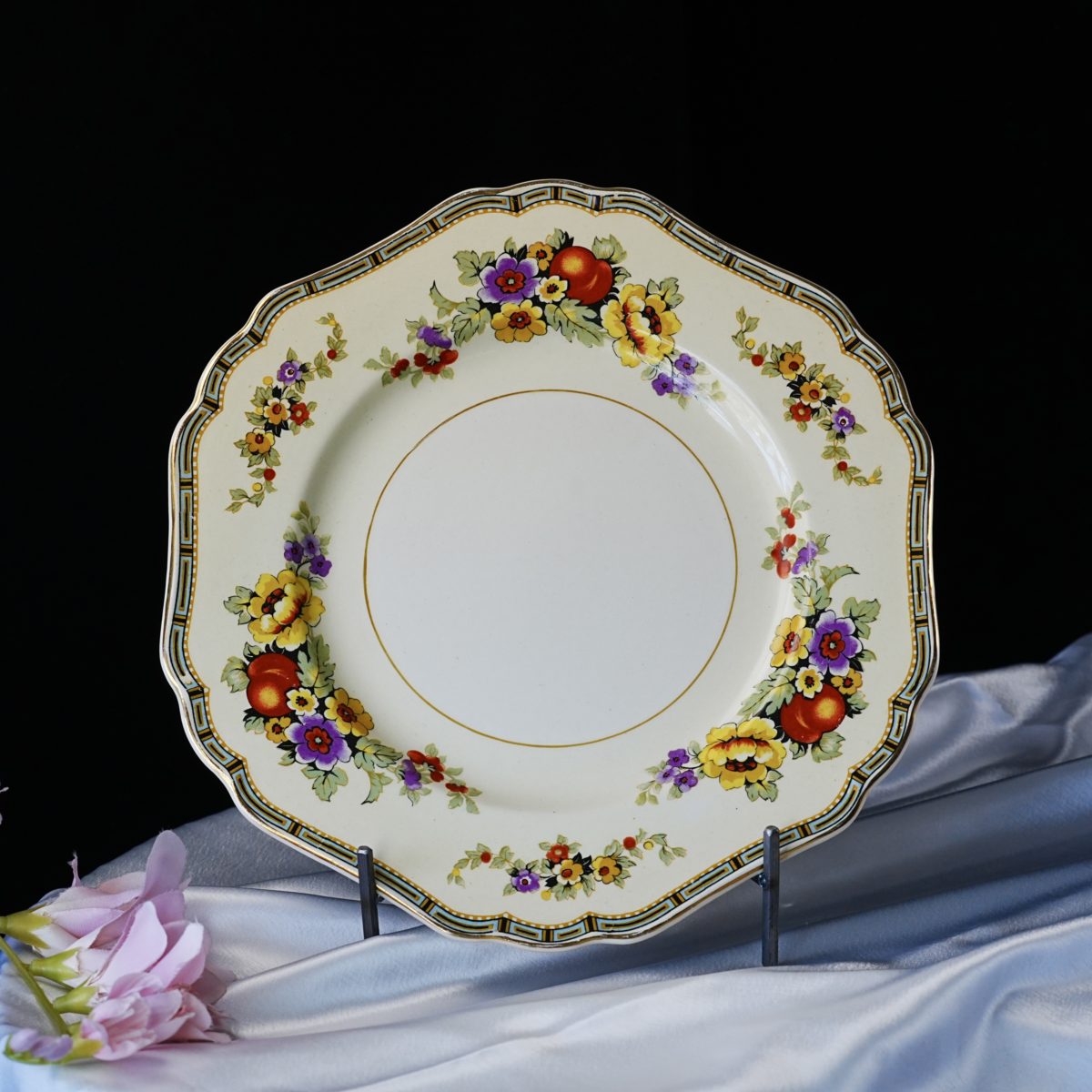
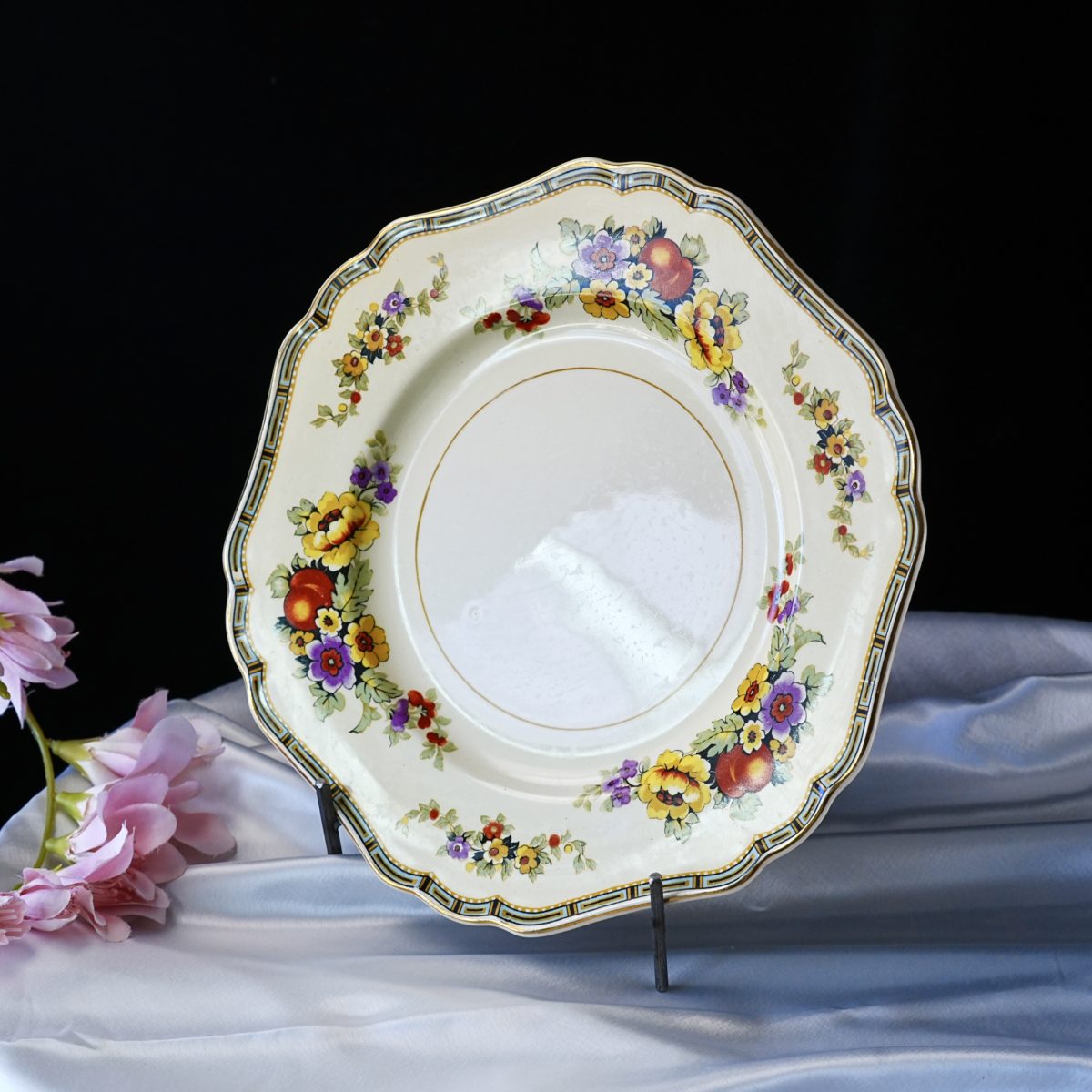
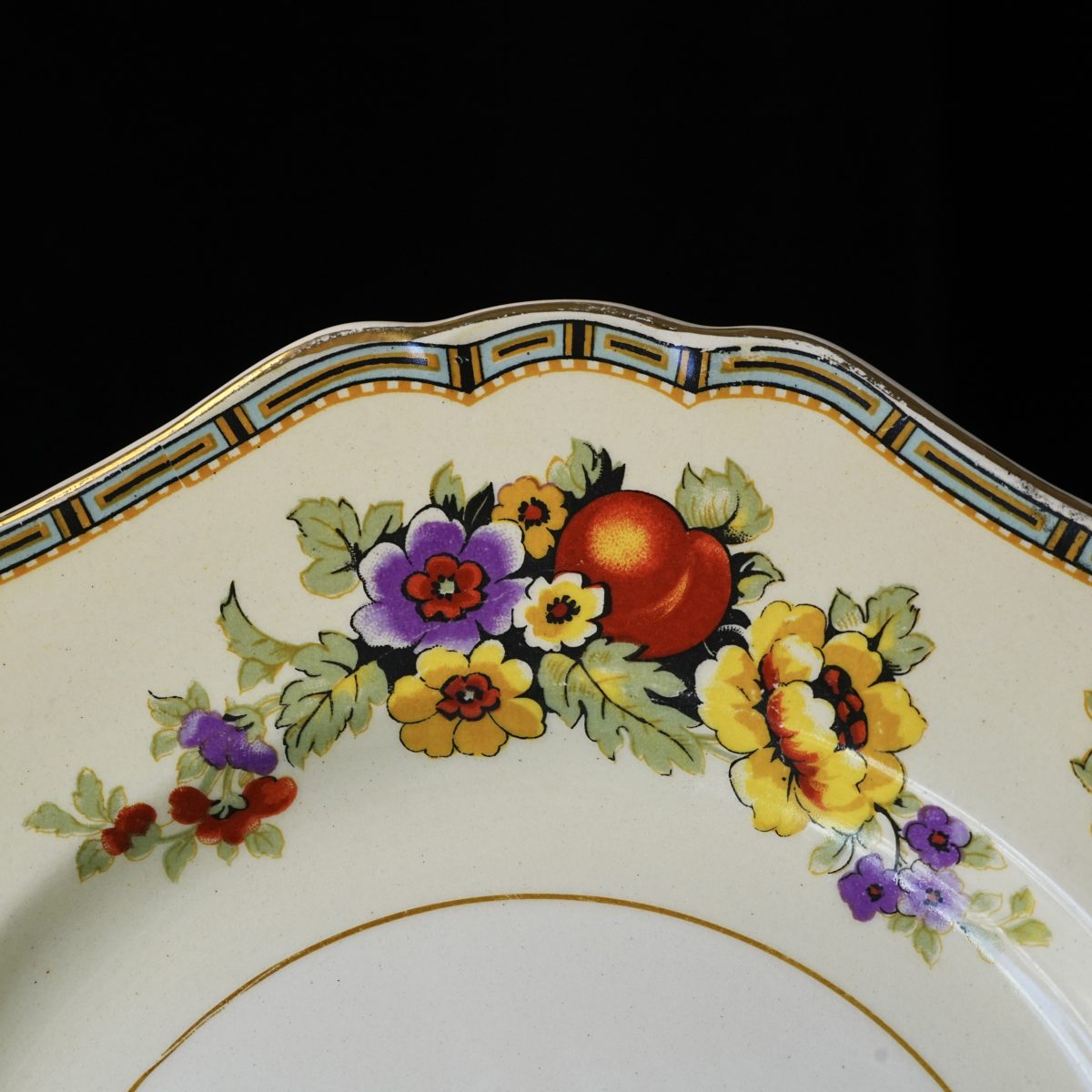
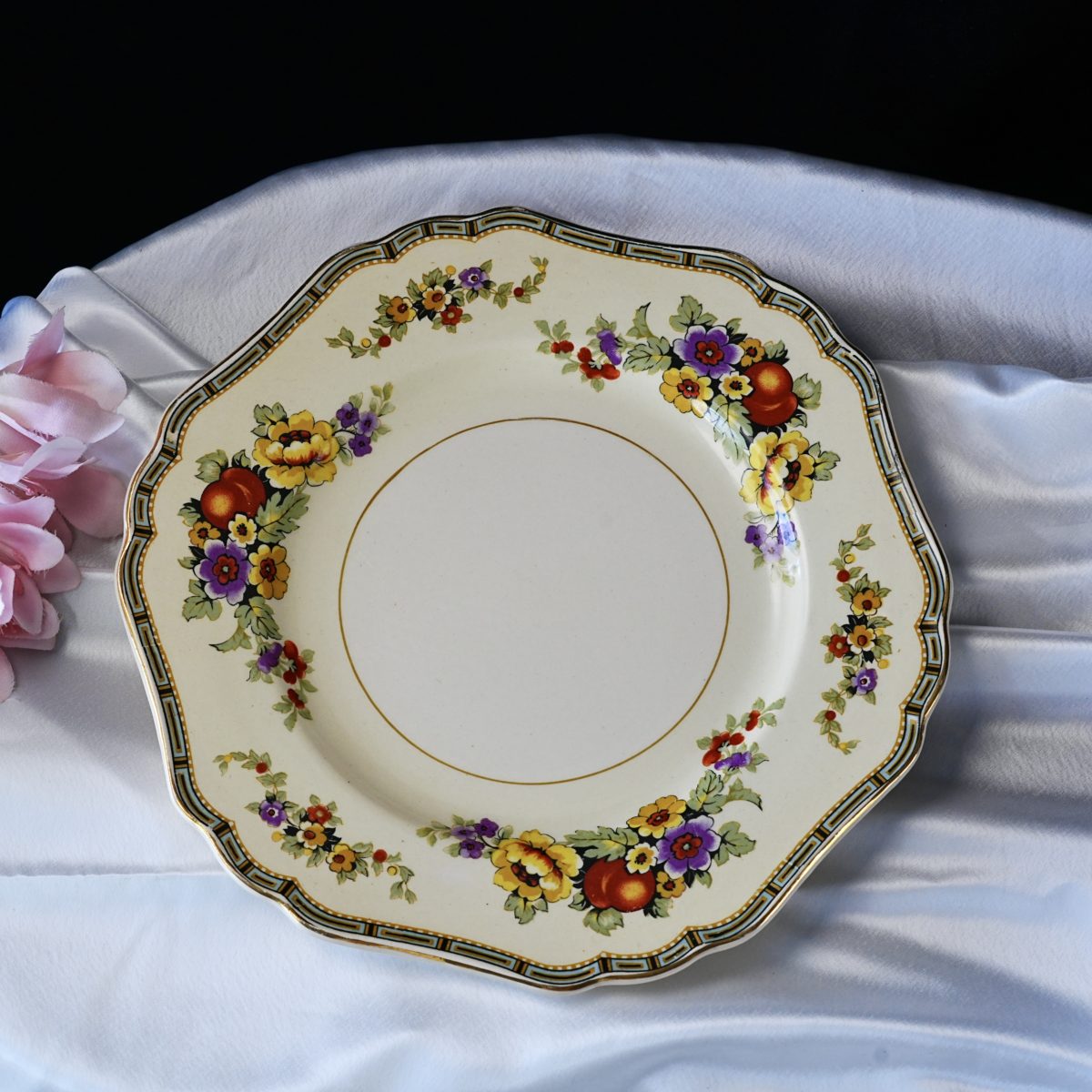
AvailableA ring of autumn-coloured bouquets — golden flowers, deep crimson fruit, purple blossoms, and sprays of red currants — circles an ivory ground, framed by a narrow band of black-and-gold Greek key that follows every curve of the scalloped edge. The centre is left clean, just warm cream inside a single gilt ring, letting the border do all the talking.
The plate is square with softened corners — each side scalloped into gentle waves rather than meeting at a hard angle. It is the Minerva shape (Regd 737954), an Art Deco silhouette that turns a serving plate into something closer to a tray or a frame. The ivory ground has the warm, faintly yellow tone that gives Maddock's Royal Ivory line its character.
John Maddock & Sons Ltd was founded in the 1830s at Burslem, Staffordshire — the oldest of the six pottery towns. John Maddock began with granite ware for the American market before shifting to fine tableware. His sons John Jr. and James took over in the 1870s, and by the early twentieth century the firm was producing its Royal Vitreous and Royal Ivory earthenware lines. The company won a gold medal at the 1904 St. Louis World's Fair. The Minerva pattern (No. 4150) belongs to Maddock's Royal Ivory earthenware range and dates from the late 1920s to 1930s. The factory closed in the mid-1960s.
Details
- Type
- Luncheon Plate
- Maker
- John Maddock & Sons Ltd
- Origin
- England (Burslem, Stoke-on-Trent, Staffordshire)
- Era
- Circa 1927–1930s
- Pattern
- Minerva (No. 4150)
- Shape
- Regd Shape 737954 (Art Deco scalloped square)
- Size
- Approx. 9" (23 cm) across
- Material
- Royal Ivory Earthenware (ivory-glazed)
- Decoration
- Multicolour transfer print with hand colouring — golden flowers, crimson fruit, purple blossoms, red currants, green foliage; black-and-gold Greek key border; gilt rim and centre ring
Backstamp & Pattern
- Maker
- John Maddock & Sons Ltd
- Pattern
- Minerva (No. 4150)
- Era
- Circa 1927–1930s
The base carries the maker's printed mark; the wording — especially “England” versus “Made in England” versus “Bone China” — together with any pattern or registration number are the main clues to its age.
Read the full backstamp & pattern guide →