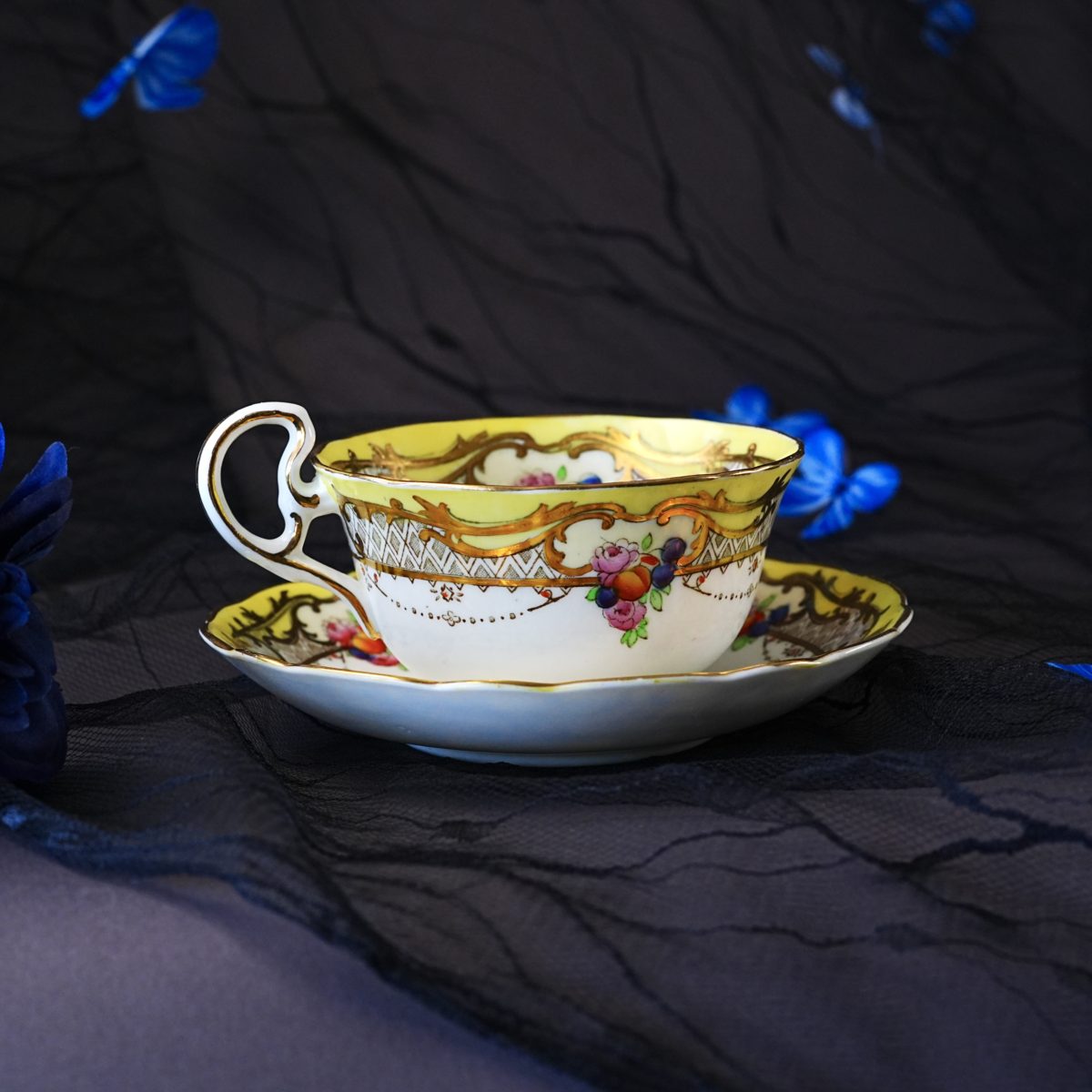
Antique Samuel Radford Fenton Yellow Gold Chintz Teacup & Saucer – Cartouche Florals, Rococo Scrollwork, 4699, Bone China, England 1930s
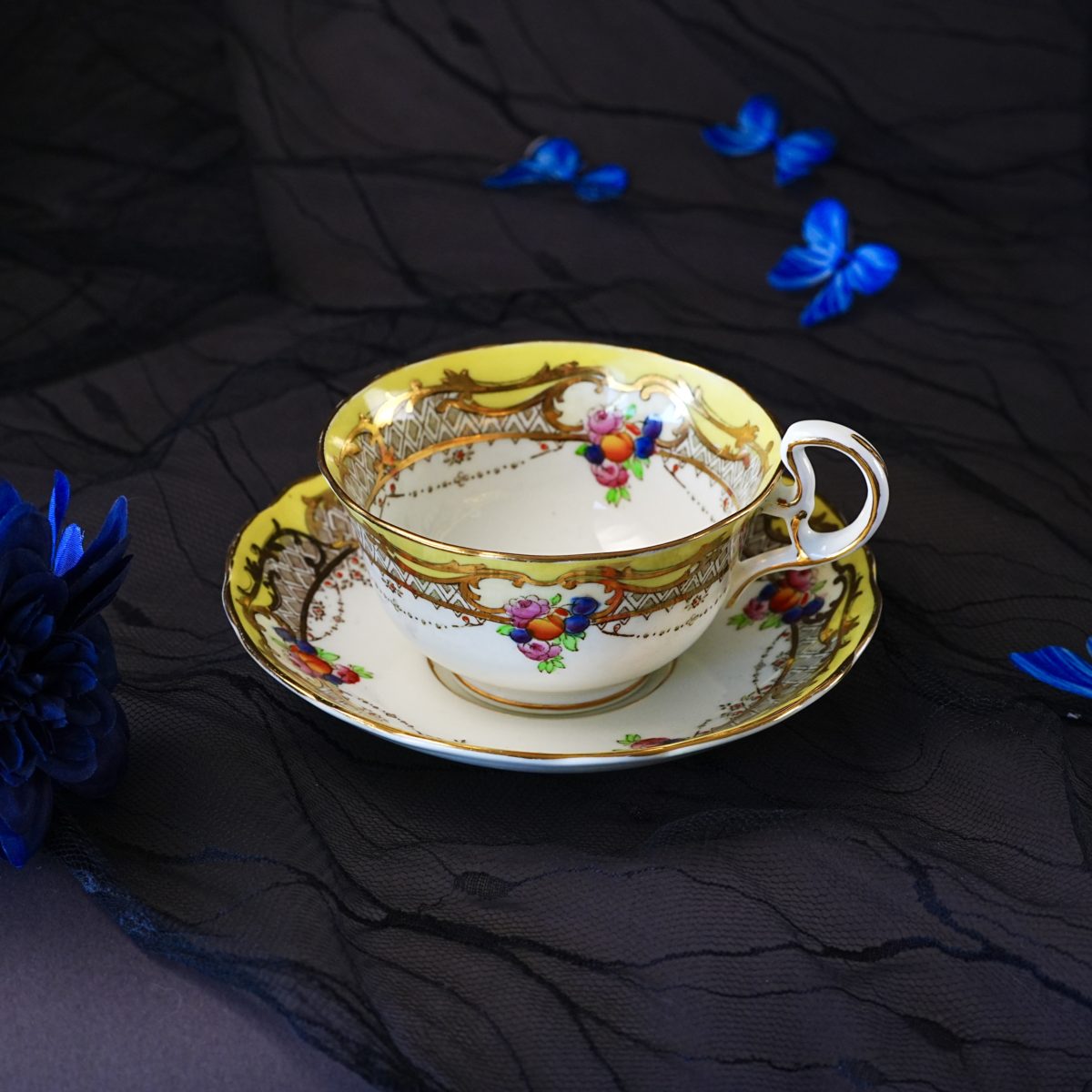
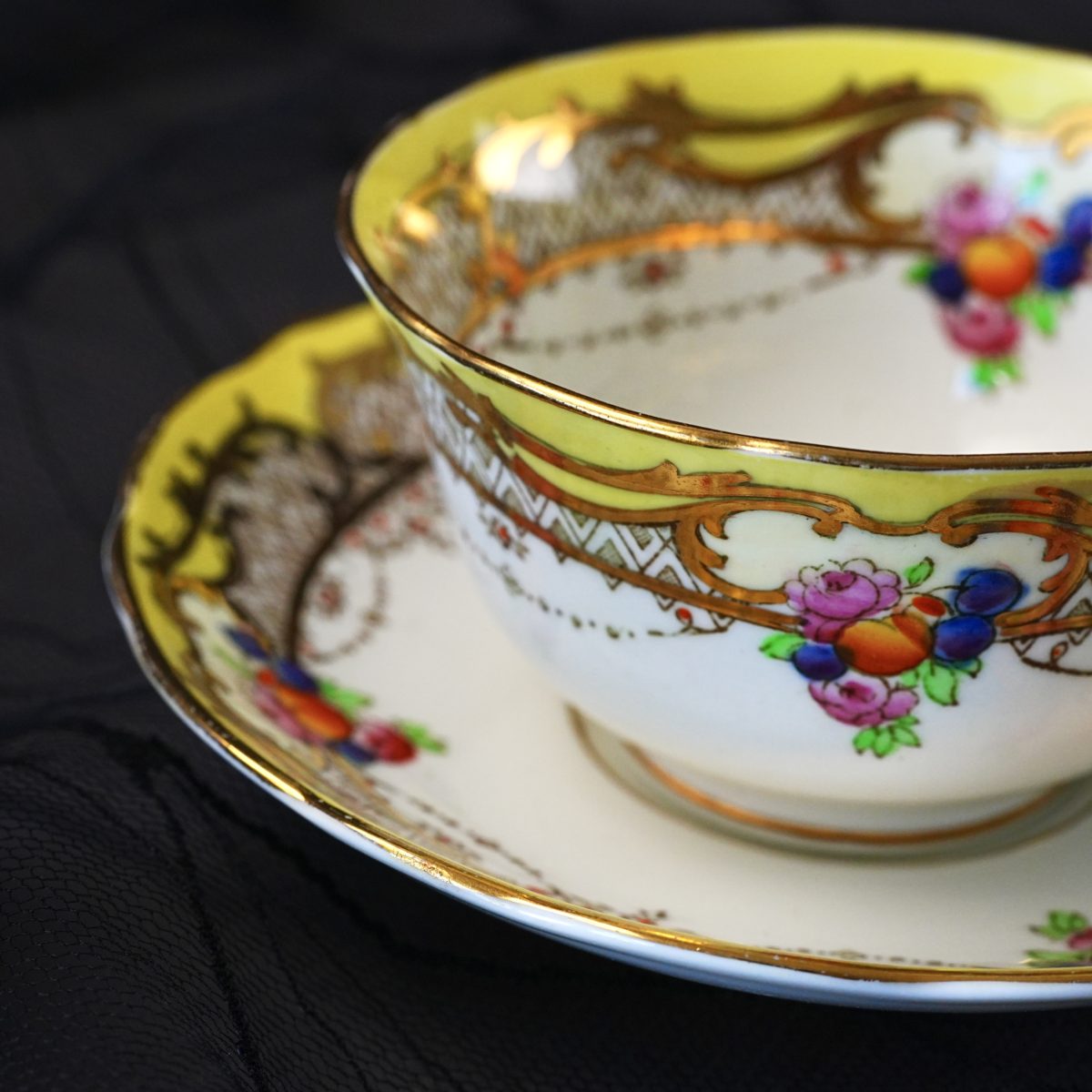
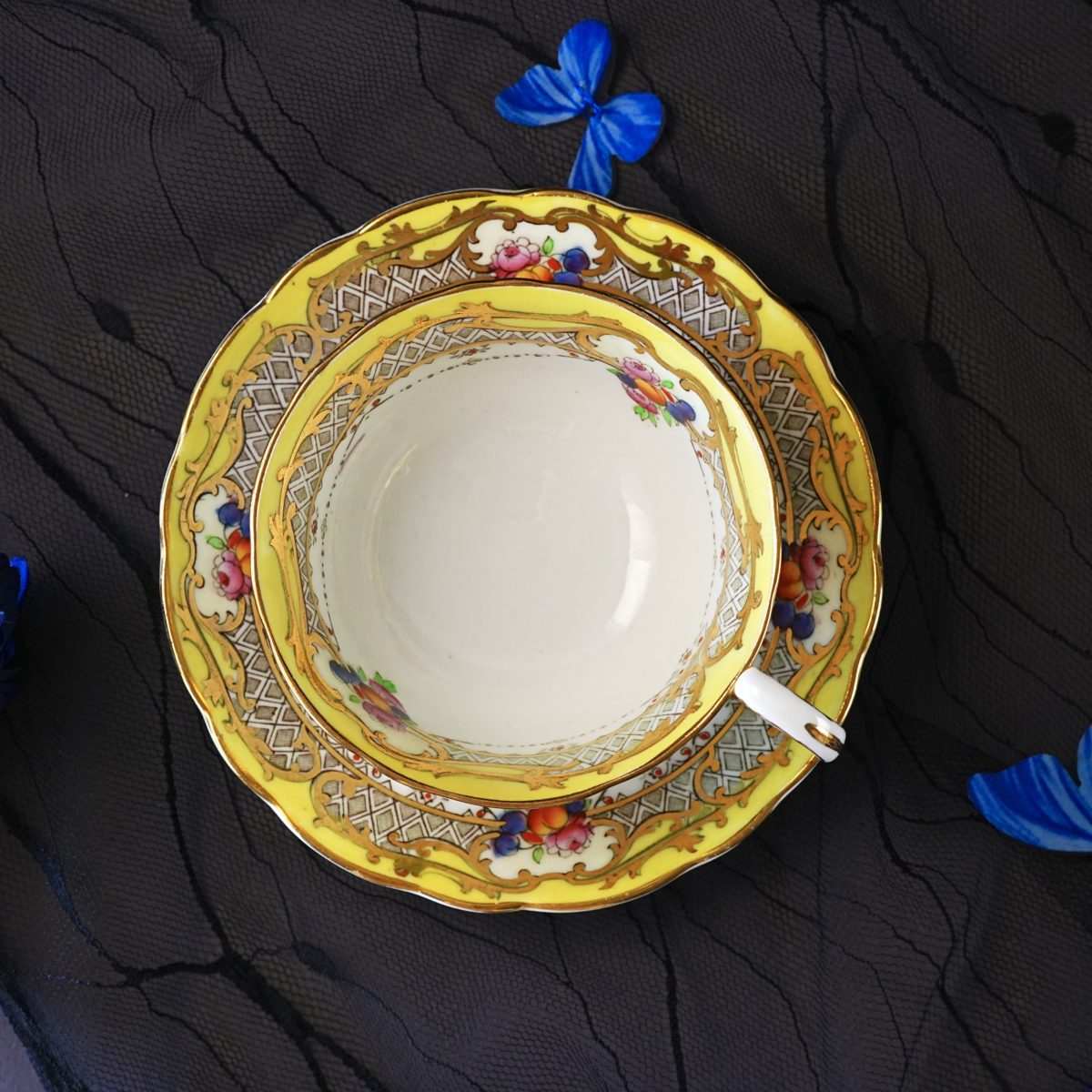
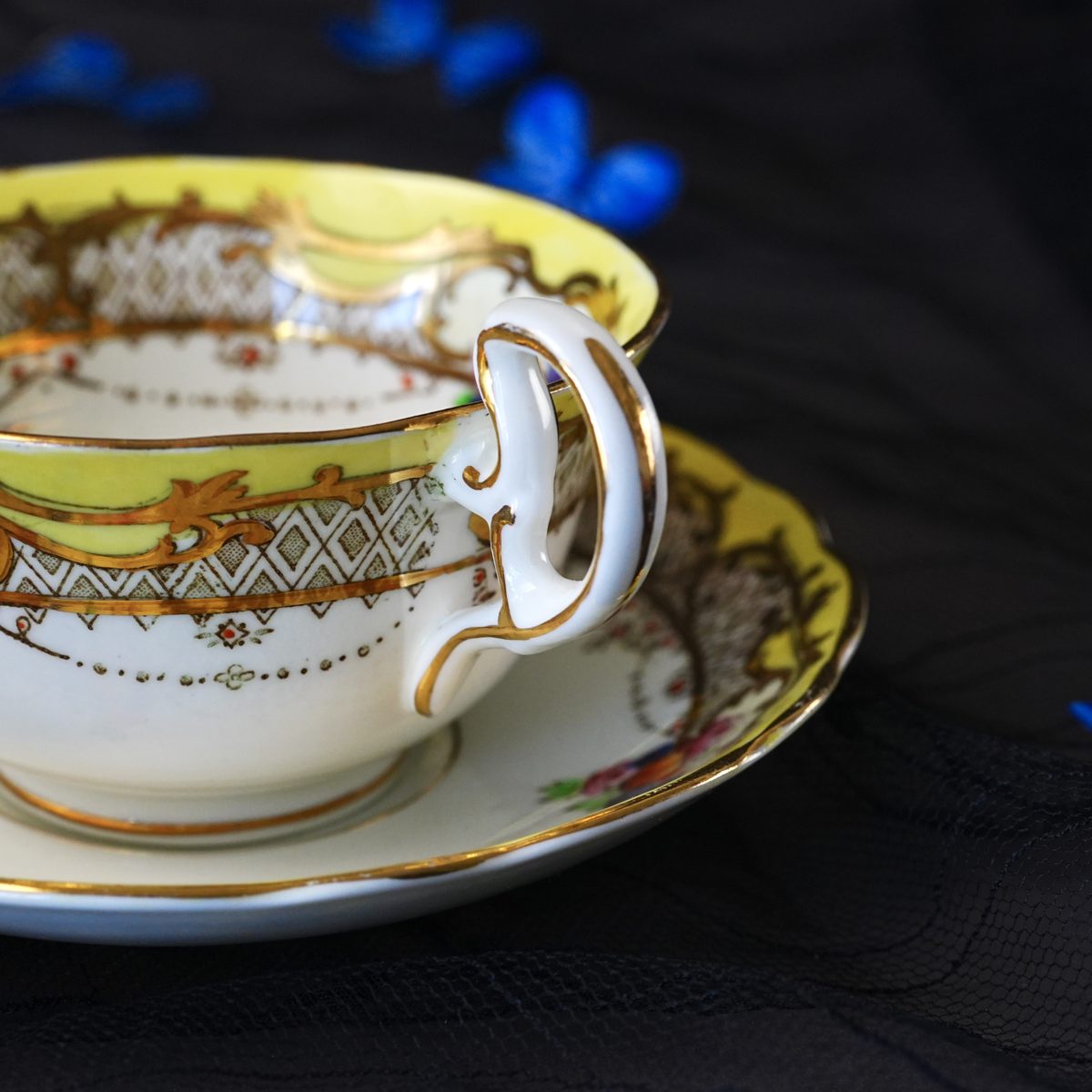
AvailableA teacup and saucer from Samuel Radford of Fenton, Staffordshire — the discontinued English bone-china workshop that ran from 1879 until the firm closed in 1957. The pattern is 4699, named DIAR in the firm's hand-inked register: a vibrant yellow rim band wrapped in gold Rococo scrollwork and a fine cross-hatched gilt diaper-lattice, broken at intervals by oval cartouches holding small chintz-style hand-tinted floral bouquets — pink garden roses, deep purple anemones, peach-orange fruit, blue wildflowers, soft green foliage. The white centres are left clean for the tea, the 22K gilt scalloped edge runs the rim, and the curved handle is fully gilded.
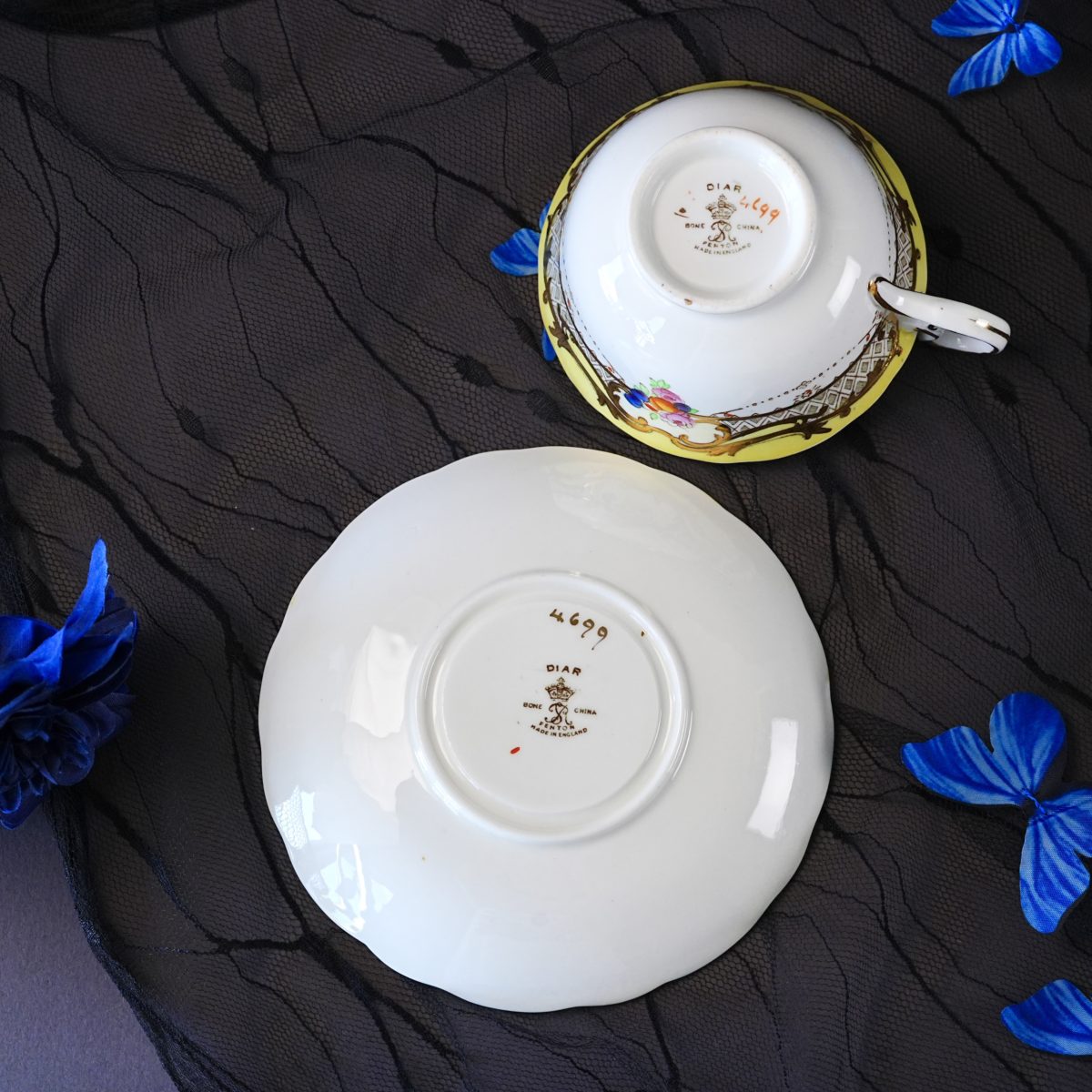
The base carries the firm's full mark in gold: the crown over the SR monogram, Bone China either side, Fenton below, and Made in England underneath. Hand-painted 4699 and DIAR sit above the maker mark; a small red oval decorator's quality mark sits beside the foot ring. The full hand-painted Samuel Radford backstamp + named pattern + decorator's mark is the marker of high-end cabinet ware rather than ordinary tea service.
Samuel Radford — S. Radford Ltd. — was a small but well-regarded bone-china workshop on High Street in Fenton, one of the Six Towns of Stoke-on-Trent (Fenton, Longton, Burslem, Hanley, Stoke, Tunstall). The firm competed in the inter-war years against Aynsley's Adam Brocade, Coalport's Batwing, and Mintons' Garland in the high-end cabinet chintz market — pieces meant for display and special-occasion tea rather than the everyday Royal Albert / Royal Doulton table. The workshop closed in 1957, which means every surviving Samuel Radford piece is finite supply — and the named 4699 DIAR pattern is one of the less-common patterns in the firm's chintz catalogue.
Three decorative techniques sit on this single piece: (1) a coloured underglaze ground (the yellow rim), (2) gilt printed pattern fired over it (the cross-hatched lattice and Rococo scrollwork), and (3) hand-tinted polychrome enamel work in the cartouches (the floral bouquets). Three-technique layered decoration is the marker of high-end cabinet bone china rather than everyday tea service.
A piece for the Samuel Radford collector chasing the closed-workshop output, for the Fenton / Stoke-on-Trent bone-china specialist, for the antique English chintz cabinet collector, for the Rococo-revival or Georgian-revival interior, or as a 90th-birthday / Mother's Day / anniversary gift to someone who collects the inter-war cabinet teaware era.
Details
- Type
- Teacup & Saucer Set (Antique)
- Maker
- Samuel Radford / S. Radford Ltd., High Street, Fenton, Stoke-on-Trent, Staffordshire, England
- Era
- Circa 1920s–1940s (workshop active 1879–1957; closed)
- Pattern Number
- 4699 (hand-inked in gold on base)
- Pattern Name
- DIAR (hand-inked in gold on base)
- Shape
- Wide-rim cup with curved D-handle, scalloped saucer
- Size
- Cup ~3.5" / 9 cm rim dia × 2.5" / 6.5 cm tall; Saucer ~5.5" / 14 cm dia
- Material
- Fine Bone China
- Decoration
- Three layered techniques — (1) vibrant yellow underglaze rim band, (2) gilt cross-hatched diaper lattice + Rococo scrollwork, (3) hand-tinted polychrome chintz floral cartouches (roses, anemones, fruit, wildflowers); 22K gilt scalloped edge and fully gilded handle
- Markings
- Gold crown over interlinked SR monogram + Bone China / Fenton / Made in England + hand-inked gold 4699 and DIAR + small red decorator's oval mark on base of both pieces
Backstamp & Pattern
- Maker
- Samuel Radford / S. Radford Ltd., High Street, Fenton, Stoke-on-Trent, Staffordshire, England
- Era
- Circa 1920s–1940s (workshop active 1879–1957; closed)
- Mark on base
- Gold crown over interlinked SR monogram + Bone China / Fenton / Made in England + hand-inked gold 4699 and DIAR + small red decorator's oval mark on base of both pieces
The base carries the maker's printed mark; the wording — especially “England” versus “Made in England” versus “Bone China” — together with any pattern or registration number are the main clues to its age.
Read the full backstamp & pattern guide →