Fancy Birds: A Painted Aviary in Gold and Enamel
Turn over almost any old teacup decorated with a bird and try to name the species, and you will often find you cannot. The tail is too long, the crest belongs to another continent, the colours were never issued by nature. This is not a mistake. It is a whole tradition — and it has a name. In the trade we call them fancy birds.
A fancy bird is not a portrait. It is an invention: a creature assembled from the memory of parrots and pheasants and finches, given a perch on a flowering branch and a sky it will never fly through. For the best part of three centuries, painting these birds was one of the highest and best-paid skills in a porcelain factory. Some of the finest hands in the business spent their whole working lives doing almost nothing else. This is the story of where those birds came from, and why they still make us stop and look.
A genre, not a species
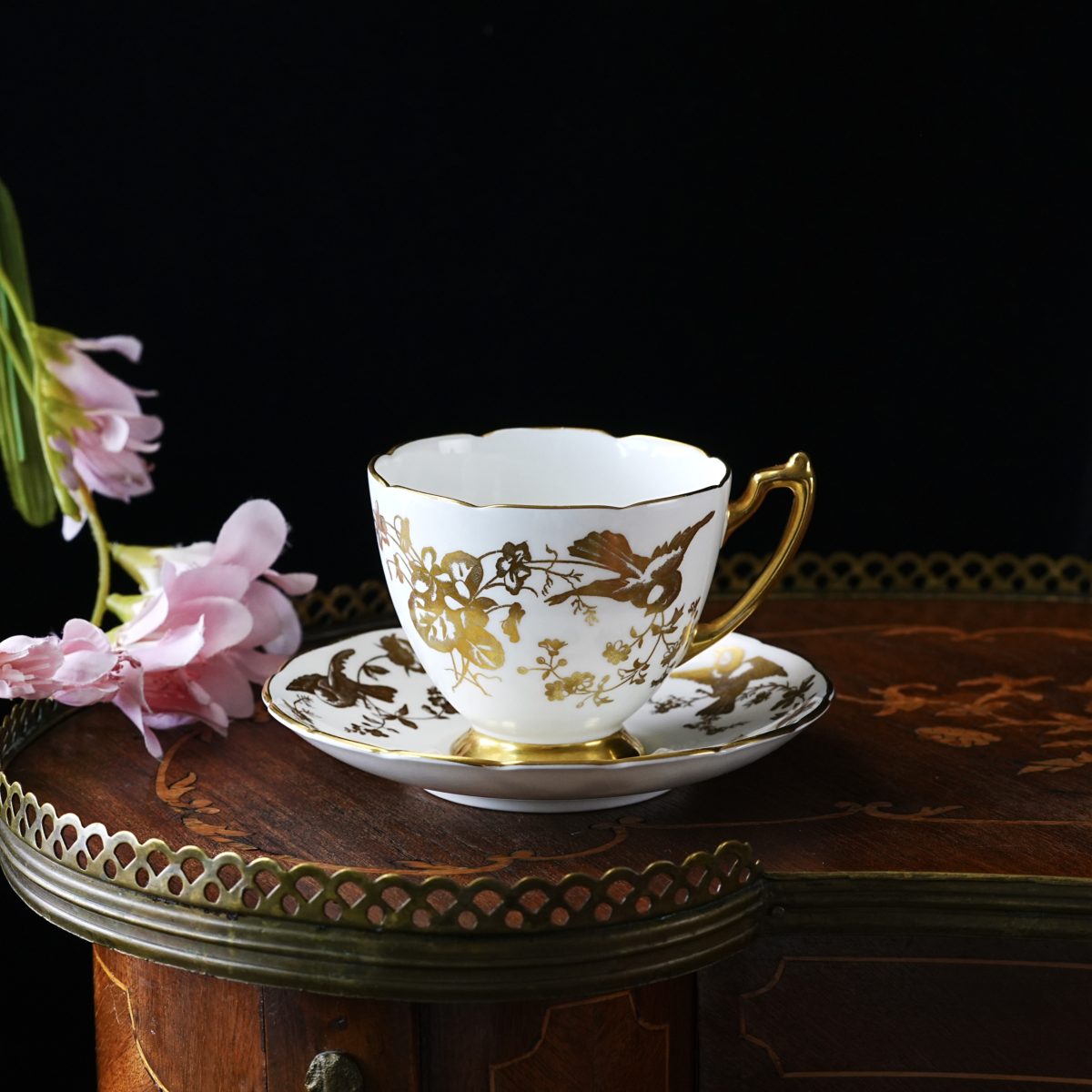
The fancy bird arrived in Europe the same way tea and blue-and-white did — by ship, from the East. Chinese export porcelain had long placed birds on branches among peonies and insects, less as ornithology than as symbols of good fortune and long life. When European factories began to find their own footing in the eighteenth century, they borrowed the grammar wholesale: a bird, a branch, a scatter of butterflies and moths. Even the insects on early English “bird” patterns were lifted straight from Chinese export models.
What Europe added was theatre. At Meissen, at Sèvres, and soon in the English factories, painters began to invent birds that were grander, brighter and stranger than anything in a hedge — the French called them oiseaux fantastiques, fantastic birds. They perched in gilded cartouches, framed by rococo scrollwork, glowing against deep cobalt or apple-green grounds. The point was never that a naturalist could identify them. The point was that no one could.
The paradox of the painted bird
Here is the curious part. The age that painted the most fantastical birds was also the great age of bird science, and the painters knew it. The second half of the eighteenth century saw a flood of magnificent illustrated bird books, and porcelain factories kept them on the shelf as pattern sources. The London naturalist George Edwards published his Natural History of Uncommon Birds between 1743 and 1751, following it with the Gleanings of Natural History — together more than three hundred hand-coloured plates of parrots, cockatoos, toucans and macaws from the far corners of the trading world. In France, the Comte de Buffon's monumental Histoire naturelle des oiseaux gave Sèvres a whole genre: the celebrated “Buffon” services, the first made for the Comte d'Artois in 1782, their plates each carrying a named, catalogued bird.
And yet, given accurate models, the painters chose to be inaccurate. The birds on Sèvres are rendered in colours “more decorative than accurate” — pastel doves, sweet unlikely parrots, plumage tuned to the palette of the service rather than the species. The exotic bird was a real bird half-remembered and then improved: enough truth to feel alive, enough fantasy to belong to the porcelain and not to the world. That tension — science pulling one way, ornament the other — is exactly what gives a good fancy bird its charm.
A fancy bird is a real bird half-remembered, then improved: enough truth to feel alive, enough fantasy to belong to the porcelain and not to the world.
Coalport, and the man who painted birds for fifty years
No English factory carried the fancy bird further, or longer, than Coalport. Founded on the banks of the Severn in Shropshire by John Rose around 1795, Coalport grew by swallowing its rivals — Rose bought the neighbouring Caughley works, then absorbed the celebrated Welsh factories of Nantgarw and Swansea, moving their painters and their secrets across the country to his own kilns. The result was porcelain of exceptional whiteness and painters of exceptional skill, and among the things they painted best were birds.
Early Coalport bird wares can be dazzling. One pattern, known simply by its number, 759, is prized for a small piece of quiet ambition: on a full service, every bird is different — each one a distinct species, each flower its own, none repeated. The great freelance painter Thomas Baxter decorated Coalport porcelain around 1805; a generation later the factory's grounds of cobalt, rose-pink and its own “Sardinian” green became stages for exotic birds set in reserves and framed in raised, tooled gold.
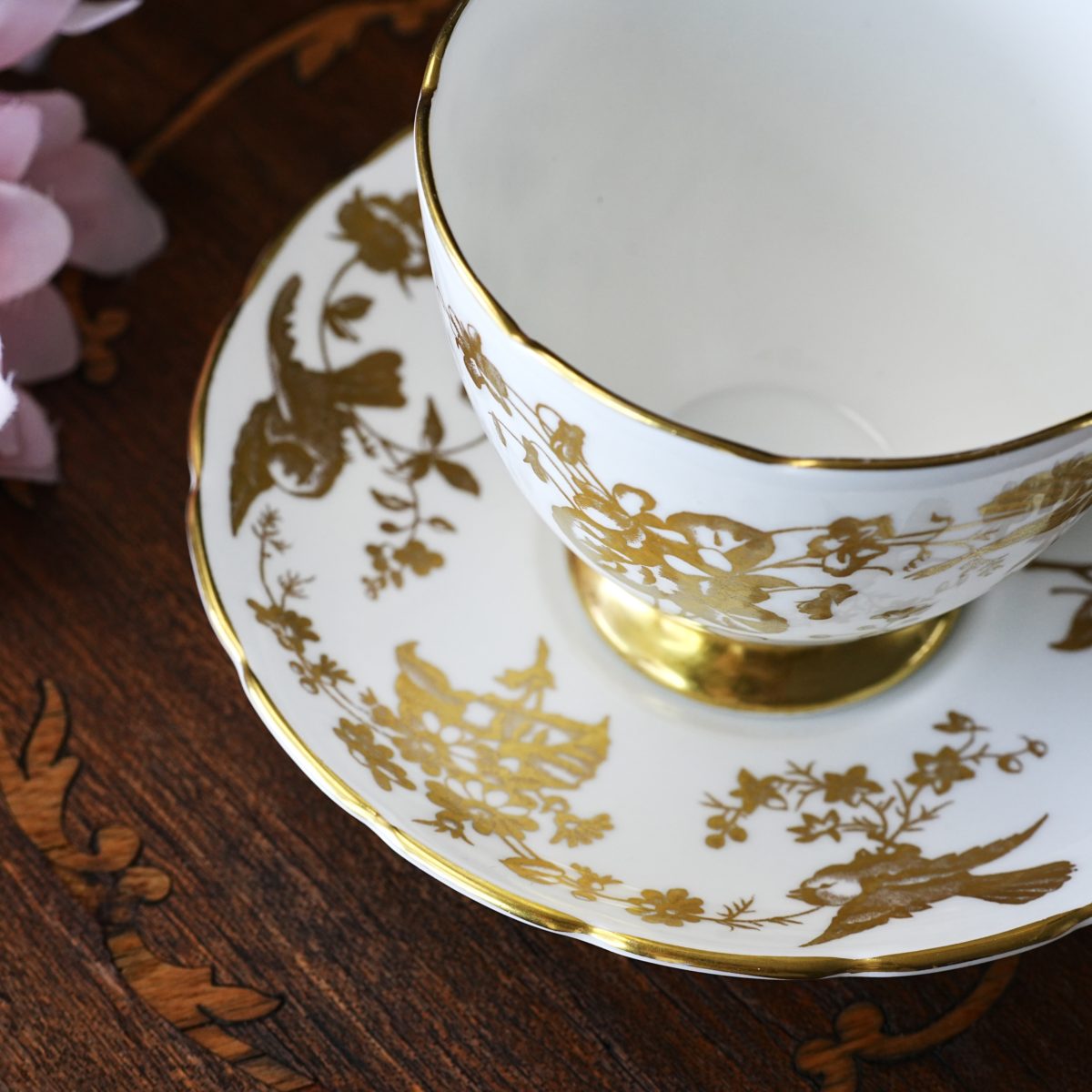
But the name most worth remembering is John Randall. Born in 1810, he trained young in his uncle's decorating shop, where imported French porcelain was painted up in the Sèvres taste for the English market — so he learned exotic birds, in effect, from the source. He then spent close to half a century at Coalport as its finest bird painter, laying brilliant plumage into gilded reserves through the whole high-Victorian heyday of the factory. And he was no narrow craftsman: Randall was an amateur geologist and historian who wrote books on the Severn Gorge, and when at last his eyesight failed him he laid down the brush and became the village postmaster. He died in 1910, reportedly sharp and witty to the end, at very nearly a hundred years old. Half a century of hand-painted birds, from one pair of eyes — and when those eyes gave out, so did the birds.
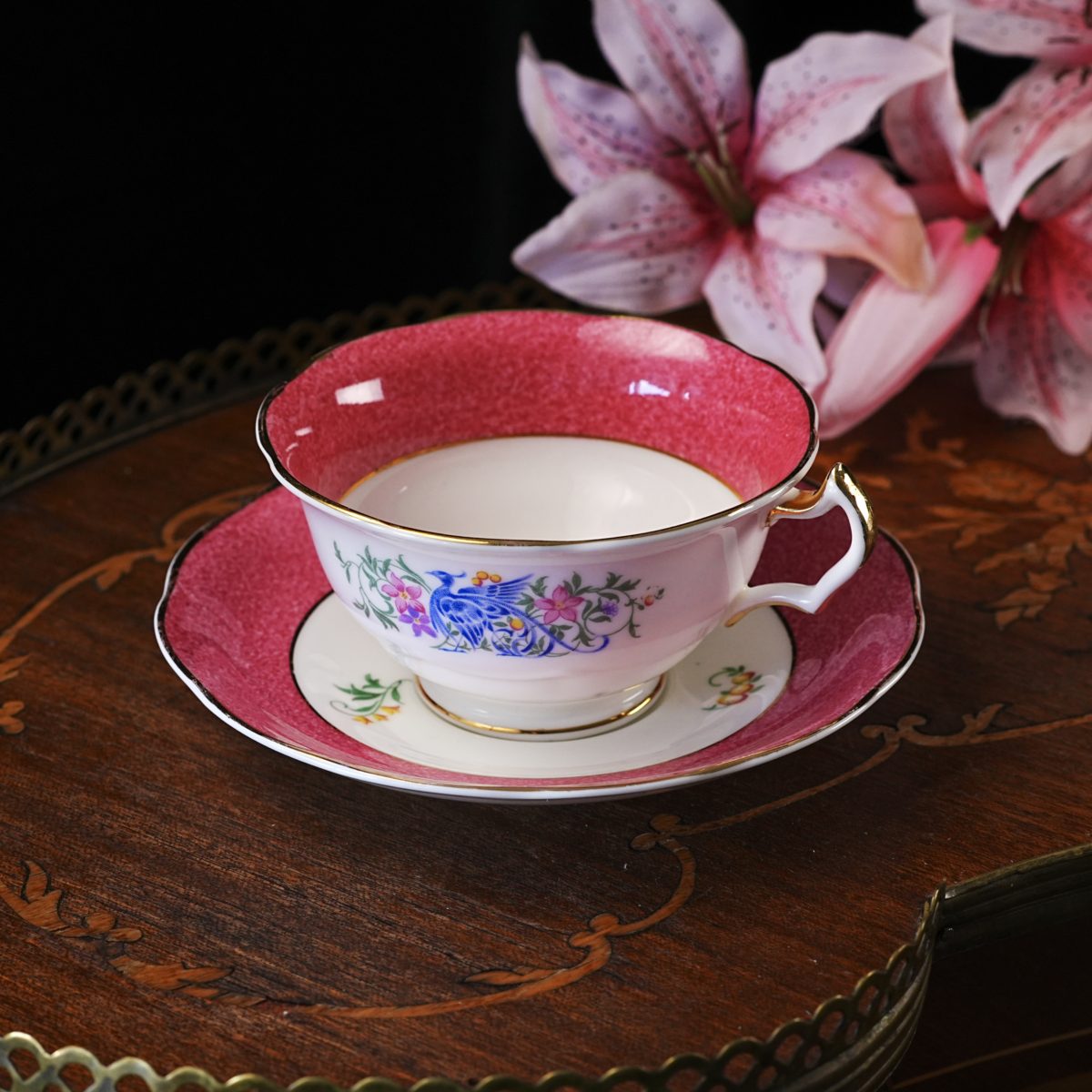
The fancy bird did not retire with Randall's generation, though. Coalport went on painting birds well into the twentieth century, and one of its later patterns — Broadway — carries perhaps the best fancy-bird story of all on its cup wall: a bird of paradise, that long-tailed emblem of the unreachable. The bird owes its entire myth to a mistake. When the first specimens reached Europe in the sixteenth century, aboard the ships that survived Magellan's voyage, the hunters who prepared the skins had cut off the feet. Europeans, holding a dazzling, footless bird, drew the only romantic conclusion available: that it never landed at all — that it lived its whole life aloft, feeding on dew, sleeping on the wind, somewhere near heaven. Science believed it too. In 1758 Linnaeus gave the greater species its formal name, Paradisaea apoda — the “footless bird of paradise.” Two hundred years later the creature is still with us, perched on a Coalport teacup among blossoms that grow in no earthly garden: the fancy bird, and its imagined paradise, painted one last time.
The same birds, a dozen factories
Once you have the eye for it, you see fancy birds everywhere in English and Continental china, migrating from maker to maker. Chelsea gave its name to a pattern — the “Chelsea Bird” — of colourful, fanciful birds in gilt-edged cartouches on a cobalt ground, sometimes shown squabbling, the small reserves filled with those borrowed Chinese insects. First-period Worcester, in the Dr Wall years around 1770, painted “fancy birds” in bright roundels hung with gilt swags against bands of deep mazarin blue — so admired that the Paris firm of Samson built a business copying them a century later. Derby had its own exotic-bird painters; and into the twentieth century the theme simply changed its clothes, reappearing as printed patterns with names like Royal Cauldon's “Exotic Birds.” The bird outlived every fashion around it.
What shifted, slowly, was the taste for truth. By the turn of the twentieth century, under the spell of Japanese art and a new appetite for nature observed rather than invented, some of the loveliest bird china went the other way entirely — toward the portrait.
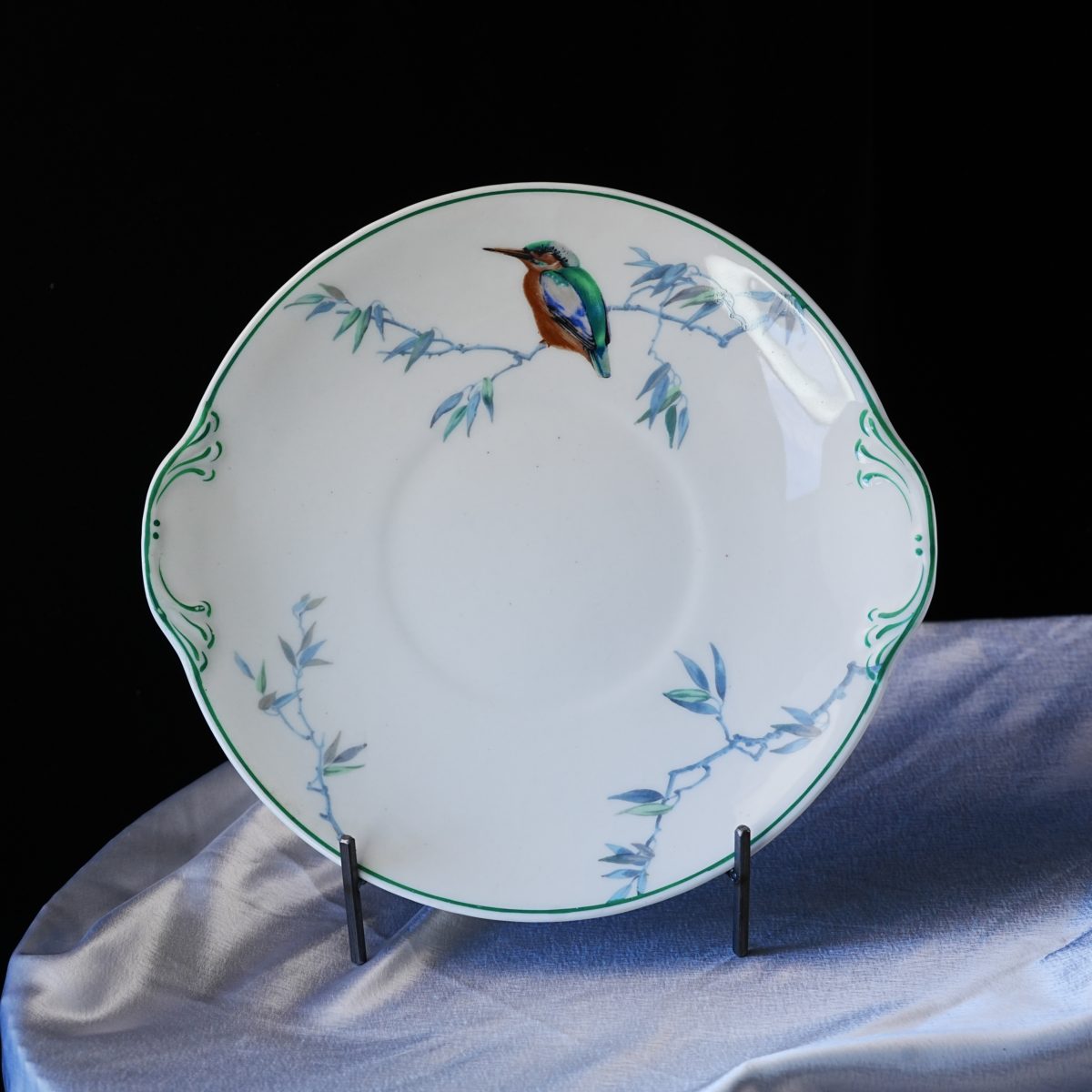
Set this kingfisher beside the gilded Coalport songbirds and you can see the whole argument of two centuries in two objects. One bird is a real creature, studied and loved; the other is a beautiful fiction. Both are “bird china,” and a good collection has room for both.
How to read a bird piece
A few habits will tell you a great deal about a bird on porcelain, and roughly when and how it was made:
- Is every bird different? On genuine hand-painted work — the Coalport tradition at its best — birds and flowers vary from piece to piece and even around a single rim. Identical, perfectly repeated birds usually mean a printed transfer, later and more affordable.
- Hand-paint versus transfer. Look for slight ridges of enamel you can feel with a fingertip, tiny irregularities in the outline, brushstrokes that overrun. A printed bird sits flat and dead-even under the glaze, its outline a fine engraved line.
- Fancy or faithful. Ask whether you could name the bird. A nameable, correctly coloured bird points to the later naturalist taste; a gorgeous impossibility points to the older exotic tradition.
- The ground and the gold. Deep cobalt, rose or green grounds with birds in tooled-gold reserves are the language of the grand nineteenth-century services; flat gilt silhouettes on plain white tend to be twentieth-century patterns quoting the old idea.
- Then turn it over. The base carries the maker and, often, a pattern number that pins the decoration exactly. How to read those marks is a subject of its own — see our Backstamp & Pattern Guide, including the Coalport entry.
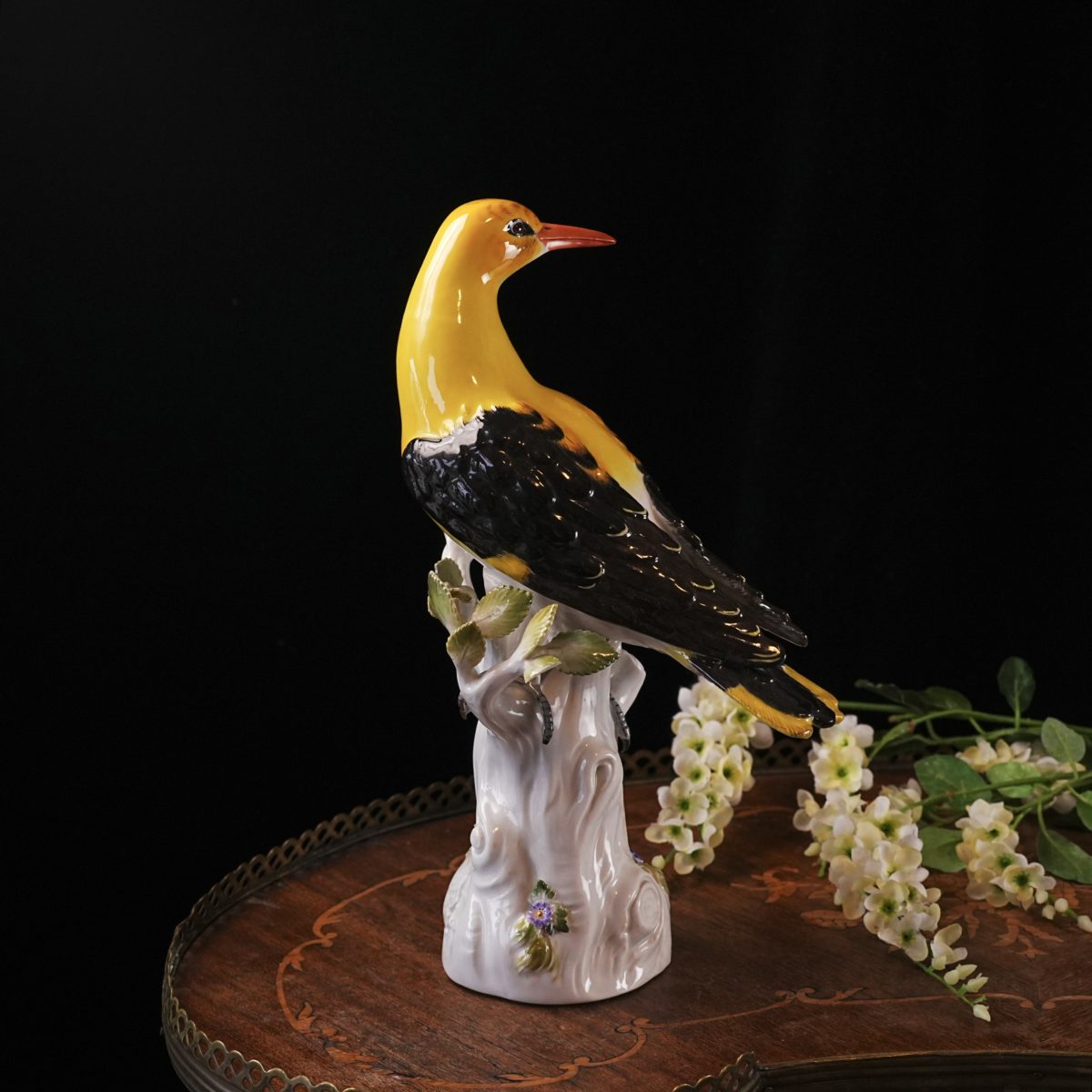
There is one last fancy bird worth meeting — not painted flat on a plate but modelled fully in the round. Meissen's golden oriole, first sculpted in the 1730s for a king's porcelain menagerie, is the exotic bird set free from the cartouche and made to stand on its own three-dimensional branch. Its story is told here.
The birds in this piece — the gilded Coalport songbirds, the Doulton kingfisher, the Meissen oriole — are all in the shop now. Come and find your own fancy bird.
Browse the collection Shop on Etsy ↗Sources: the fancy-birds and Chelsea/Worcester tradition, and the borrowing of insects and birds from Chinese export porcelain, drawn from dealer and museum descriptions of eighteenth-century English porcelain via Mirabelle Antiques and 1stDibs; George Edwards, Buffon and the Sèvres “Buffon” services, and birds rendered “more decorative than accurate,” from the Toledo Museum of Art and Wikipedia; Coalport's founding, its absorption of Caughley, Nantgarw and Swansea, and pattern 759 from Wikipedia; John Randall's biography from surviving accounts of the Coalport bird painters via Gentle Rattle of China; Royal Cauldon's “Exotic Birds” pattern from Figurines-Sculpture. Patterns and dates on the shop's own pieces recorded from the objects themselves.