A Coat of Arms in Your Pocket
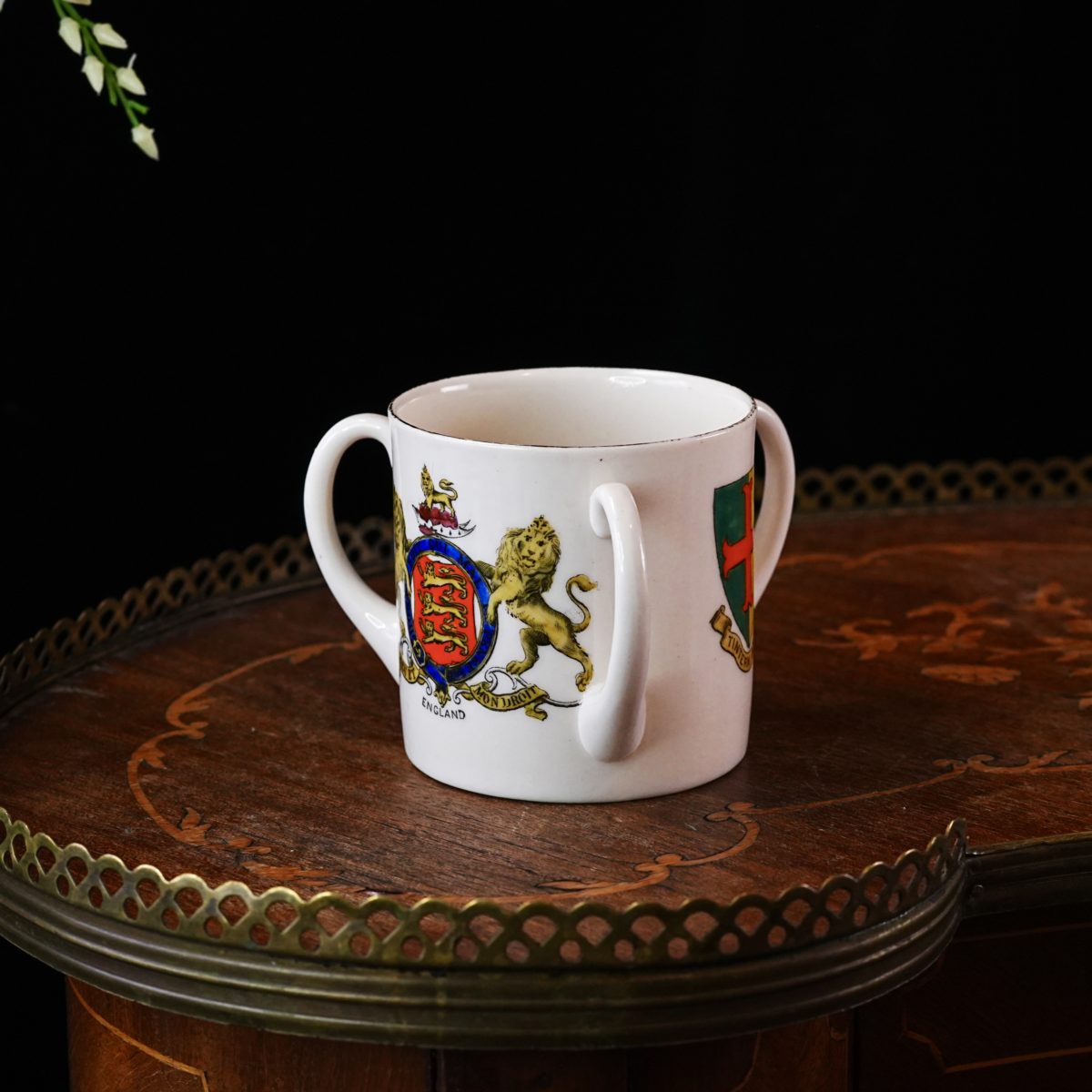
The smallest cup in the shop at the moment has three handles and four coats of arms. It stands about as tall as a hen's egg, in a white porcelain so fine it glows, and around its little body march the Royal Arms of England, the arms of Queen Victoria, and — between them, quite unembarrassed by the company — the shield of Tintern Abbey, a ruined monastery on the Welsh border. A fair question to ask of such an object is what all these emblems are doing together on one cup the size of an egg. The answer is a whole vanished industry.
The bird on the base
Turn any of these little pieces over and you meet the same bird: a goshawk, wings raised, above the words W.H. GOSS. William Henry Goss was London-born, trained at Somerset House, and served as chief designer at the great Copeland works before setting up on his own in Stoke-on-Trent in 1858, at twenty-five. From 1870 his factory was the Falcon Works, and for its first decades it chased a serious reputation — parian figures, ivory-toned porcelain, even “jewelled” ware with cut stones set into recesses in the clay before firing. Nothing about the early years suggests a souvenir empire. That idea belonged to the next generation.
The son's idea
In the early 1880s William's son Adolphus began travelling the country with a proposition. The railways had just invented the British seaside holiday, and Adolphus saw what a holidaymaker with a shilling in her pocket wanted: something small, pretty, and provably from there. The firm began producing miniature white porcelain models decorated with the civic arms of towns and resorts, and Adolphus built the machine that sold them — one agent in each town, granted the exclusive right to sell Goss ware in that locality. By 1900 there were roughly 480 of these agencies; a decade later, more than a thousand. As collectors tell it, the etiquette of the thing was half the charm: the arms on the piece were meant to be the arms of the place where you stood when you bought it, so a shelf of crests at home read as an honest travel diary. You could not, respectably, buy Brighton in Blackpool.
What I find most touching about the system is the shapes themselves, because Goss did not simply invent pretty forms. A large share of the firm's six-hundred-odd models were scale copies of real objects — Roman urns, ancient jugs, curiosities dug up or dredged up somewhere in Britain, each one traceable to the museum that kept the original. The factory printed the provenance right on the porcelain, like a tiny catalogue card.
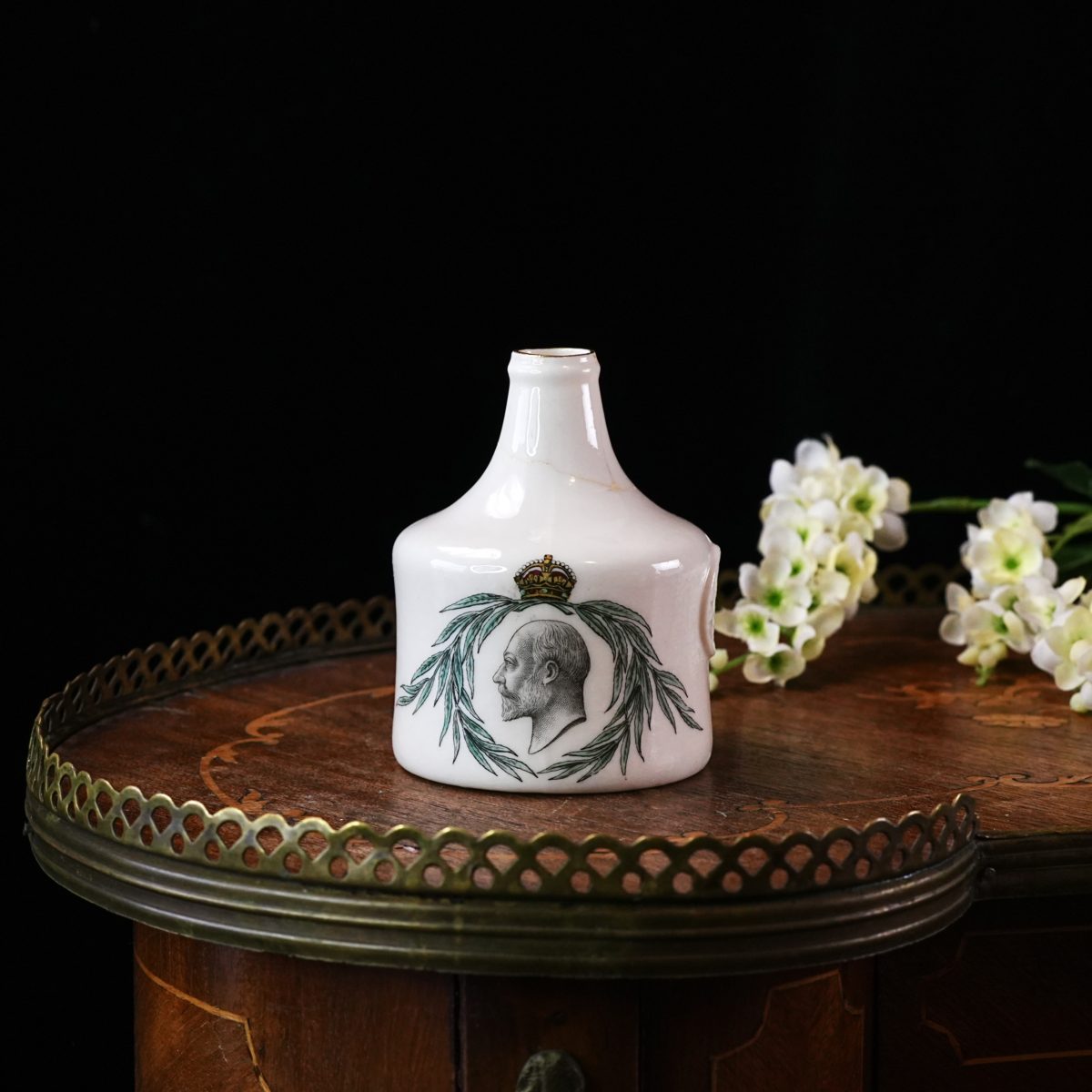
Our own example carries that idea twice over. The form is Goss's copy of a wine bottle fished out of the River Dart in Devon, its original still in Exeter's museum, down to the raised seal reading H.Z. Holdsworth, Dartmouth, 1735. And onto this borrowed shape the factory added a second layer of history: a laurel-wreathed portrait of Edward VII and, in Gothic letters, Edward the Peacemaker, with the dates of his birth, accession and death in May 1910. One object no bigger than a plum, holding a Devon river, a Georgian wine merchant, and the mourning of a king. I confess this is the piece I pick up most often when the shop is quiet.
The craze
How big did it get? The Goss Collectors' Club's own histories claim that by 1910 some ninety-five per cent of British homes owned a piece of crested china — a figure I pass on with a raised eyebrow, though every estate I visit here in Ottawa with English roots does seem to yield a crested something. A League of Goss Collectors was founded in 1906, growing into an International League after 1918 — one of the earliest brand collectors' clubs anywhere. Success bred imitators by the dozen; Arcadian, Willow Art, Grafton and even Shelley ran crested lines, and during the First World War the trade turned out miniature tanks and helmets with the same little crests. Purists then and now hold that Goss's porcelain, whiter and finer, stands apart — the goshawk on the base still commands a premium over every rival's mark.
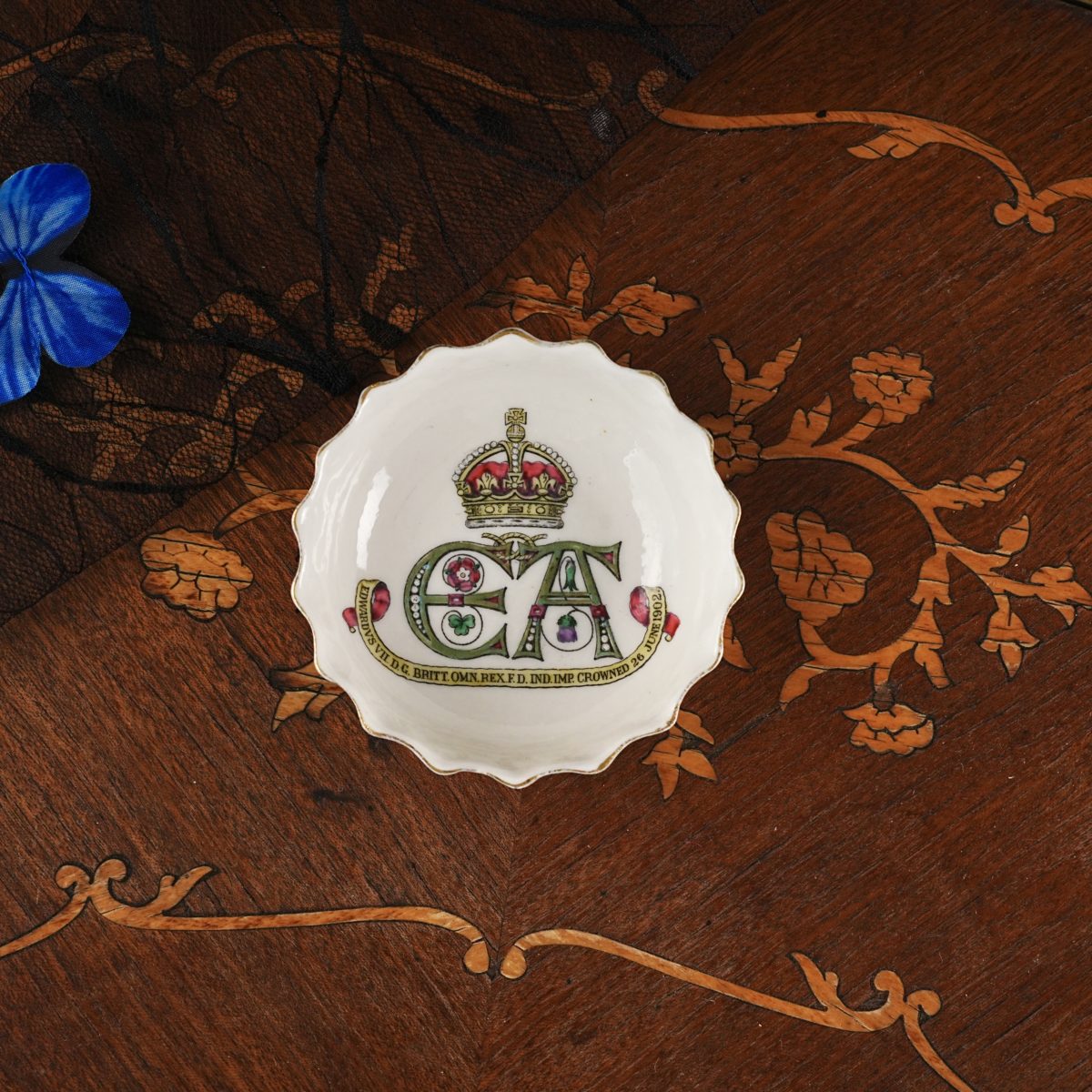
The third Goss piece in the shop belongs to the craze's high summer: a fluted dish for the coronation of Edward VII, crowned — so the Latin around its rim insists — on 26 June 1902. He was not. Two days before the ceremony the King went under the surgeon's knife for an abscessed appendix, and the coronation moved to August while a nation's worth of souvenirs, this dish among them, went on sale bearing a date on which nothing happened. Collectors are gentle about it; the wrong date is half the reason to own one.
The tide goes out
After the war the mood changed, as moods do. The generation that had filled its parlours with little white pots had other things to remember, and the seaside itself was changing. The Goss family sold the business to a competitor in 1929; the goshawk mark faded from use after 1938, and the Falcon Works closed for good in 1941. The whole arc — from Adolphus's first agency to the last kiln — fits inside a single long lifetime.
A shelf of crests read as an honest travel diary: you could not, respectably, buy Brighton in Blackpool.
What remains is, to my mind, one of the friendliest doors into antique collecting that exists. Goss pieces survive in enormous numbers, most cost less than a restaurant lunch, every one carries a place and often a story printed on its own body, and there is a devoted collectors' club still keeping the records straight. If you are starting a first cabinet — or starting a child on one — a little white pot with a goshawk under it is a fine first acquisition. Look for the bird on the base, crisp colour in the crest, and, if you can manage it, the arms of a place that means something to you. That, after all, was always the point.
All three Goss pieces in this story — the three-handled tyg, the sack bottle and the 1902 dish — are in the shop now, alongside the rest of our royal commemoratives.
Browse Royal Commemoratives Shop on Etsy ↗Sources: William Henry Goss's training at Copeland, the 1858 founding, Adolphus Goss's souvenir idea and the scale of the craze from the Goss Collectors' Club (including the club's 95%-of-homes claim, reported here as their estimate); the Falcon Works dates, jewelled ware, the exclusive agency system with its 480-then-1,000 agencies, and the 600-model catalogue from thepotteries.org; the League of Goss Collectors (1906, International League 1918) and the goshawk mark from Wikipedia; Adolphus's travels and the wartime crested tanks from crestedchina.co.uk. The sack bottle's provenance inscription and the 1902 dish's dating recorded from the objects themselves.