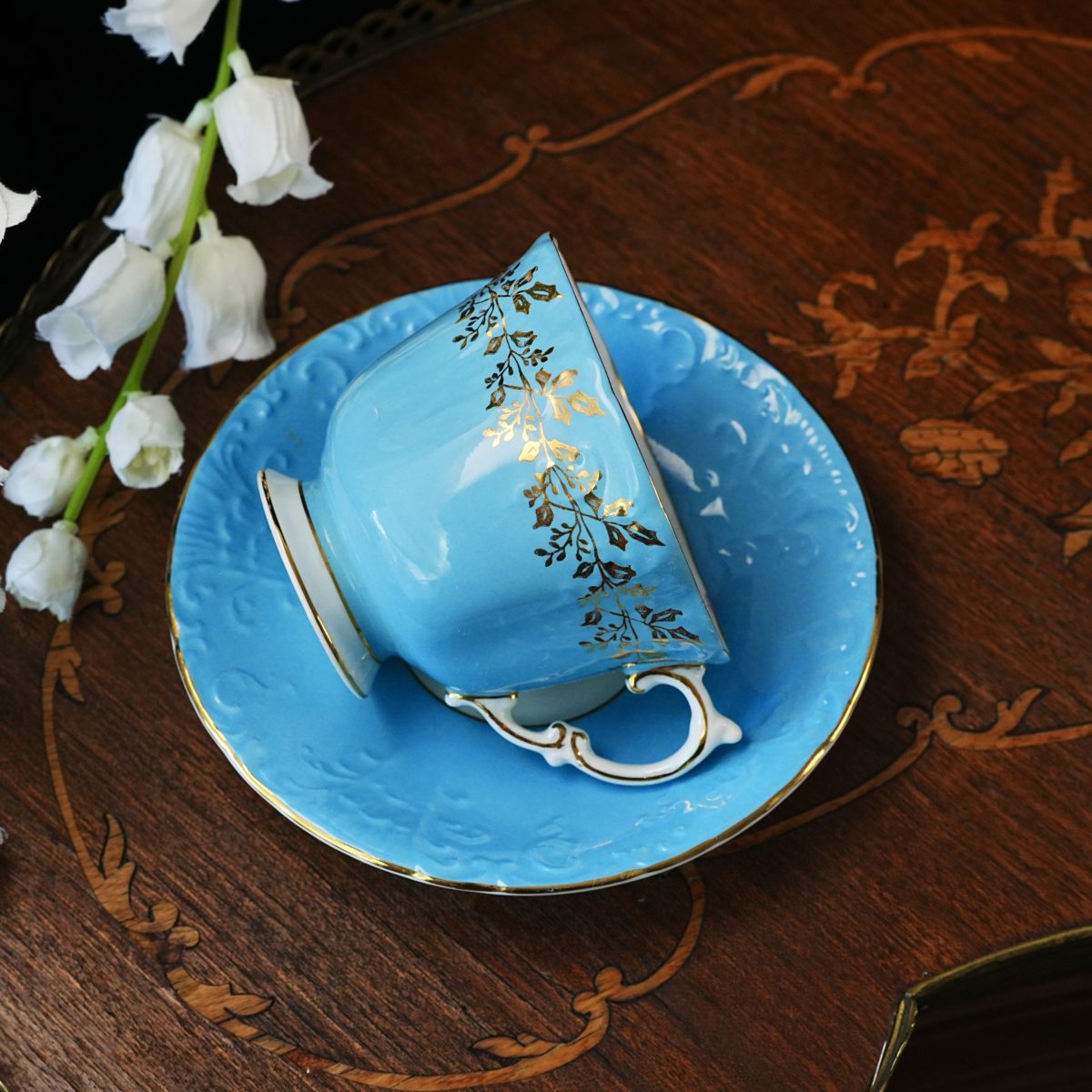
Vintage Aynsley Cottage Bouquet Teacup & Saucer – Paneled Square Rim, Turquoise Blue or Coral Pink Choice, Bone China, England 1960s
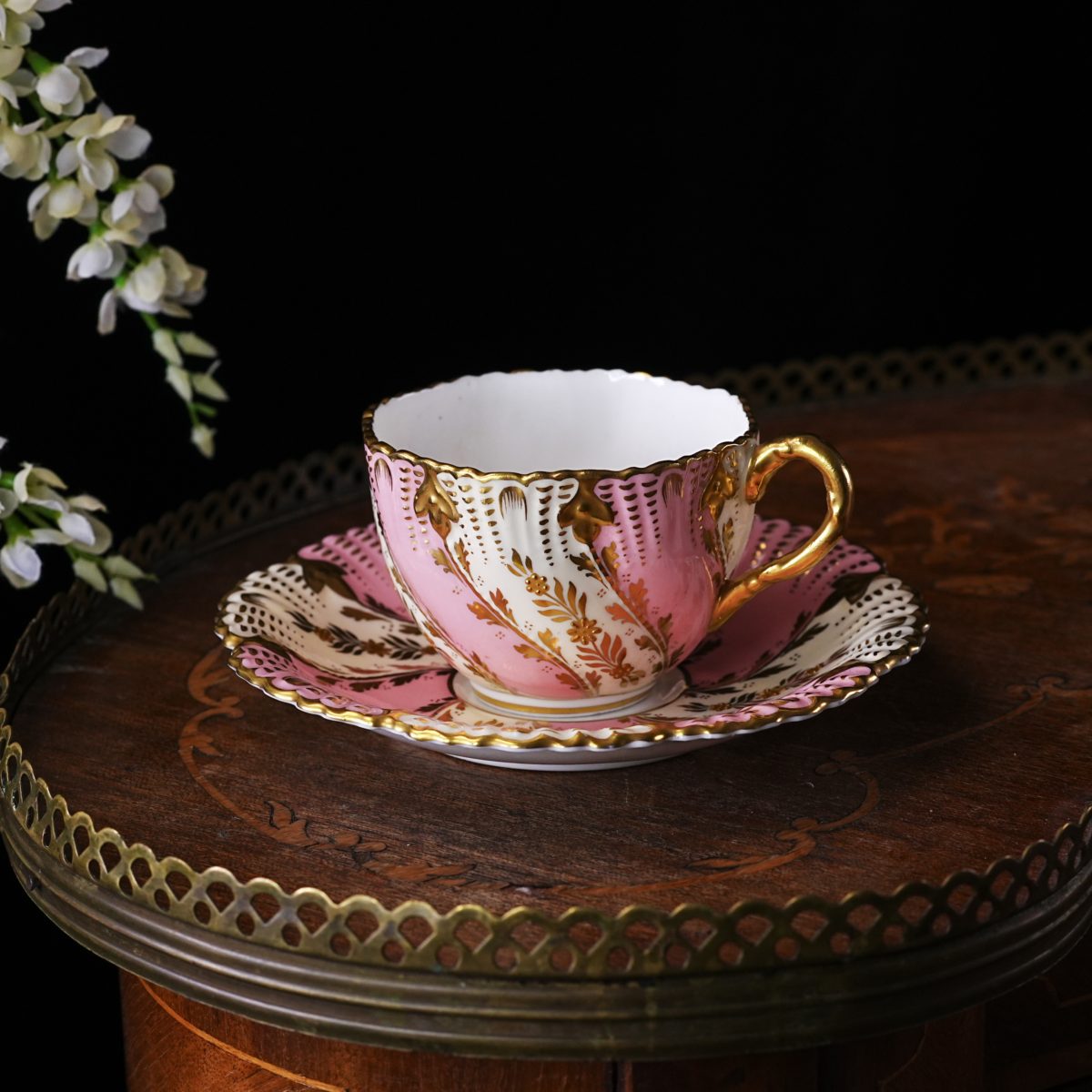
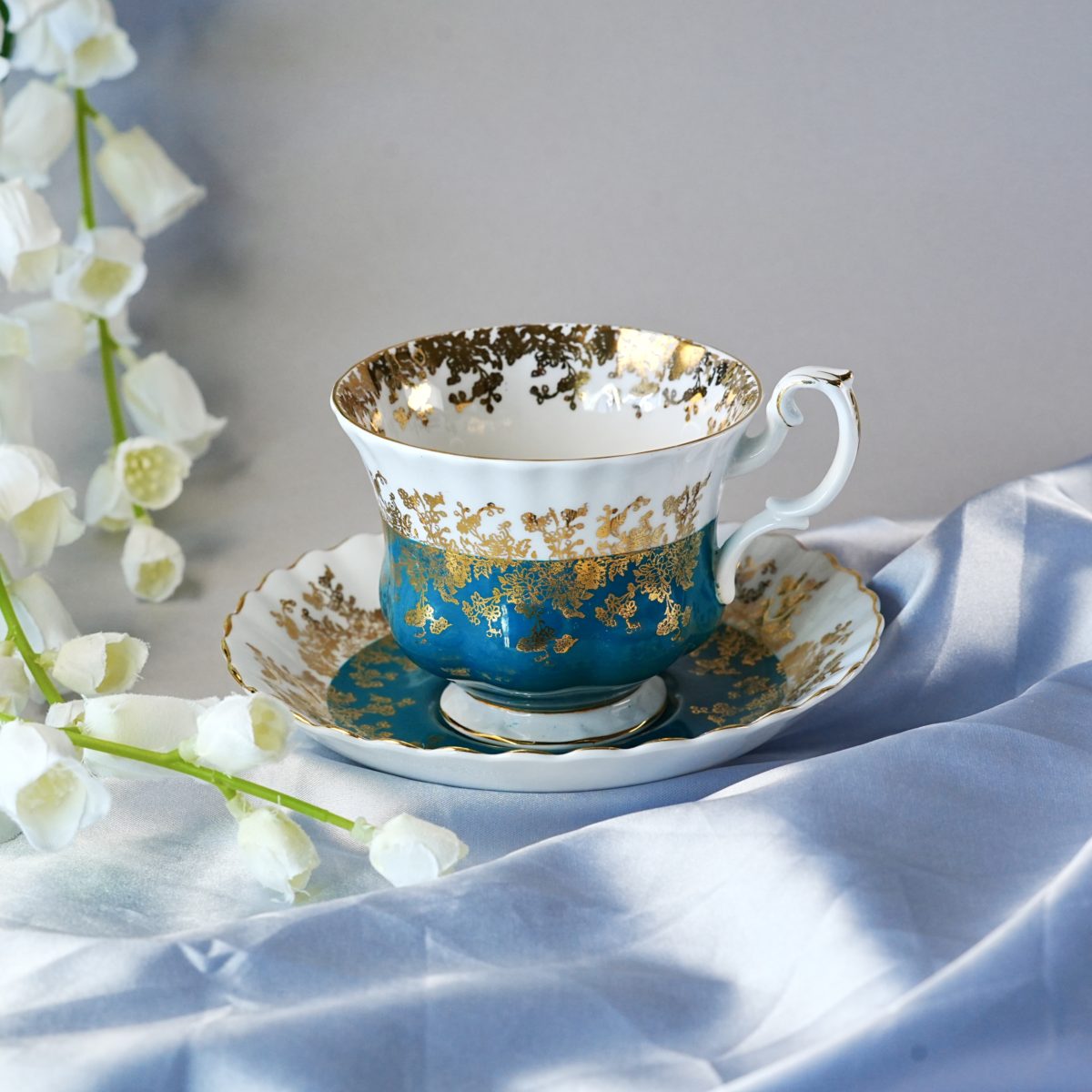
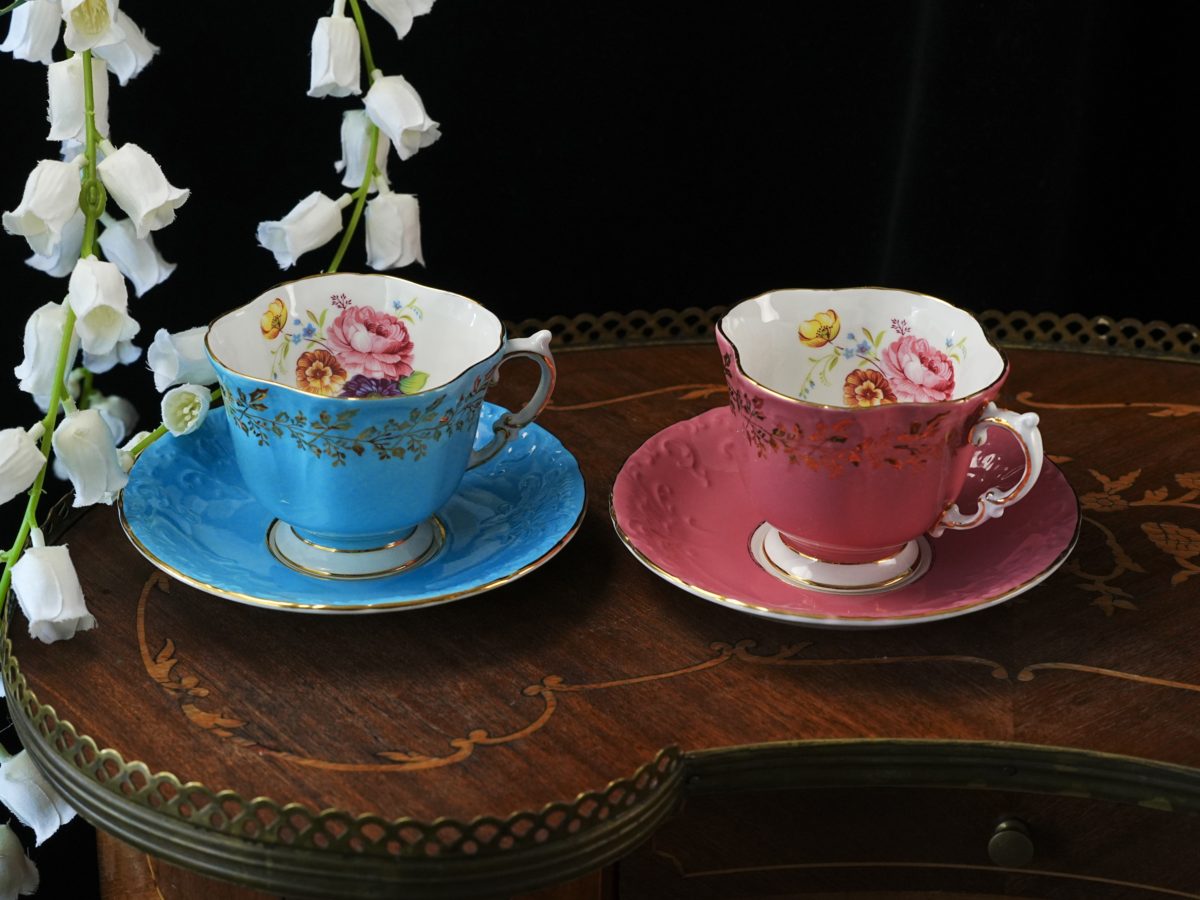
An Aynsley bone-china teacup and saucer offered in two colour choices of the same model — choose the Turquoise / Cerulean Blue version or the Coral / Raspberry Pink version. The two pieces are identical in every respect except the exterior glaze colour. Both carry the same paneled square shape, the same gold leaf-scroll filigree band, and the same hand-painted cottage-garden bouquet at the interior centre.
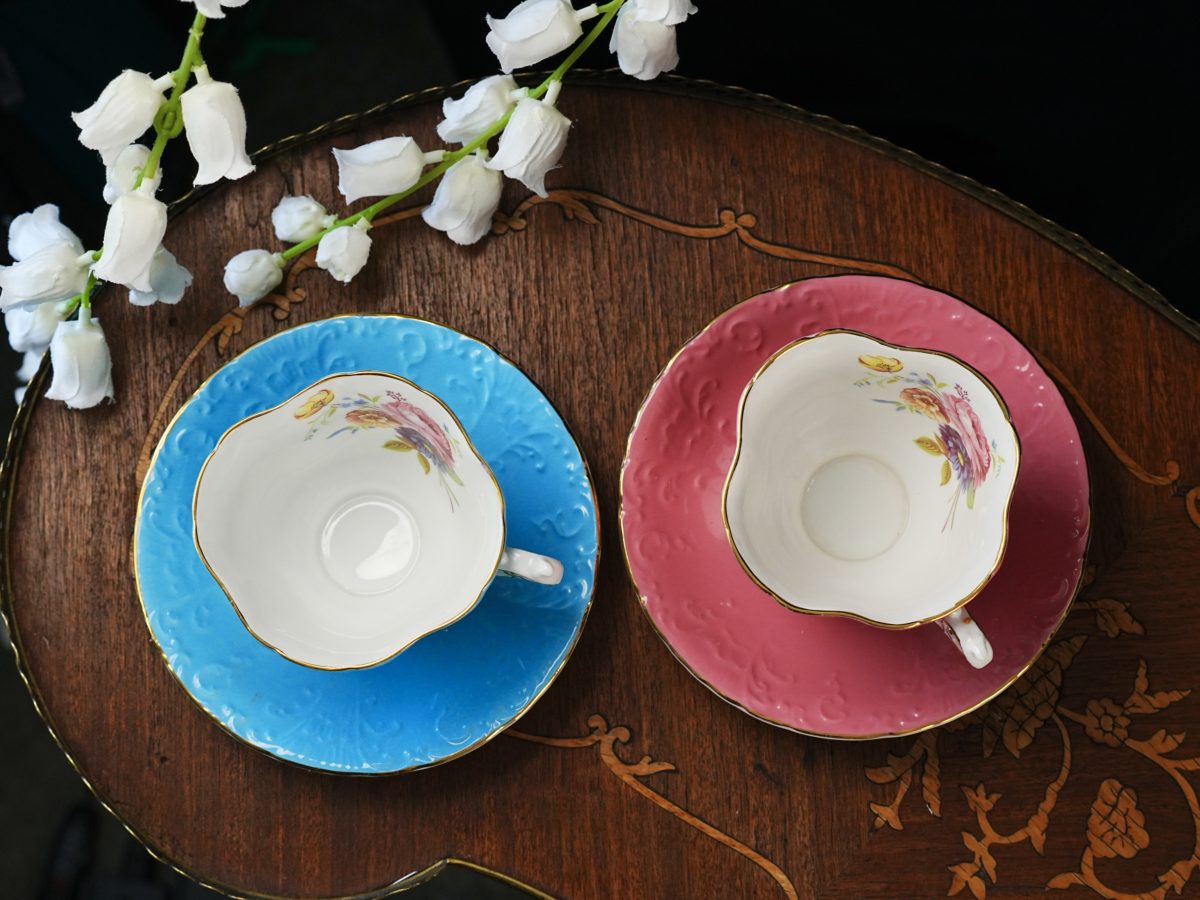
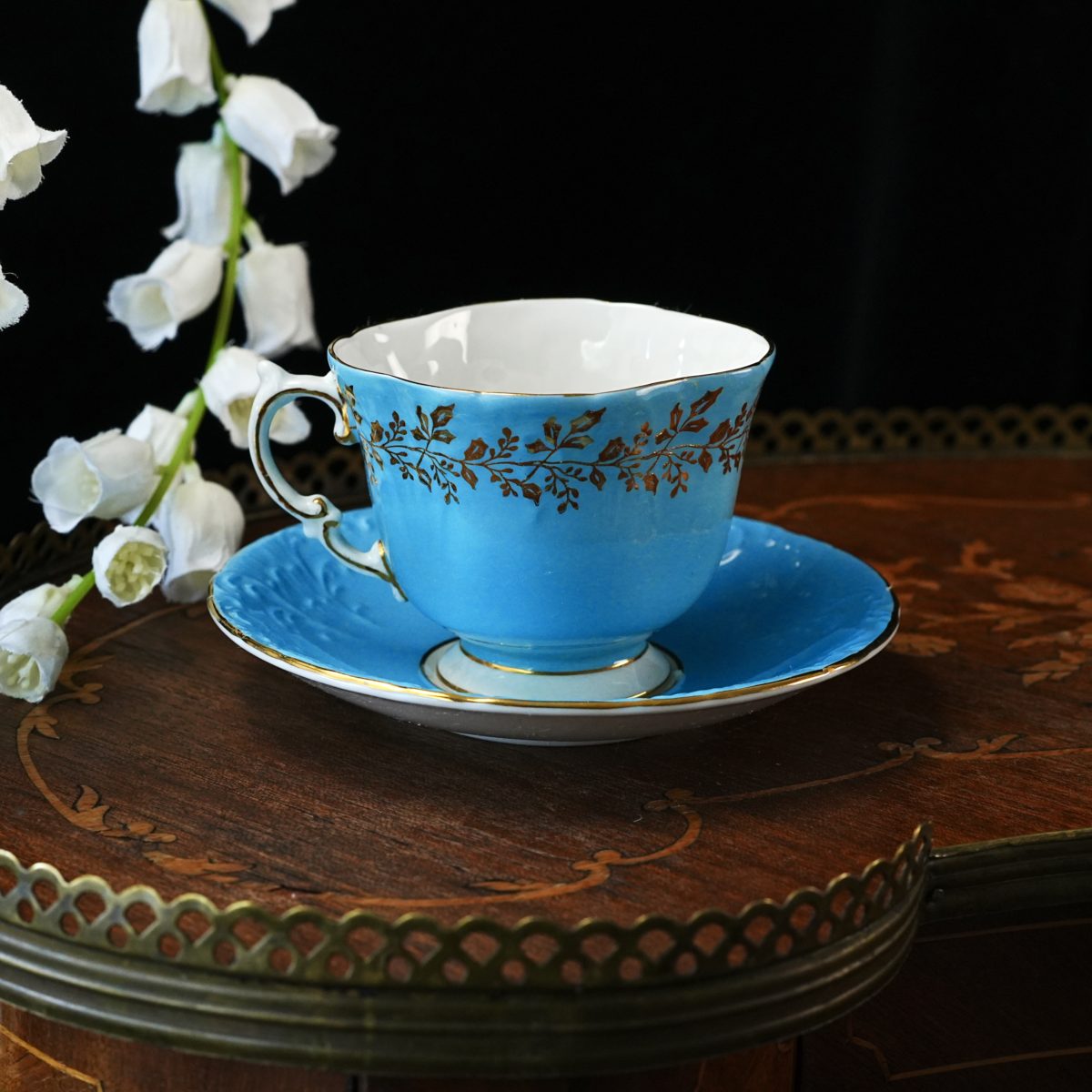
Look at the cup from above and the shape is the first thing to notice. The rim is not round. It reads as a softened square with four inward indentations — what collectors call a paneled quad-lobed square or sometimes the Aynsley Athens shape, following the firm's mid-century habit of naming its more architectural teacup lines after classical Greek and Roman cities (Athens, Sparta, Corinth). The cup body carries the indentations down as four matching panels with vertical ridge-seams between them, so when you turn the cup in the hand it reads as four distinct facets rather than a single rounded body. The base returns to a small circular pedestal foot — the geometric trick of the shape is in the transition between the square upper body and the round foot. The saucer follows the same four-indent rim logic, in matching colour.
The paneled square is a harder shape to fire than a standard round teacup, and Aynsley's mid-century factory records suggest the kiln-loss rate on its paneled shapes ran roughly 15–20% higher than on its round Crocus and Athenia lines — the four panels warp differently from each other in firing, the ridge-seams pool the glaze, and the four inward rim points concentrate firing stress. That higher loss rate is why paneled-shape Aynsley pieces turn up in the secondary market roughly two-thirds as often as the equivalent round Aynsley shapes; for collectors specifically chasing the Aynsley architectural shapes, this is part of the appeal.
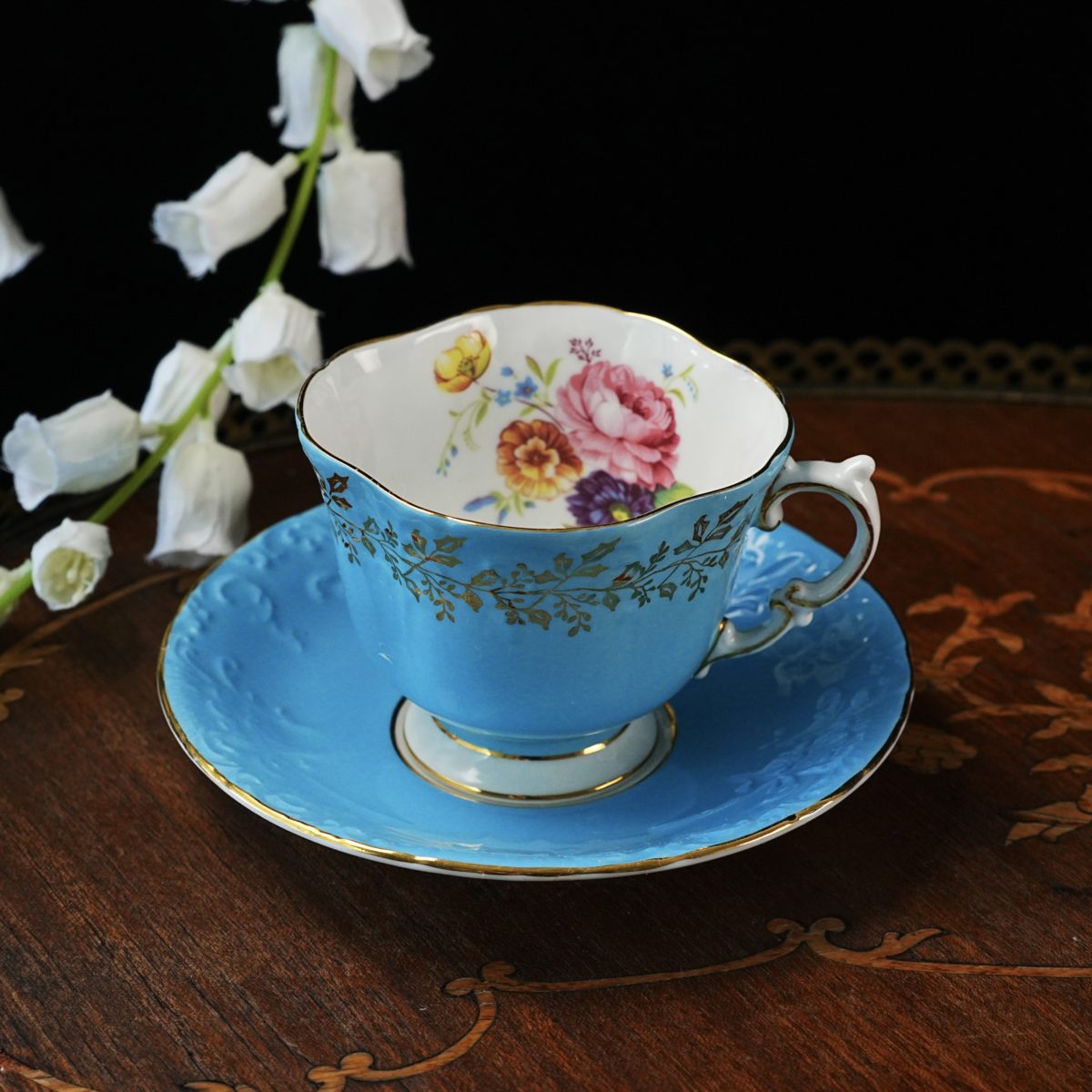
The outside colour on each cup is a single dipped underglaze — turquoise-cerulean on Option A, coral-pink on Option B — even and mirror-smooth across all four panels with no speckle or wash mark. Aynsley produced this exact colour pairing through the early-to-mid 1960s as one of its "matched-pair-for-cabinet" colourways; the two were intended to read alongside each other as a his-and-hers or harlequin display. Above the colour band runs a gold leaf-scroll filigree — a wider band of acanthus leaves, scrolling tendrils, and small leaf dots — finished in a transfer-print gold with acid-etched detail picked out within. A fine 22K gilt line runs the rim, the four corners of the rim, the scrolled handle, and the pedestal foot.
Tilt the cup forward and the interior bouquet reveals itself — Aynsley's cottage-garden composition hand-painted against the white interior. A pink cabbage rose at the centre, six layered petals, painted in three pink tones (a deeper crease-pink at the centre, mid-pink at the petal body, paler highlight along the outer edge — the kind of three-pass hand-tinting that takes a printed base several brush passes beyond a single transfer). A smaller yellow rose tucked beside it. Above and around: small blue forget-me-nots, each with a 1 mm yellow dot painted at the centre by hand (transfer printing cannot drop a single dot that small consistently — the yellow centres are the giveaway that a painter finished the bouquet by hand). A purple violet to the side with a darker shadow at the petal base. Two small yellow daisies. A yellow buttercup. The leaves around the bouquet are the silvery sage-green of mid-century English botanical illustration, each shaded darker along the underside and lighter along the upper vein. None of these micro-decisions is required of a transfer-only piece; they are the signature of an Aynsley painter finishing the cup by hand.
The base of each piece reads in green-script Aynsley / Est. 1775 / Made in England / Fine English Bone China with the crown above — the standard mark Aynsley used through the 1950s–70s window. Production of the paneled-square line is generally read to early-to-mid 1960s, which fits both the colour pair and the bouquet style here.
A cup-and-saucer for the Aynsley collector specifically interested in the firm's paneled / architectural shapes (a less-common Aynsley collecting target than the floral patterns), for the first-tier English bone china cabinet, for the matched-pair harlequin tea display, for the cottagecore / mid-century / spring tea aesthetic, or as a Mother's Day / bridal-shower / Easter-hostess gift to someone who notices cup shapes as well as cup patterns.
Details
- Type
- Teacup & Saucer Set (single set per order; colour choice at checkout)
- Maker
- Aynsley (John Aynsley & Sons, established 1775, Royal Warrant from Queen Victoria), Longton, Stoke-on-Trent, England
- Era
- Circa 1960s (early to mid — paneled-shape production window with cerulean / coral colour pair)
- Shape
- Paneled quad-lobed square / "Athens" shape — four-faceted body with inward-indent square rim, pedestal foot, scrolled handle, matching paneled-rim saucer
- Colour Options
- A — Turquoise / Cerulean Blue; B — Coral / Raspberry Pink (same model in both)
- Decoration
- Solid underglaze colour exterior across all four panels + gold leaf-scroll filigree band (transfer-print gold with acid-etched detail); hand-painted cottage bouquet interior (pink cabbage rose, yellow rose, blue forget-me-nots, violets, yellow daisies, buttercup, sage leaves); 22K gilt rim, four-corner rim accents, handle, and foot
- Size
- Cup ~3.5" / 9 cm dia × 2.75" / 7 cm tall; Saucer ~5.5" / 14 cm dia (both colours same)
- Material
- Fine English Bone China
- Markings
- Aynsley / Est. 1775 / Made in England / Fine English Bone China in green script + crown on base of both pieces (both colours)
Condition
Excellent vintage condition on both colour options. Solid underglaze colour even across all four panels with no rub-through; hand-painted bouquet vivid; gilt rim, handle, and foot bright; four-faceted ridge-seams clean with no glaze pooling. No chips, cracks, hairlines, or crazing on either set. Please review all photos as part of the condition record.
Backstamp & Pattern
- Maker
- Aynsley (John Aynsley & Sons, established 1775, Royal Warrant from Queen Victoria), Longton, Stoke-on-Trent, England
- Era
- Circa 1960s (early to mid — paneled-shape production window with cerulean / coral colour pair)
- Mark on base
- Aynsley / Est. 1775 / Made in England / Fine English Bone China in green script + crown on base of both pieces (both colours)
Aynsley's crown-and-banner mark; the pattern and shape numbers help date it, with later marks adding “Est 1775.”
Read the full backstamp & pattern guide →