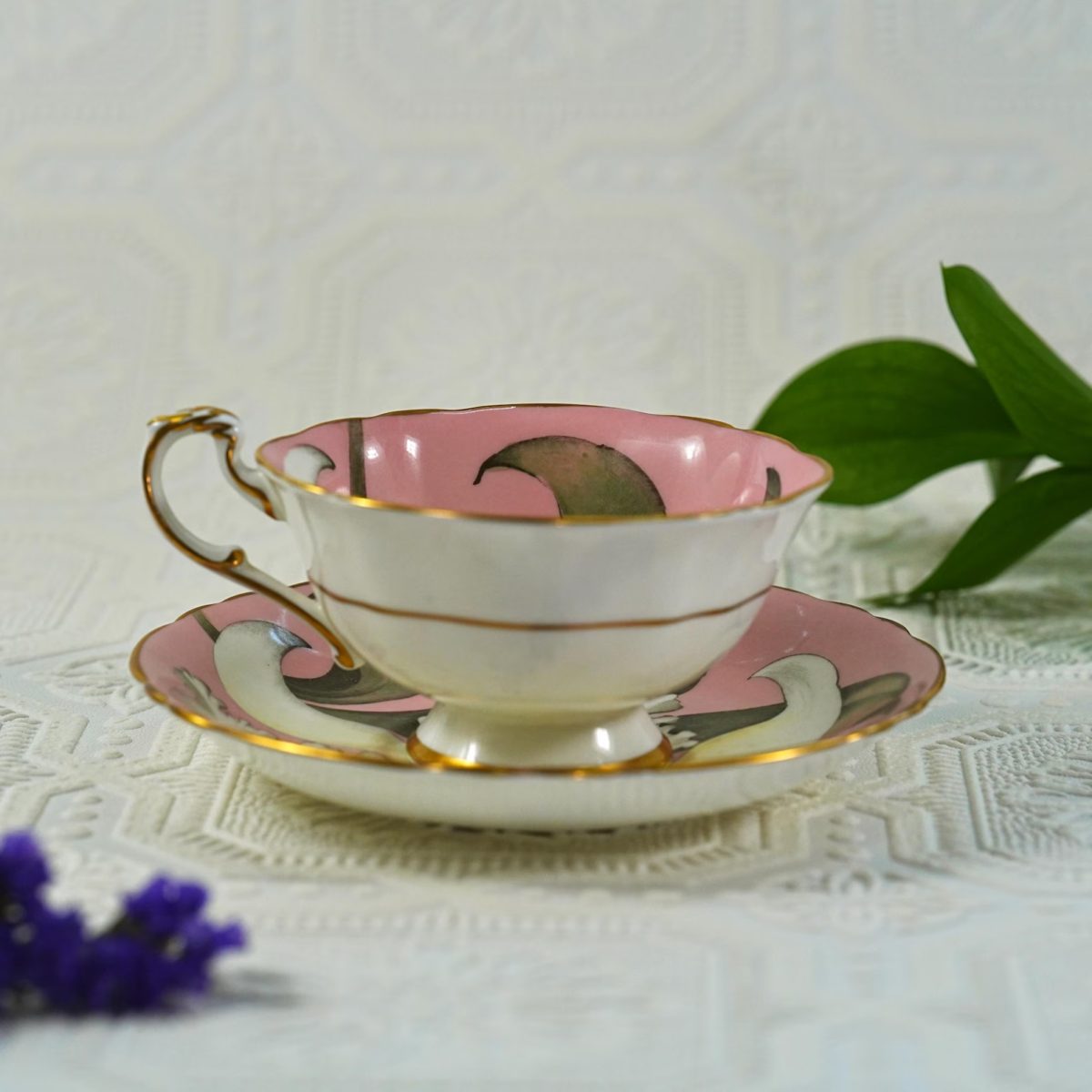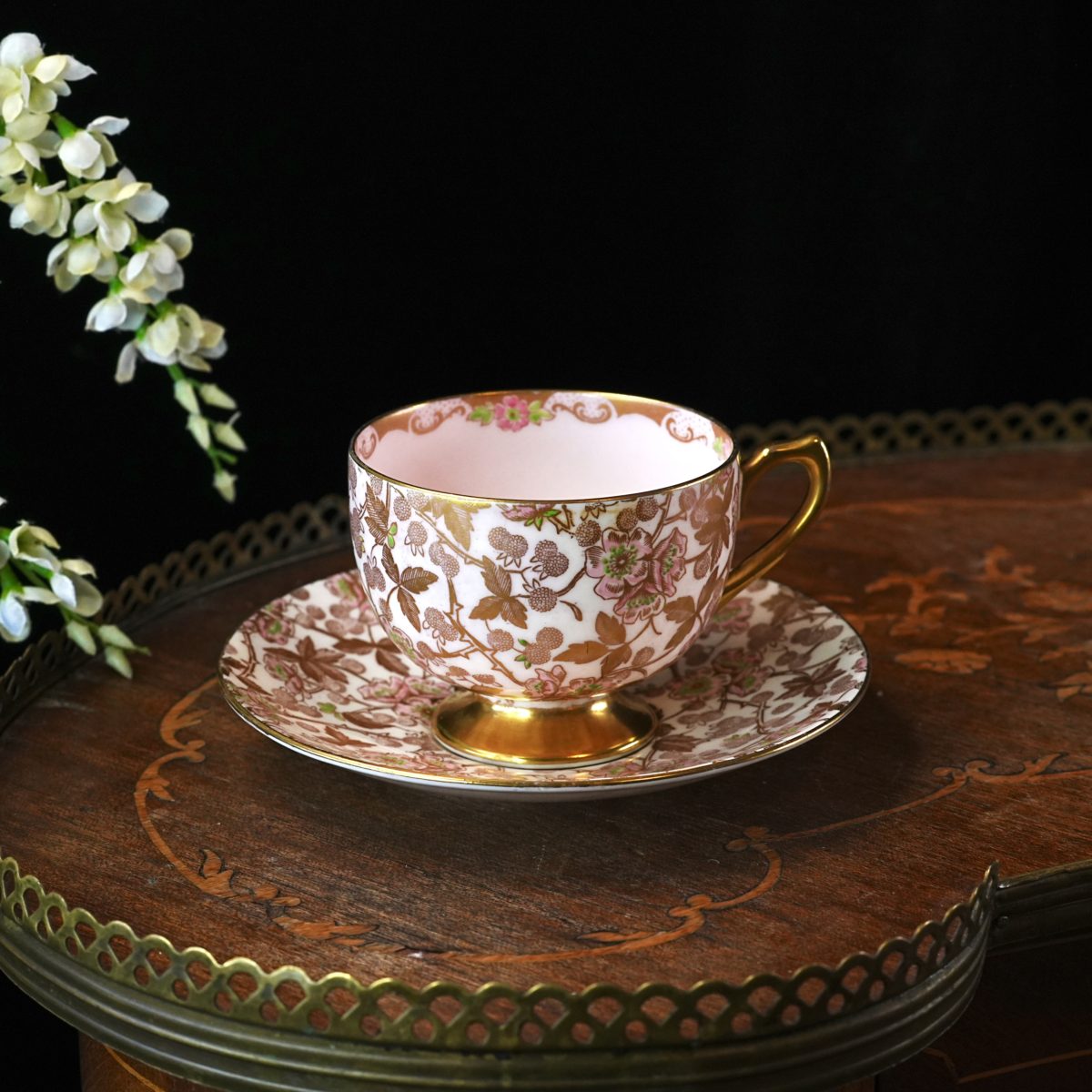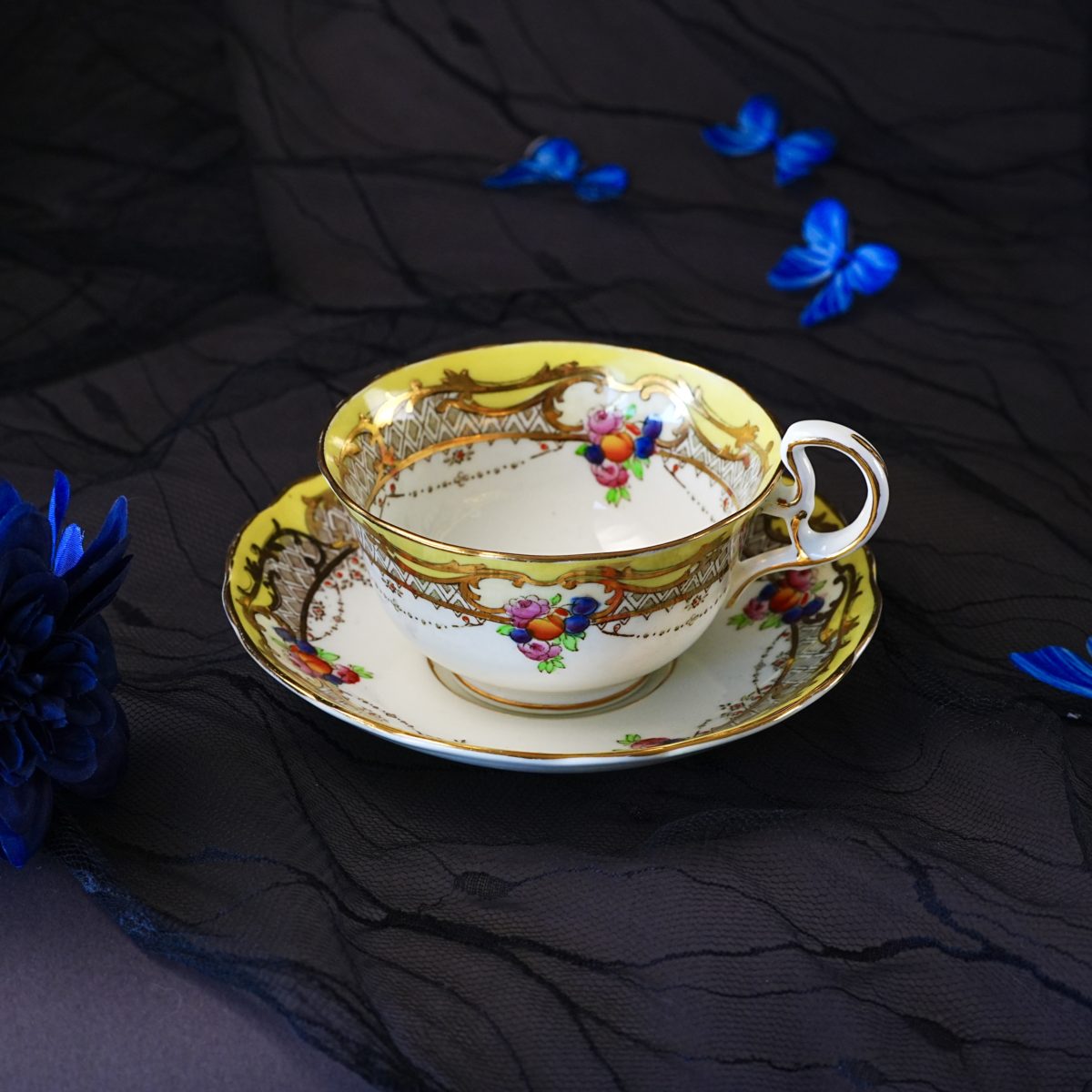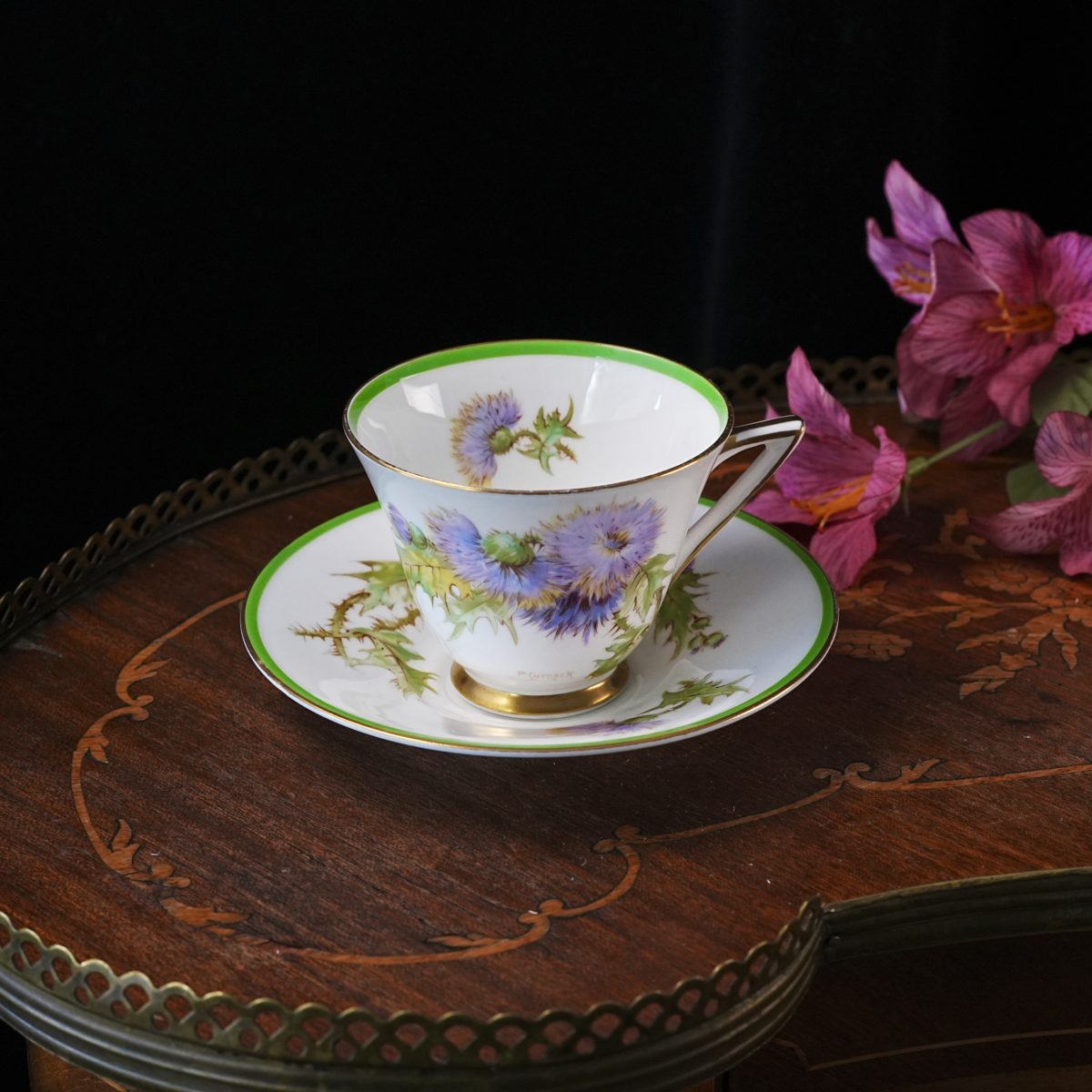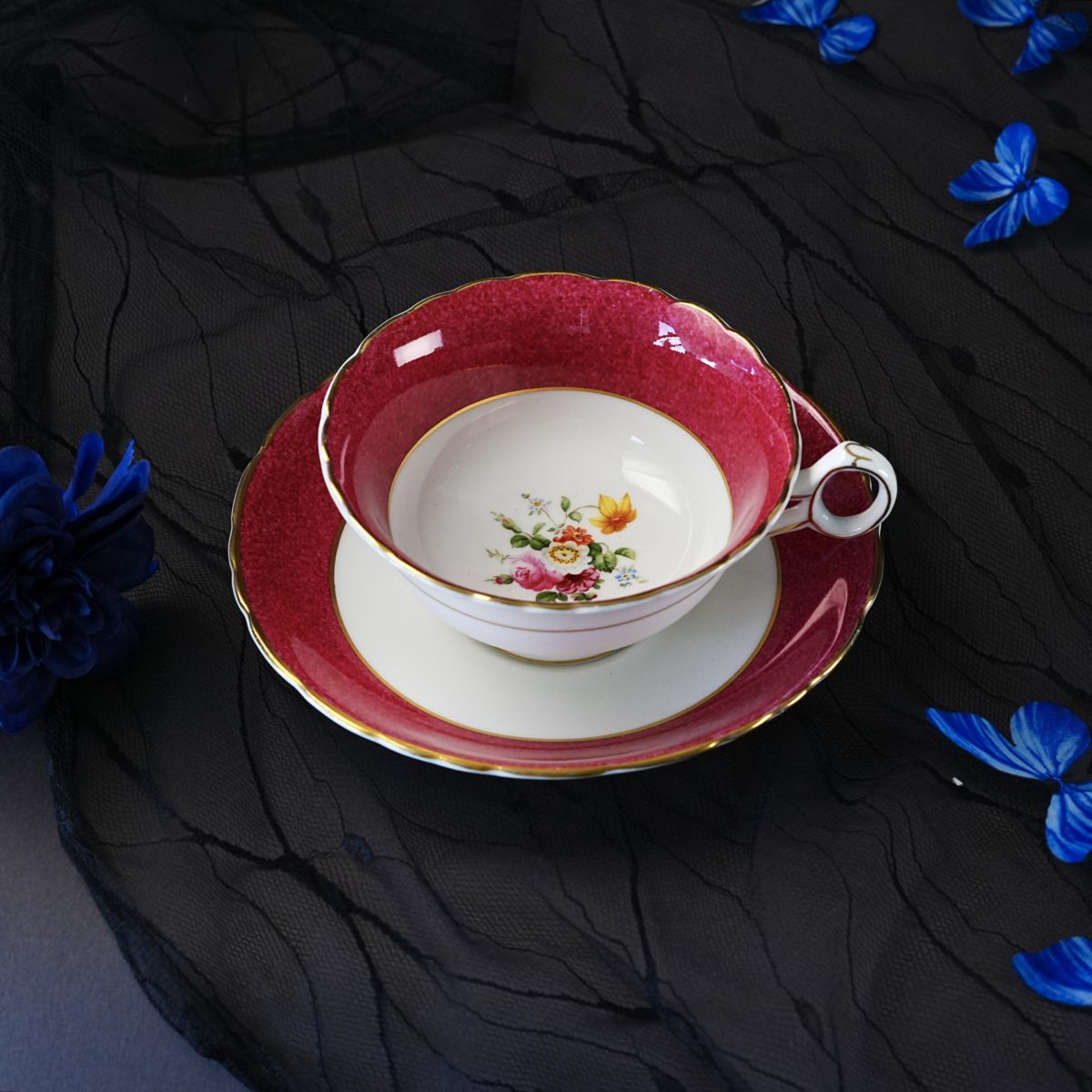
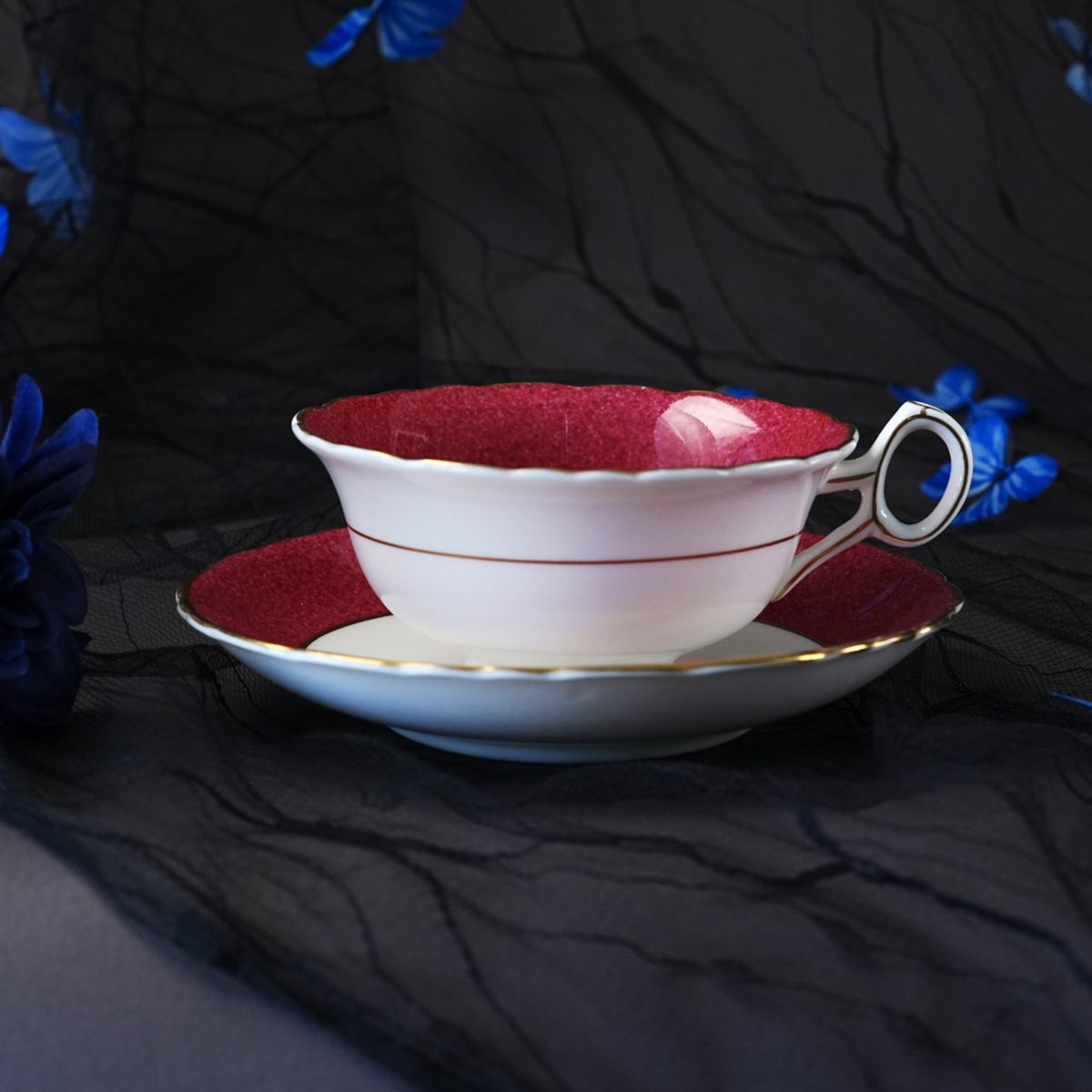
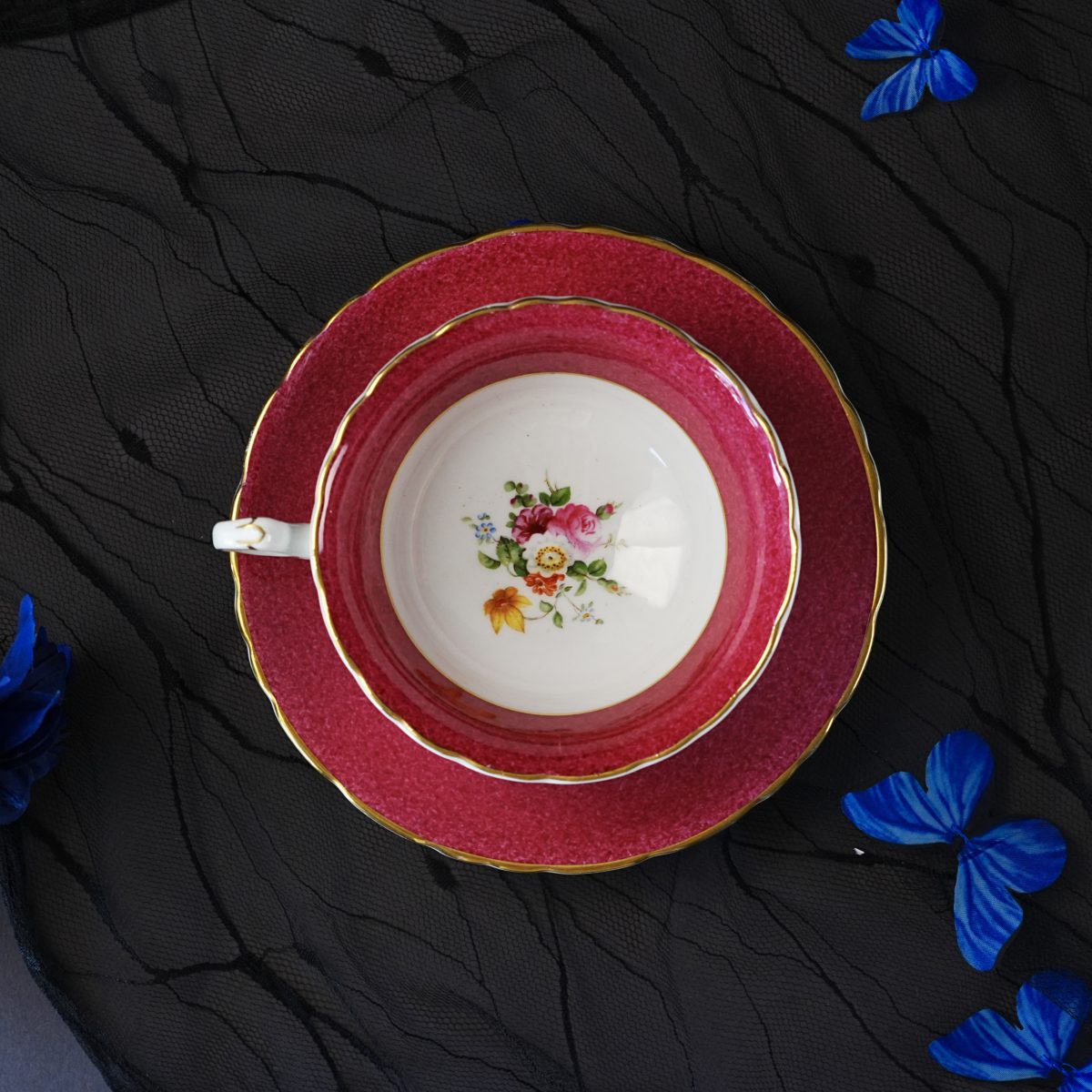
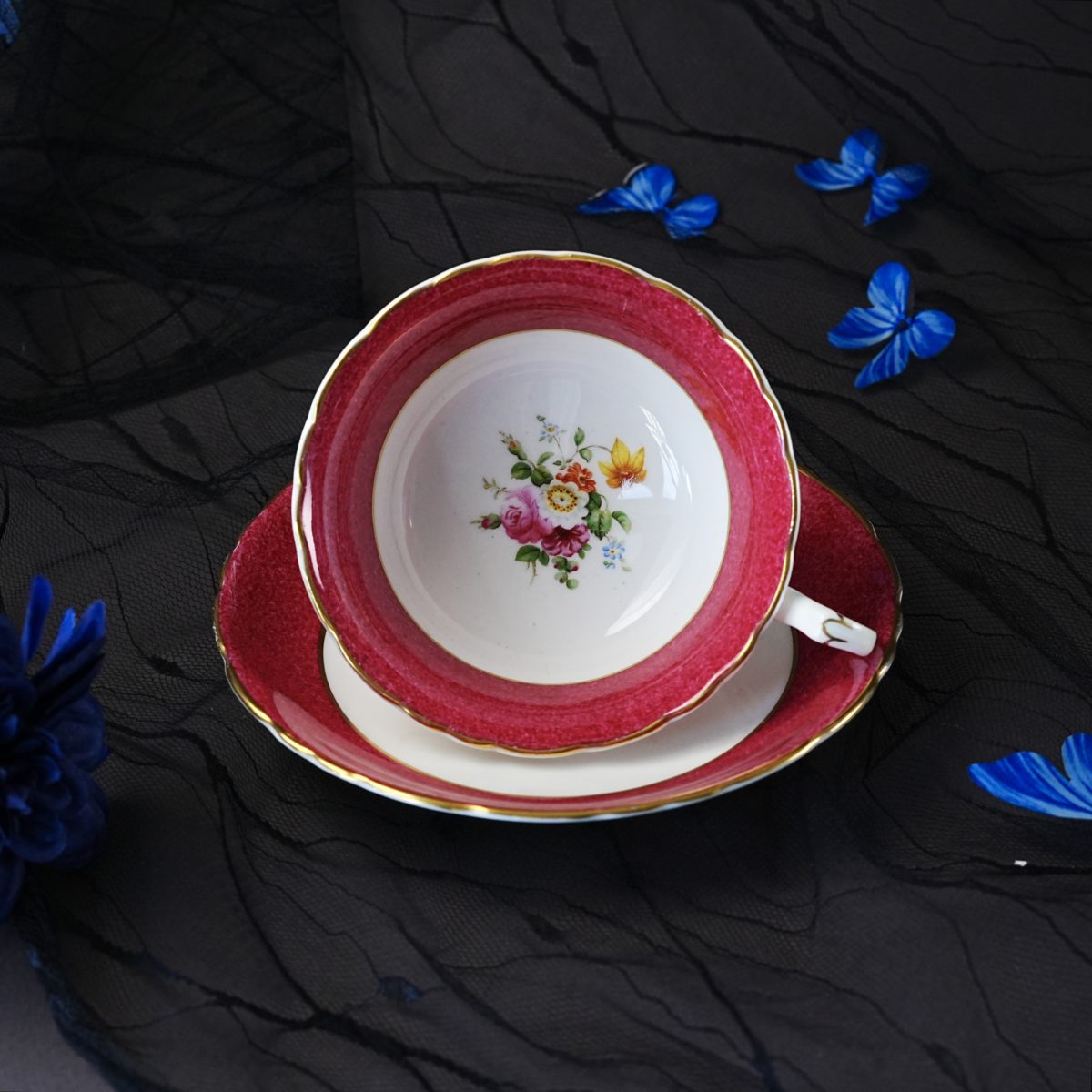
Vintage Royal Cauldon Raspberry Rim Teacup & Saucer – Speckled Burgundy Band, Floral Bouquet, Gilt Trim, 1774 Hanley England 1950s
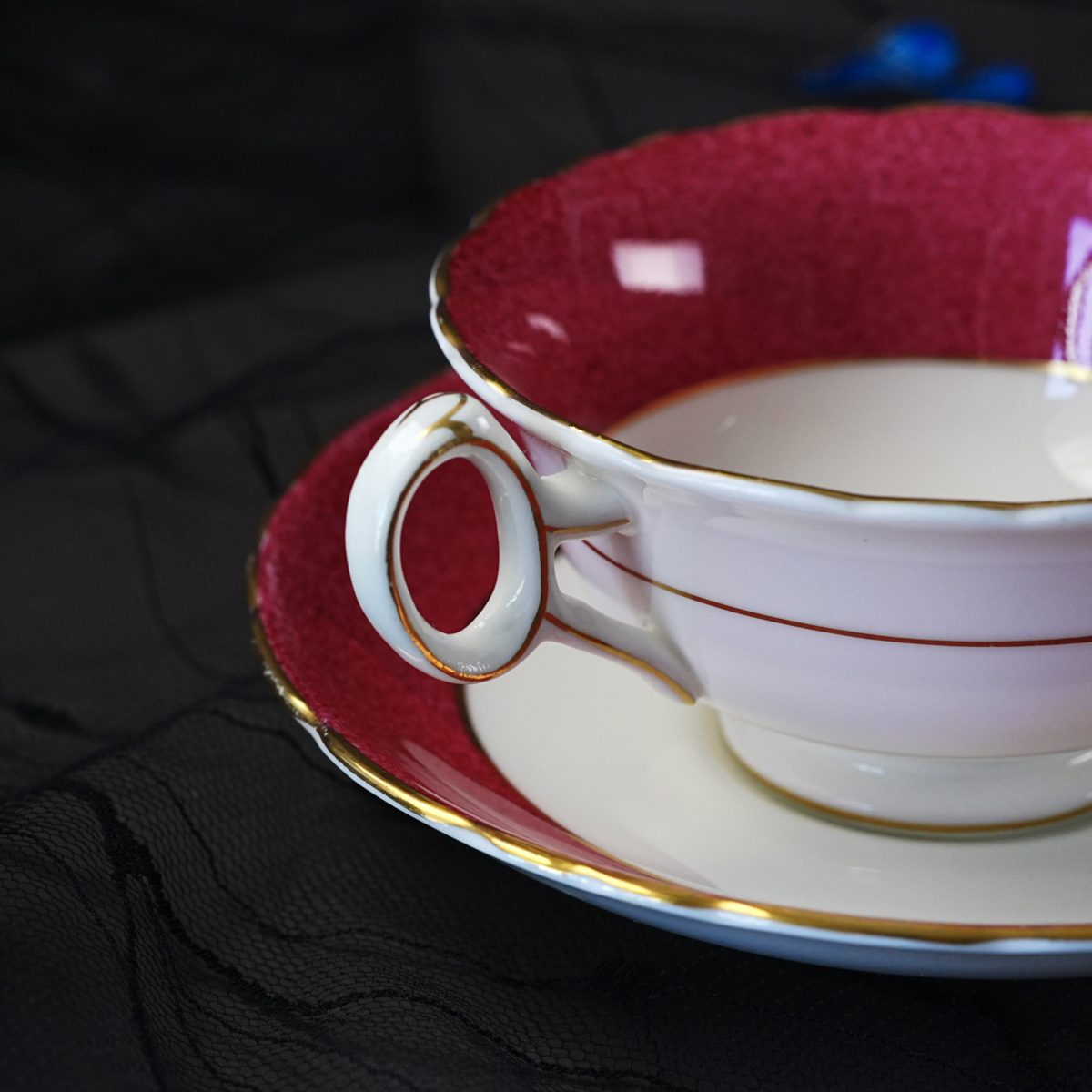
AvailableA teacup and saucer from Royal Cauldon, the discontinued English bone-china house that traces back to 1774 in Hanley / Shelton, Staffordshire — originally Job Ridgway's Cauldon Place Pottery, one of the oldest continuously-operating English potteries (predating Wedgwood by just 15 years). The pattern is raspberry-speckled rim: a wide band of deep raspberry / burgundy red running the outer rim of both pieces, mottled with the speckled-ground technique English bone-china makers used through the 1950s and 60s (the colour applied in a fine spatter rather than flat, so the rim catches light unevenly and reads more painterly than printed). The centre wells are white and hold a hand-tinted floral bouquet — pink garden roses, yellow daffodils, periwinkle forget-me-nots, small purple wildflowers, soft green leaves — and the rim and handle carry a clean 22K gilt line.
Royal Cauldon has 188 continuous years of history. Job Ridgway started the Cauldon Place Pottery in 1774 in the Six Towns of Stoke-on-Trent, the works passed through Ridgway family and successor partnerships over the nineteenth century, and the firm received the Royal prefix from Edward VII in 1905. Through the nineteenth and twentieth centuries Cauldon competed at the top tier of English bone china alongside Mintons, Coalport, and Aynsley — significantly above the smaller secondary makers (Royal Stuart, Roslyn, Royal Standard, Royal Grafton). The firm merged with Pountney & Co. in 1962, ending 188 continuous years of production — and every Royal Cauldon piece on the market today is finite supply.
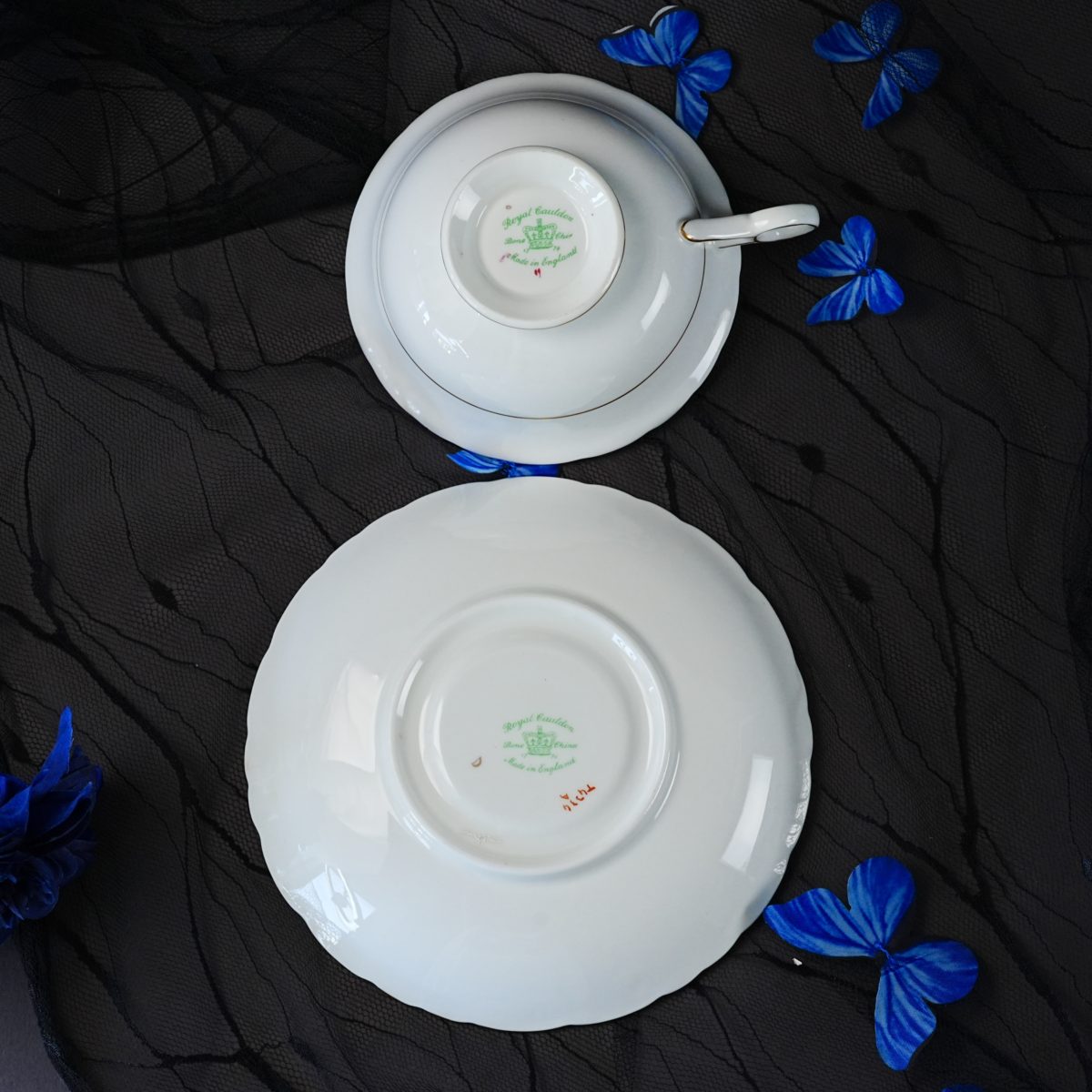
The base reads in full Royal Cauldon: green cursive Royal Cauldon + green crown + Bone China either side + the founding date 1774 under the crown + Made in England + a small red hand-painted pattern character — the standard Royal Cauldon backstamp from 1905 to closure in 1962.
A piece for the Royal Cauldon collector chasing the closed-workshop output, for the Ridgway / Cauldon Place Pottery historical-lineage collector, for the red-ground / burgundy-rim cabinet teacup collector, for the cottagecore / grandmillennial tea table, for a Valentine's-Day / Mother's-Day red-themed tea moment, or as a bridal-shower / anniversary gift in a warm red palette.
Details
- Type
- Teacup & Saucer Set
- Maker
- Royal Cauldon (originally Cauldon Place Pottery / Ridgway, founded 1774), Hanley / Shelton, Staffordshire, England (closed 1962)
- Era
- Circa 1950s–early 1960s (workshop active 1774–1962; closed)
- Pattern
- Raspberry-speckled rim band with central polychrome floral bouquet
- Shape
- Wide-rim cup with curved D-handle, low pedestal foot, scalloped saucer
- Size
- Cup ~3.5" / 9 cm rim dia × 2.5" / 6.5 cm tall; Saucer ~5.5" / 14 cm dia
- Material
- Fine Bone China
- Decoration
- Raspberry speckled-ground underglaze rim band; transfer-printed and hand-tinted central floral bouquet; 22K gilt rim and handle trim
- Markings
- Green cursive Royal Cauldon + green crown + Bone China + founding date 1774 + Made in England + red hand-painted pattern character on base of both pieces
Backstamp & Pattern
- Maker
- Royal Cauldon (originally Cauldon Place Pottery / Ridgway, founded 1774), Hanley / Shelton, Staffordshire, England (closed 1962)
- Pattern
- Raspberry-speckled rim band with central polychrome floral bouquet
- Era
- Circa 1950s–early 1960s (workshop active 1774–1962; closed)
- Mark on base
- Green cursive Royal Cauldon + green crown + Bone China + founding date 1774 + Made in England + red hand-painted pattern character on base of both pieces
The base carries the maker's printed mark; the wording — especially “England” versus “Made in England” versus “Bone China” — together with any pattern or registration number are the main clues to its age.
Read the full backstamp & pattern guide →