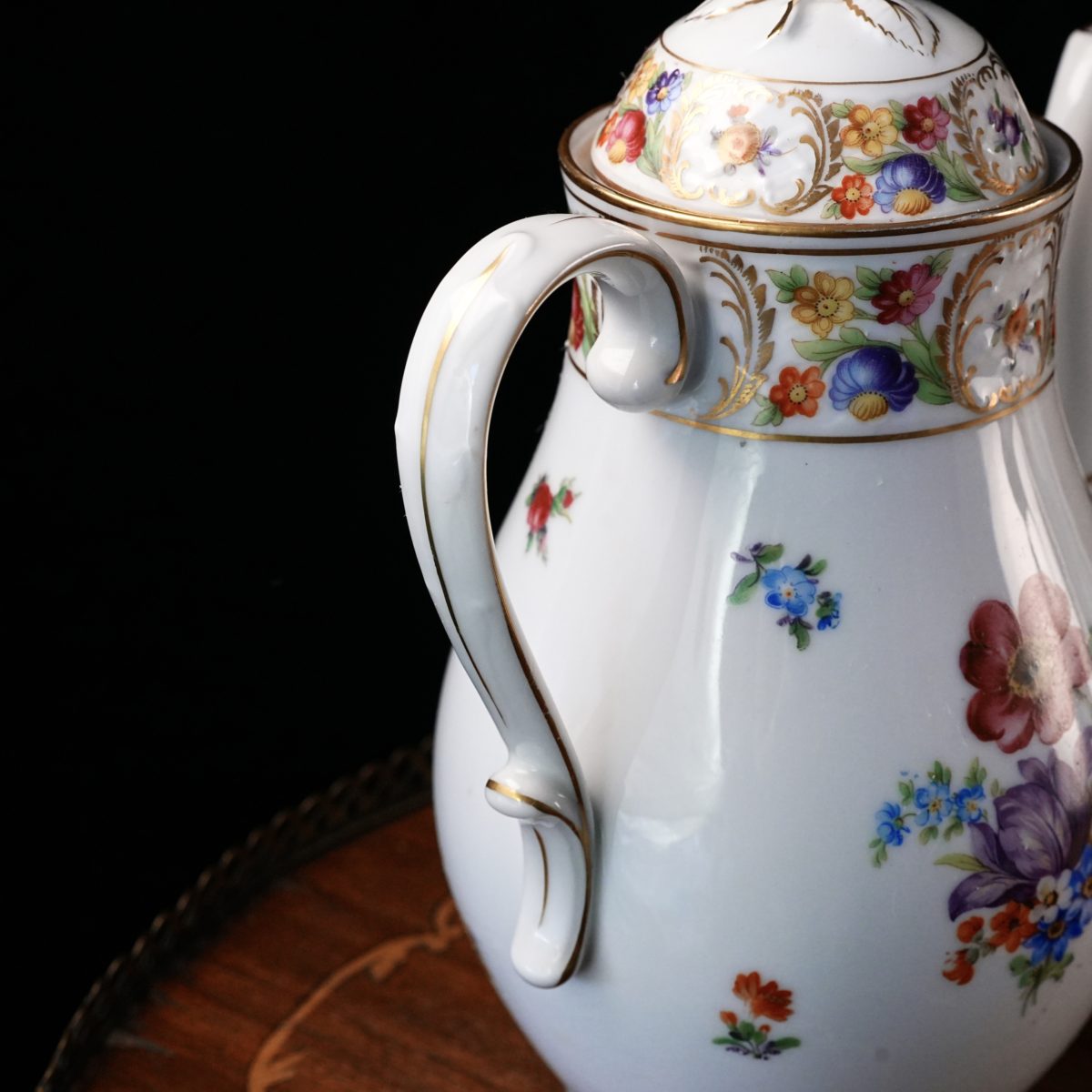
Antique Schumann Bavaria Dresdener Art Porcelain Service – Transfer Saxon Flower, Hand Gilt Cartouche, Coffee Tea Pot Chocolate or Creamer Choice, Germany 1920s
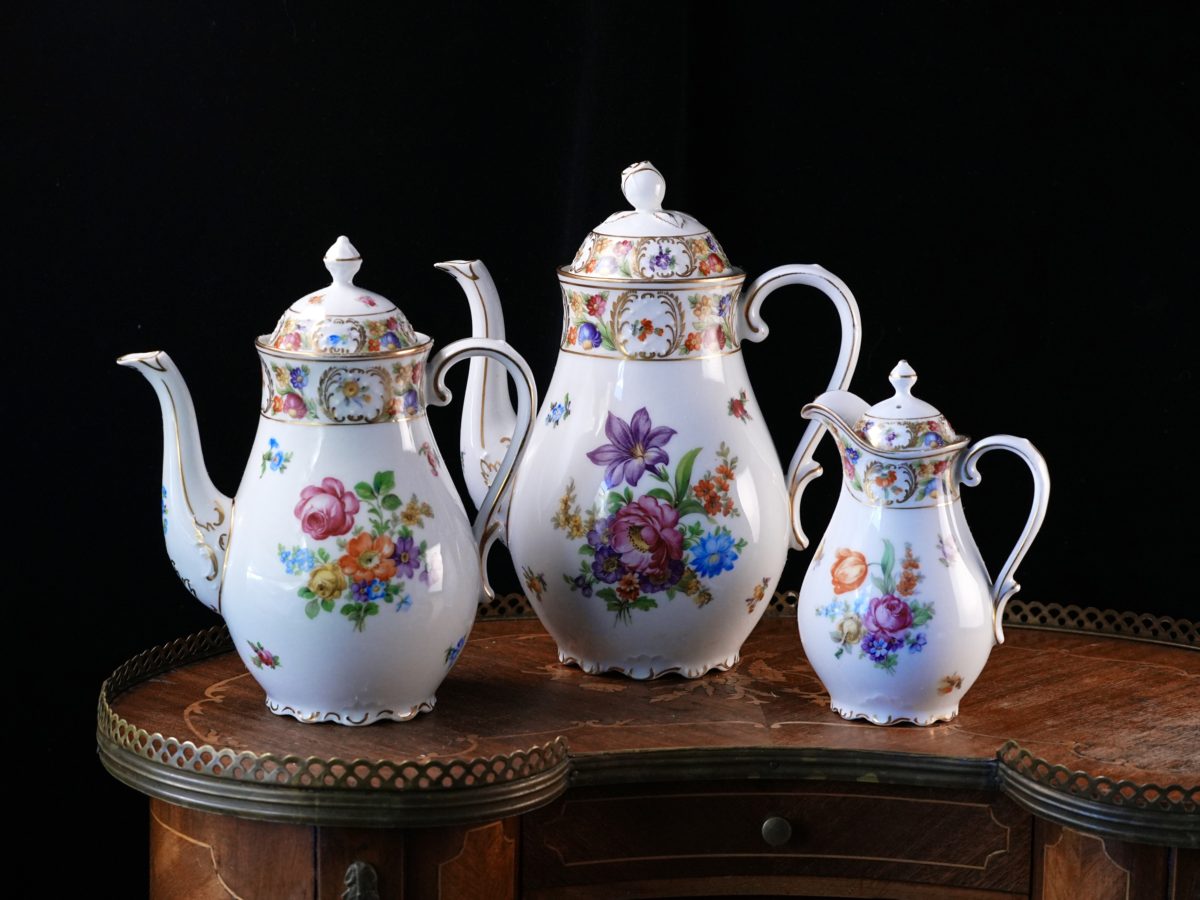
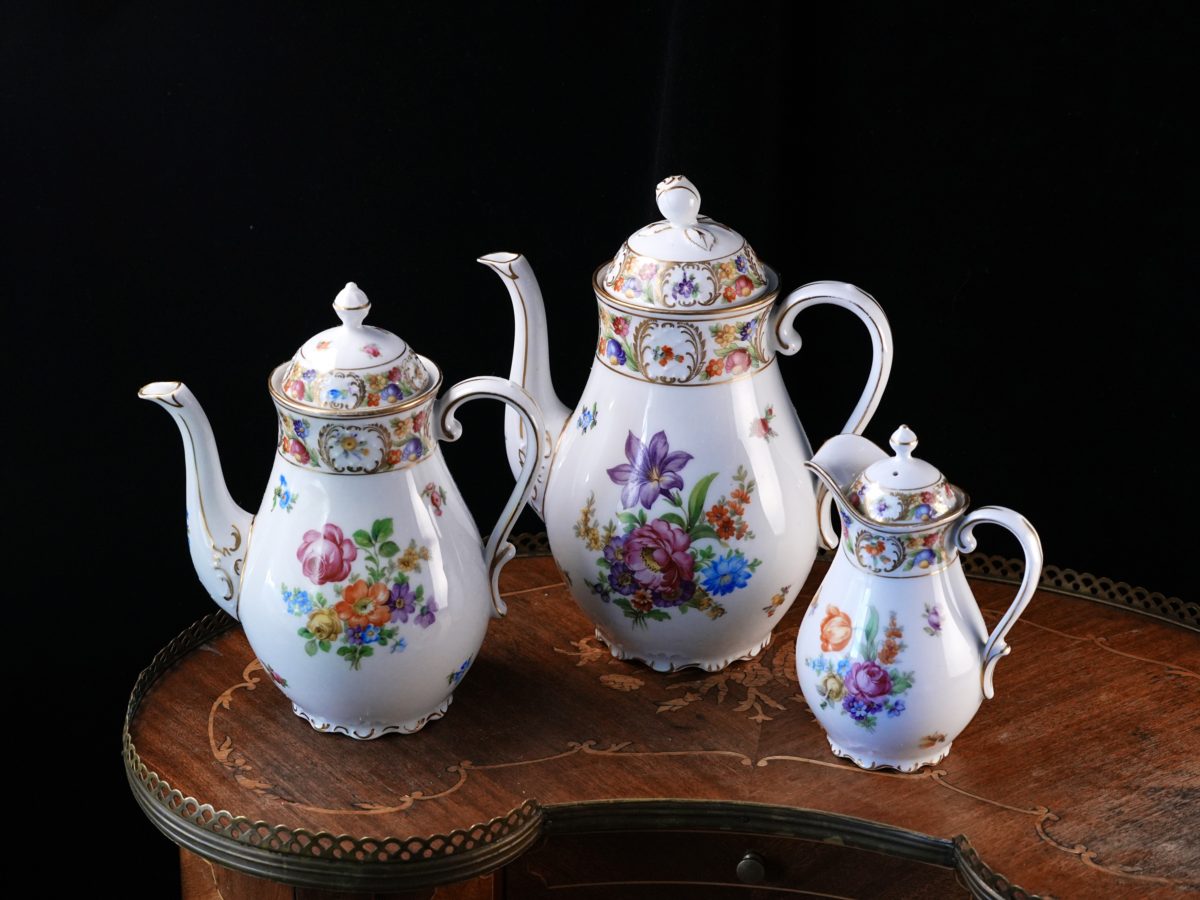
A three-piece Schumann Bavaria Dresdener Art service in the German Saxon-flower tradition — a coffee pot, a slightly taller chocolate-or-tea pot, and a matching creamer, all hand-painted in the same Dresden vocabulary, all finished in gold cartouche neck bands, all from the same workshop in Arzberg, Bavaria.
Sold as individual pieces or as the complete three-piece service — pick what you want at checkout. See Purchase Options below for pricing on each piece.
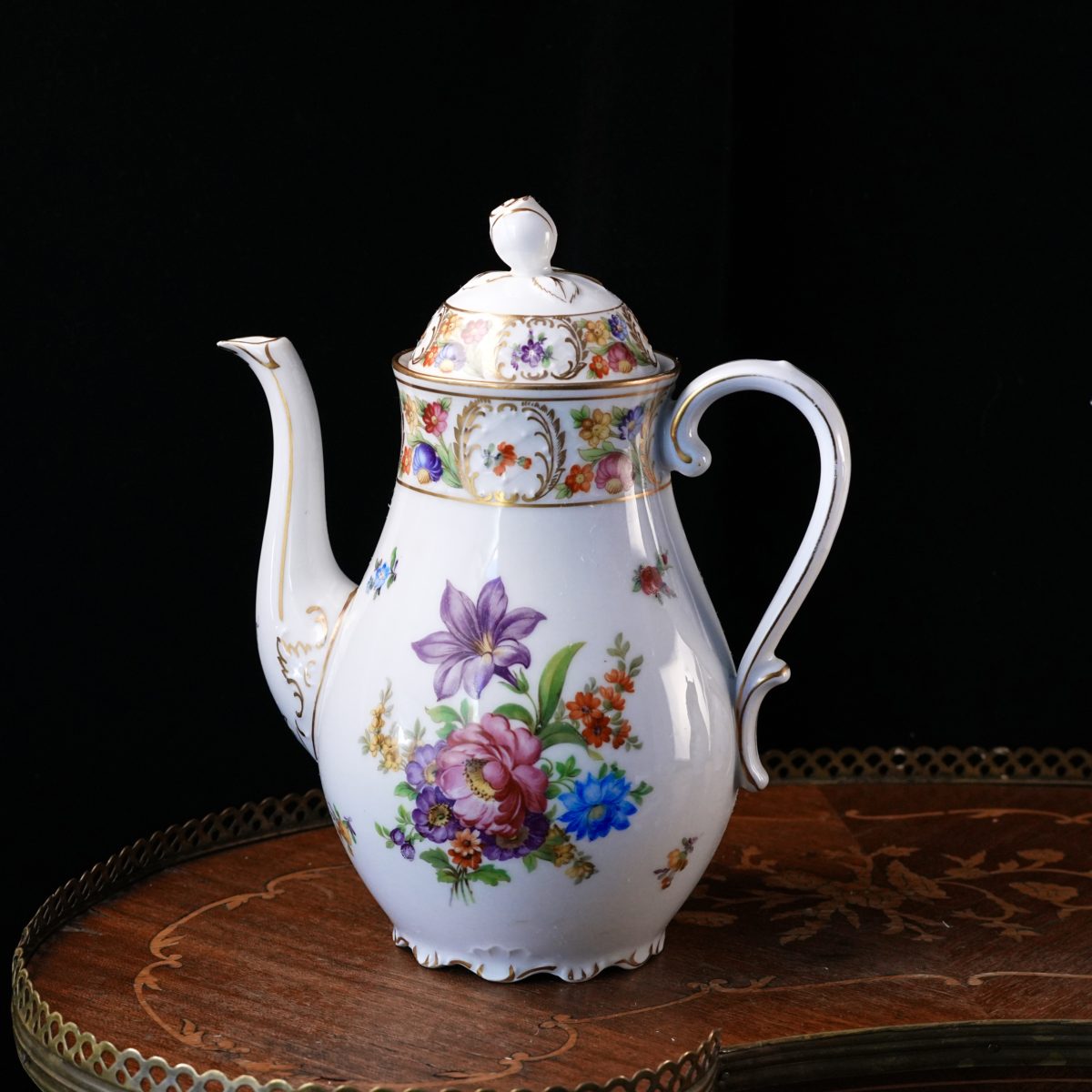
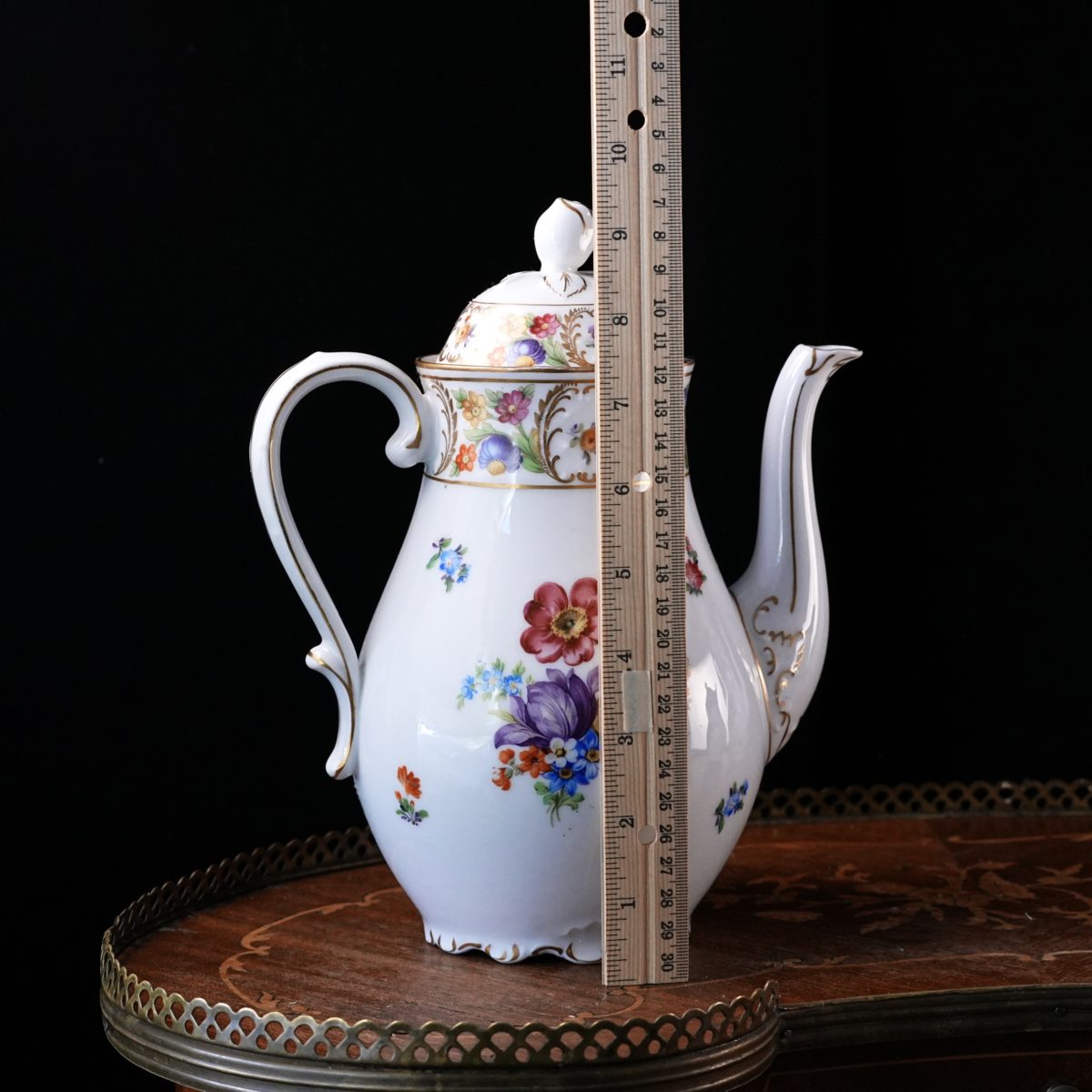
On the three forms. The coffee pot (~8.5" / 21.5 cm) is the rounded baluster on the left in the group photo — its long curved gooseneck spout originates from the mid-body, the classic European coffee-pot form designed so the brewed liquid pours from above the grounds settled at the base. The largest pot (~9.5" / 24 cm) is the tall slender baluster — only about an inch taller than the coffee pot but proportionally different (slenderer body, different spout treatment), the typical paired-form approach of mid-century European service sets where each pot was designed for a different beverage. Its short angled spout sits high on the body; this is most consistent with the chocolate-pot form (chocolate is heavy and silty, so chocolatières use a high-positioned spout to pour from above the sediment), though the same tall slender shape can also serve as a tea pot when the spout originates mid-body, so I have hedged the form attribution rather than confidently assigning it. The creamer (~6" / 15 cm) is the small rounded jug with a triangular three-way pouring lip — slightly larger than the typical mid-century European creamer (4–5"), proportioned to match the rest of the service.
Sit with any of the three pieces and the Saxon-flower tradition reveals itself in two layers — the printed floral layer done by transfer, and the hand-applied gilt layer done at the bench. The main bouquet on each body is a multi-colour Saxon-flower composition — pink cabbage rose at the heart, red and orange and yellow garden flowers tumbled around it, blue forget-me-nots scattered above, small daisies and violets and buttercups tucked into the gaps, sage-green foliage threading the composition. This printed floral decoration is the Dresden-style transfer print Schumann used through its Dresdener Art line, the standard production-line method that allowed the firm to put a Dresden-tradition bouquet on a piece without the expense of fully hand-painting it. Honest disclosure: the bouquets look like hand-painted Dresden work at first glance — close inspection (and Kate's eye on the pieces in hand) confirms they are transfer-printed.
The gilt work, however, is hand-applied — the heavy gold cartouche band that runs around the neck of each piece, the small floral medallion frames inside the cartouche, the gilt accents along the spouts and finials. Hold any piece under angled light and the gold catches the eye unevenly: the cartouche scrolls sit at multiple depths, the gilt thickens slightly at the centre of each scroll-curl, and the gilt line along the spout shows the painter's hand in the slight thickening at the centre of the curve. None of this is transfer-print gold; the gilt is etched, laid, and burnished by hand — the time-consuming half of the production sequence, and the half Schumann did not shortcut.
The two-layer approach — printed floral + hand gilt — sits Schumann Bavaria's Dresdener Art in a particular tier: above purely-transfer everyday porcelain, below fully hand-painted Dresden originals (Wolfsohn / Thieme / Lamm) and the small share of Schumann's own top-line hand-painted output. It's the same craft logic that brought Dresden-tradition aesthetics into middle-class European households between the wars without the cabinet-piece price tag.
The base of the creamer carries the green Schumann Bavaria mark in full: a shield-and-crown emblem above Bavaria, Schumann in the centre, and Dresdener Art along the lower line, plus a hand-inked blue batch number 83. The mark format places the set in the 1918–1940 Schumann production window — the firm's strongest Dresdener Art period — before the post-war reorganisation simplified the marks. Schumann itself ran from 1881 in Arzberg, Bavaria, through to 1996; Dresdener Art was the workshop's homage to the great nineteenth-century Dresden decorators (Helena Wolfsohn, Carl Thieme, Lamm) who had founded the Saxon-flower style a generation earlier in Saxony. The Schumann pieces are not Dresden originals — they're a Bavarian workshop paying open tribute — but the painting quality was sufficient that early-twentieth-century American collectors regularly mistook them for actual Dresden work.
A three-piece set for the Schumann Bavaria collector specifically, for the Dresden Saxon-flower aesthetic cabinet, for the European hand-painted porcelain display (sitting alongside Meissen / KPM / Hutschenreuther), for the seventeenth-to-nineteenth-century coffee-and-chocolate service tradition, or as a serious wedding / anniversary / milestone heirloom gift.
Details
- Type
- Three-Piece Coffee / Chocolate Service Set — Coffee Pot + Tall Chocolate Pot + Creamer
- Maker
- Schumann Bavaria (Carl Schumann Porzellanfabrik AG, founded 1881 in Arzberg, Bavaria; closed 1996)
- Era
- Circa 1920s–1940s — Dresdener Art peak production window (mark format consistent with 1918–1940)
- Pattern
- Dresdener Art — Saxon-flower / Deutsche Blumen tradition; multi-colour hand-painted bouquets + scattered floral sprays + gold cartouche neck bands with individual floral medallions
- Decoration
- Polychrome transfer-printed Saxon-flower bouquets + scattered floral sprays (Dresden-style transfer, not hand-painted) + hand-applied / hand-burnished gold cartouche-scroll bands, floral-medallion frames, spout accents, and finials (the gilt work is the hand-applied half of the decoration)
- Coffee Pot
- ~8.5" / 21.5 cm tall (including lid) — rounded baluster body, S-curve handle, long gooseneck spout from mid-body (gooseneck spout is the classic coffee pot identifier — designed so brewed coffee pours from above the grounds settled at the base)
- Creamer
- ~6" / 15 cm tall (including lid) — rounded body, S-curve handle, triangular three-way pouring lip; slightly larger-format than typical mid-century European creamers
- Material
- Schumann Bavaria hard-paste porcelain
- Markings
- Green shield-and-crown emblem + Bavaria / Schumann / Dresdener Art + hand-inked blue batch number 83 on base
Condition
Very good antique condition. Transfer floral and hand-applied gilt intact across all three pieces; lids original; finials intact; no chips, cracks, hairlines, or restoration. Largest Pot (Option A) has light interior tea-staining (soft brown patina from decades of use — cosmetic only, not visible with lid on); Coffee Pot and Creamer interiors clean. Please review all photos as part of the condition record.
Backstamp & Pattern
- Maker
- Schumann Bavaria (Carl Schumann Porzellanfabrik AG, founded 1881 in Arzberg, Bavaria; closed 1996)
- Pattern
- Dresdener Art — Saxon-flower / Deutsche Blumen tradition; multi-colour hand-painted bouquets + scattered floral sprays + gold cartouche neck bands with individual floral medallions
- Era
- Circa 1920s–1940s — Dresdener Art peak production window (mark format consistent with 1918–1940)
- Mark on base
- Green shield-and-crown emblem + Bavaria / Schumann / Dresdener Art + hand-inked blue batch number 83 on base
The base carries the maker's printed mark; the wording — especially “England” versus “Made in England” versus “Bone China” — together with any pattern or registration number are the main clues to its age.
Read the full backstamp & pattern guide →