Antique Chinese Famille Rose Mille Fleurs Chrysanthemum Plate – Jingdezhen Republican Period, Black Ground Hundred Flowers, China 1930s
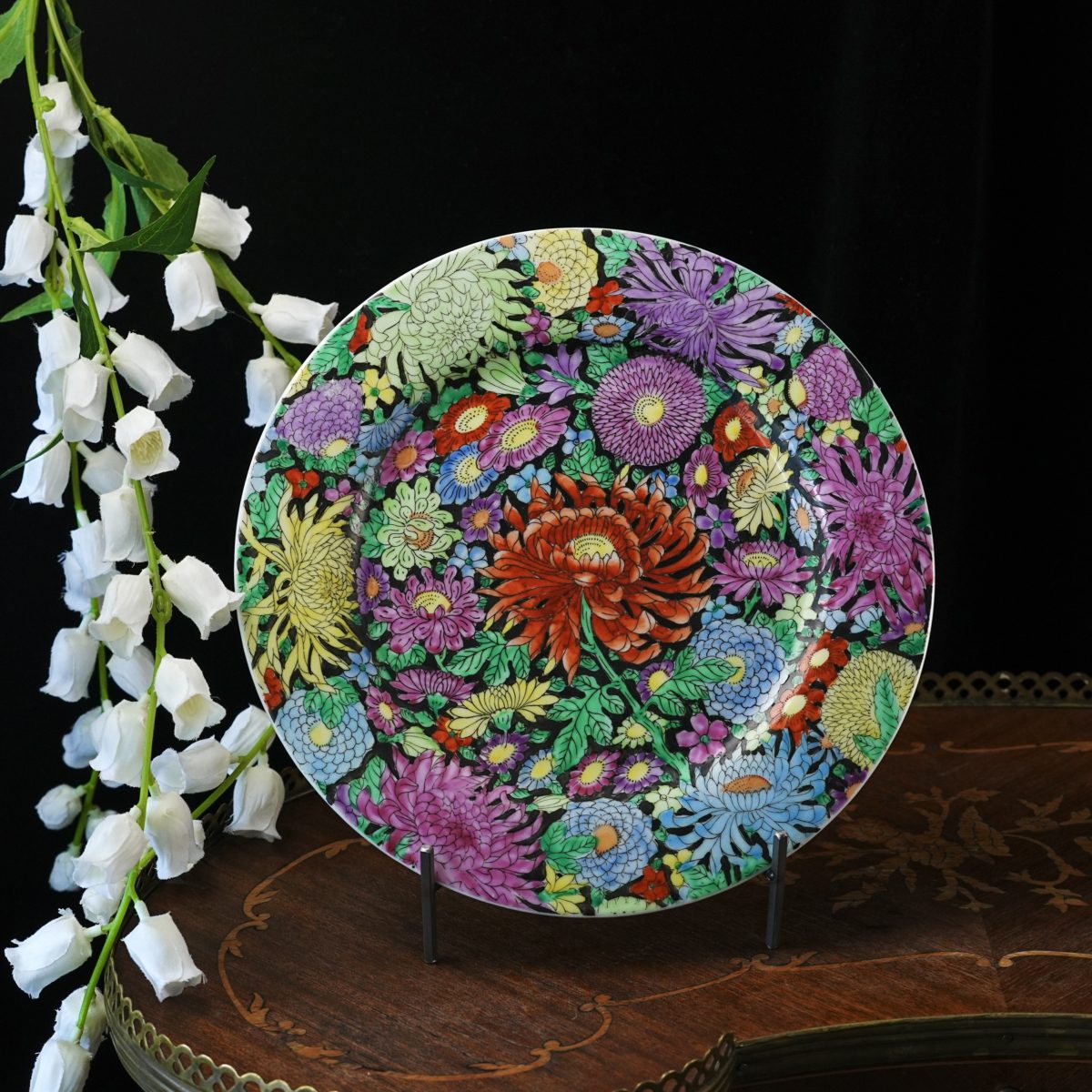
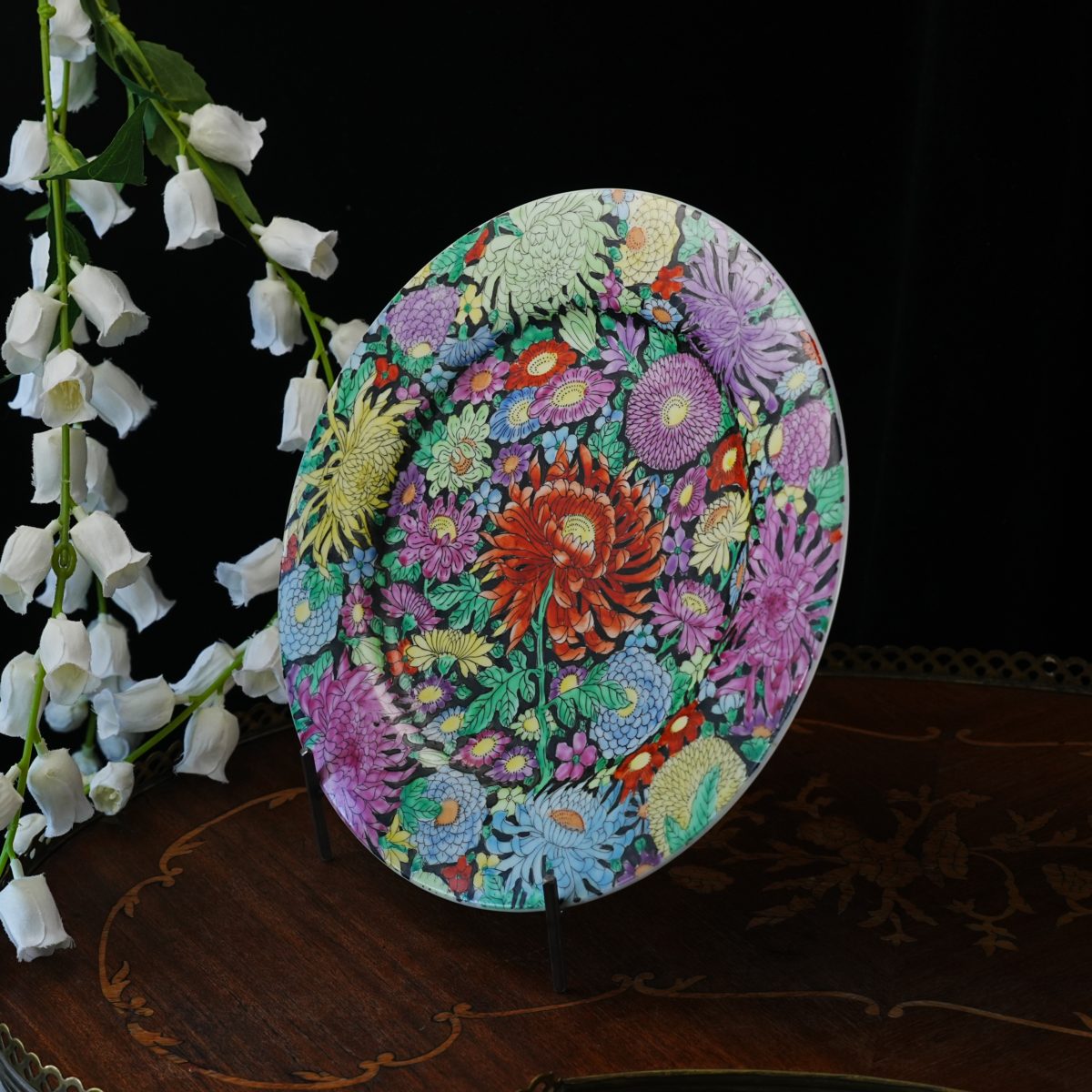
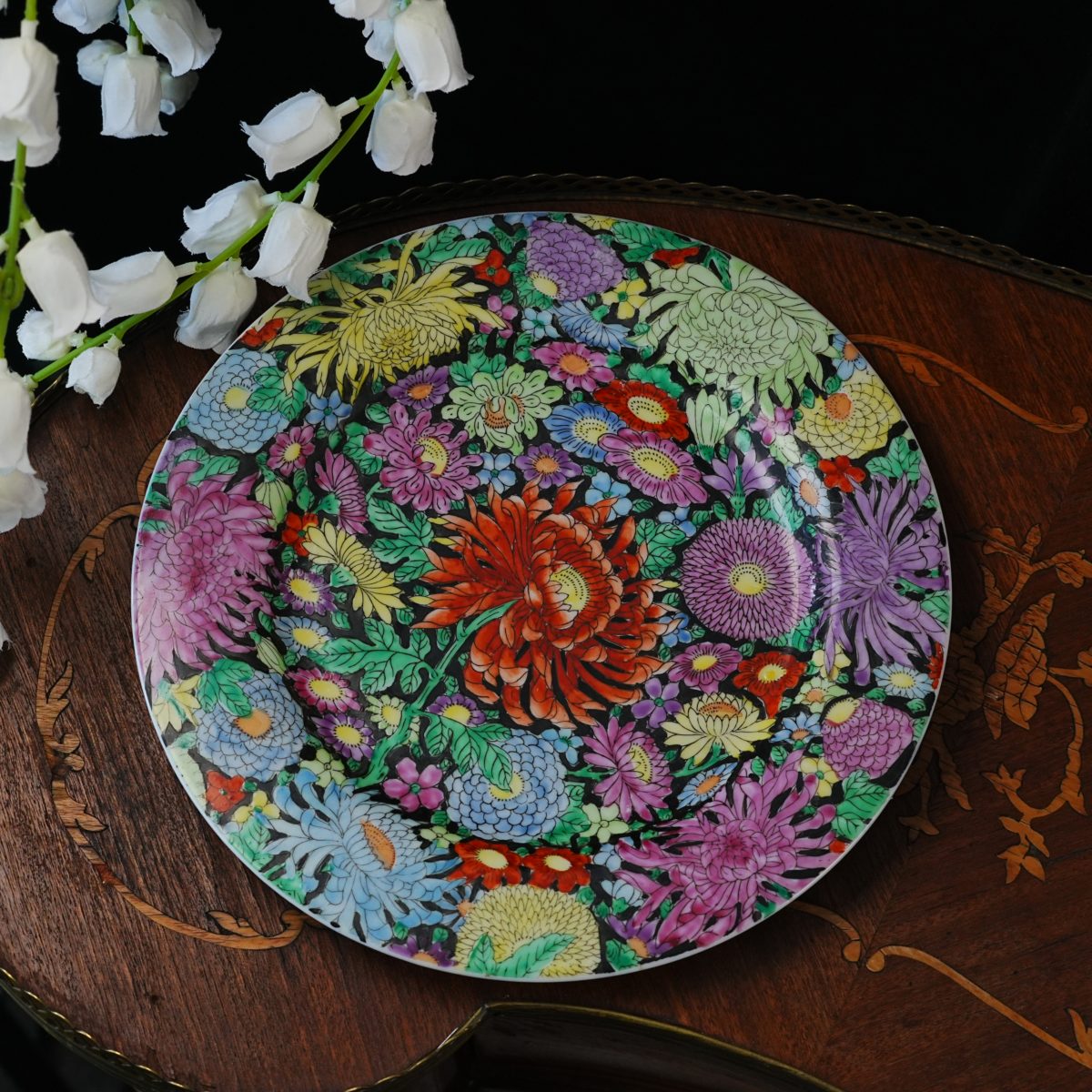
A Chinese famille-rose cabinet plate in the Mille Fleurs / 百花 (Bai Hua, "Hundred Flowers") vocabulary — chrysanthemums of ten or more varieties tumbled together across a deep black ground, with smaller peonies, asters, and wildflowers tucked into the gaps between them. The composition is densely packed in the way the Chinese tradition uses to read as auspicious — the more flowers, the more prosperity wished on the household keeping the plate. The plate is the cabinet-display size, 9.25" / 23.5 cm across.
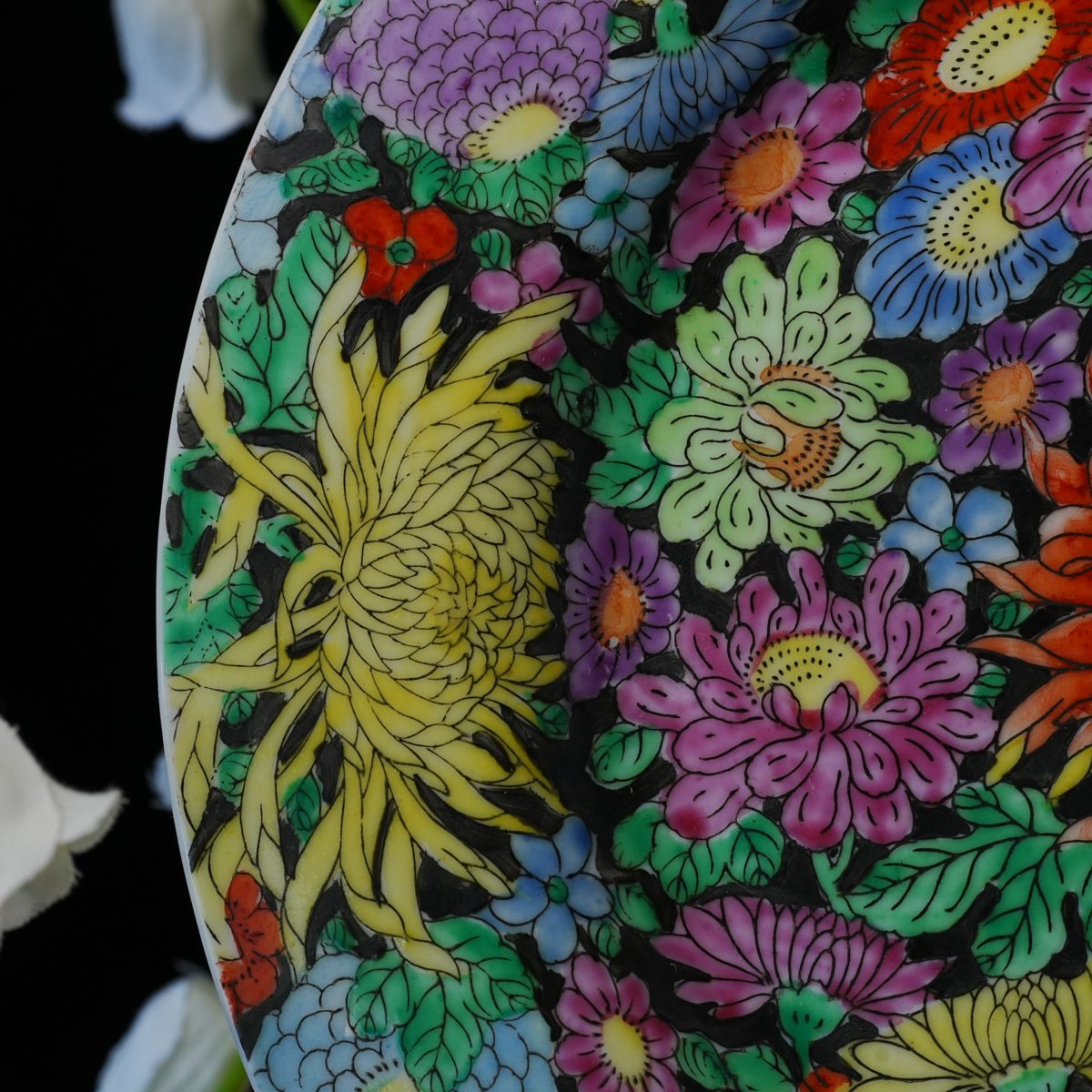
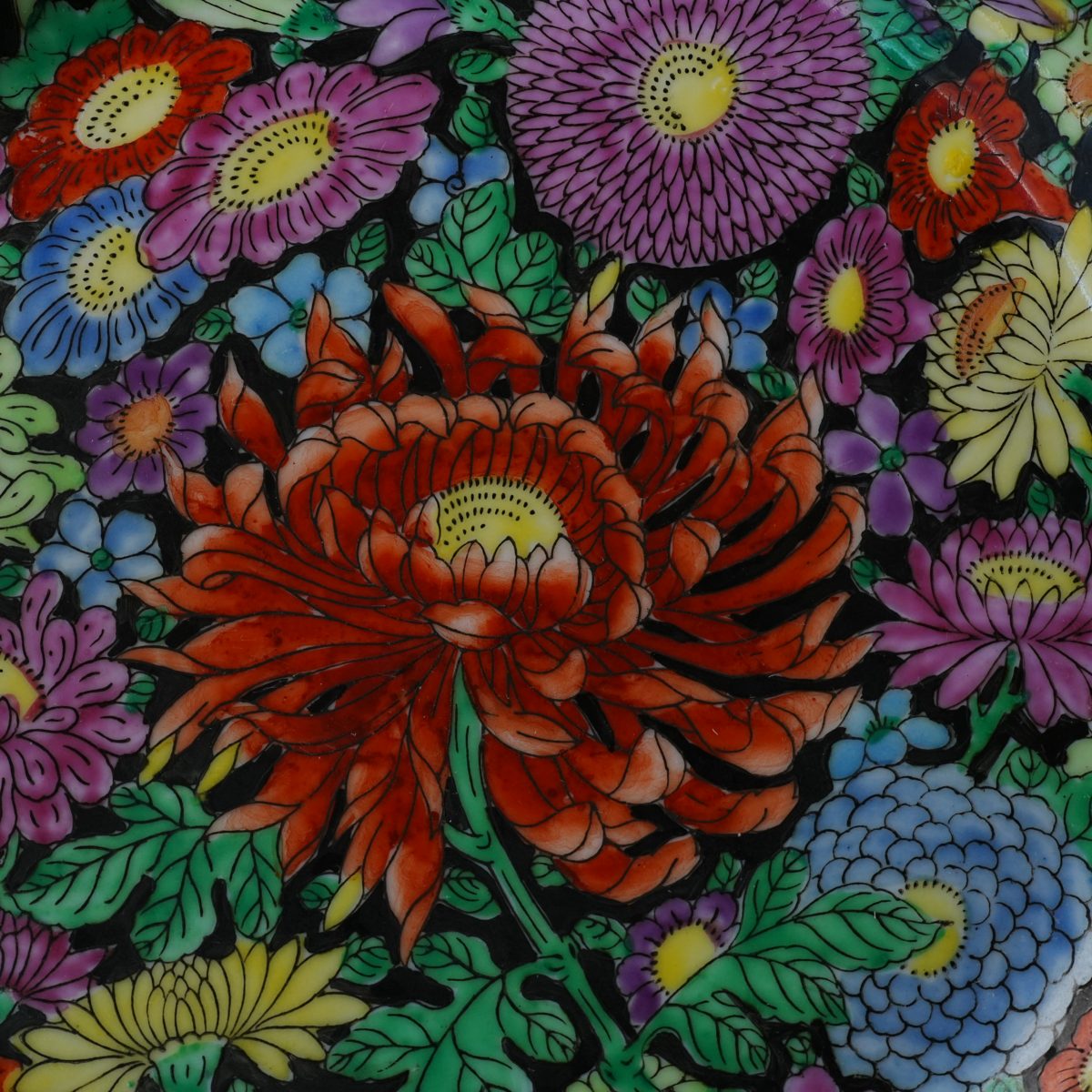
Sit with the plate and the painter's hand reveals itself. Each chrysanthemum head is individual — not stamped or repeated. The large vermillion-red dahlia-style chrysanthemum at the centre carries forty-odd petals, each shaded from deep red at the base to brighter red along the central ridge, with one or two highlight strokes added at the petal tip. The purple spider chrysanthemum behind it is built from long whisker-thin petal strokes radiating from a yellow eye — the painter must have used a fine brush and worked petal by petal, the way Chinese floral painting has demanded since the Qing dynasty. The smaller chrysanthemums around the rim — pink, yellow, white, jade-green, blue — each carry their own colour modulation; none of them is repeated by stamp.
The black ground is the hardest part of any famille-rose piece to execute. Black overglaze enamel runs unevenly during firing, and surviving examples without speckle, bubble, or uneven dye are themselves a sign of careful kiln work. On this plate the black is even and lustrous, the enamel sitting smooth around each flower's painted edge with no overlap or smudge.
The base carries a red iron-red seal mark in archaic seal script — a four-character zhuanshu / seal-script square that imitates the Qianlong nian zhi (made in the reign of the Qianlong Emperor, 1735–1795) mark. This is the standard apocryphal / reverence mark (寄托款 jì tuō kuǎn) practice of Chinese ceramics — particularly common on Republican-period (1912–1949) Jingdezhen export pieces, where the kilns retained the imperial reign mark as a quality-and-tradition signal rather than an actual dating claim. Combined with the Mille Fleurs composition style, the enamel saturation, and the black-ground execution, this places the plate in the Republican-period Jingdezhen export window — approximately 1920s through 1940s.
Chrysanthemums in Chinese culture carry layered meaning: longevity (the flower opens late and resists frost), the scholar-recluse (Tao Yuanming's famous fifth-century lines about picking chrysanthemums by the eastern hedge), and the Double Ninth Festival (九九重陽 Chong Yang, when older relatives are honoured with chrysanthemum-wine and chrysanthemum-cake). A Mille-Fleurs chrysanthemum plate is, by quiet implication, a long-life-and-prosperity wish.
A plate for the Chinese ceramics collector, for the famille rose / 粉彩 cabinet, for the Chinoiserie interior, for the East-Asian art display, for an heirloom gift on a sixtieth or seventieth birthday (chrysanthemum-as-longevity), or as a wedding-anniversary / housewarming wish for a couple beginning a hundred-flowers household.
Details
- Type
- Cabinet Display Plate
- Origin
- Jingdezhen (景德镇), Jiangxi Province, China
- Era
- Republican Period — approximately 1920s–1940s
- Pattern
- Mille Fleurs / 百花 (Bai Hua, "Hundred Flowers") — densely packed chrysanthemum-dominated floral composition on black ground
- Decoration
- Famille rose / 粉彩 (fencai) overglaze enamels — each flower hand-painted individually, multi-pass firing (5–8 firings typical for this technique); black overglaze enamel ground
- Shape
- Round flat cabinet plate with slight rim
- Size
- ~9.25" / 23.5 cm diameter; ~1.5 cm rim thickness
- Material
- Jingdezhen porcelain
- Markings
- Red iron-red seal mark on base — four-character zhuanshu seal-script square in the apocryphal Qianlong reign-mark format (reverence mark / 寄托款, standard Republican-period Jingdezhen export practice)
Condition
Very good antique condition. Enamel colour saturated and vivid across all flowers, black ground even and lustrous, gilt rim line intact, red iron-red seal-mark clear. Light age-appropriate surface wear consistent with ninety-odd years of careful storage. No chips, cracks, hairlines, or restoration. Please review all photos as part of the condition record.
Backstamp & Pattern
- Pattern
- Mille Fleurs / 百花 (Bai Hua, "Hundred Flowers") — densely packed chrysanthemum-dominated floral composition on black ground
- Era
- Republican Period — approximately 1920s–1940s
- Mark on base
- Red iron-red seal mark on base — four-character zhuanshu seal-script square in the apocryphal Qianlong reign-mark format (reverence mark / 寄托款, standard Republican-period Jingdezhen export practice)
The base carries the maker's printed mark; the wording — especially “England” versus “Made in England” versus “Bone China” — together with any pattern or registration number are the main clues to its age.
Read the full backstamp & pattern guide →