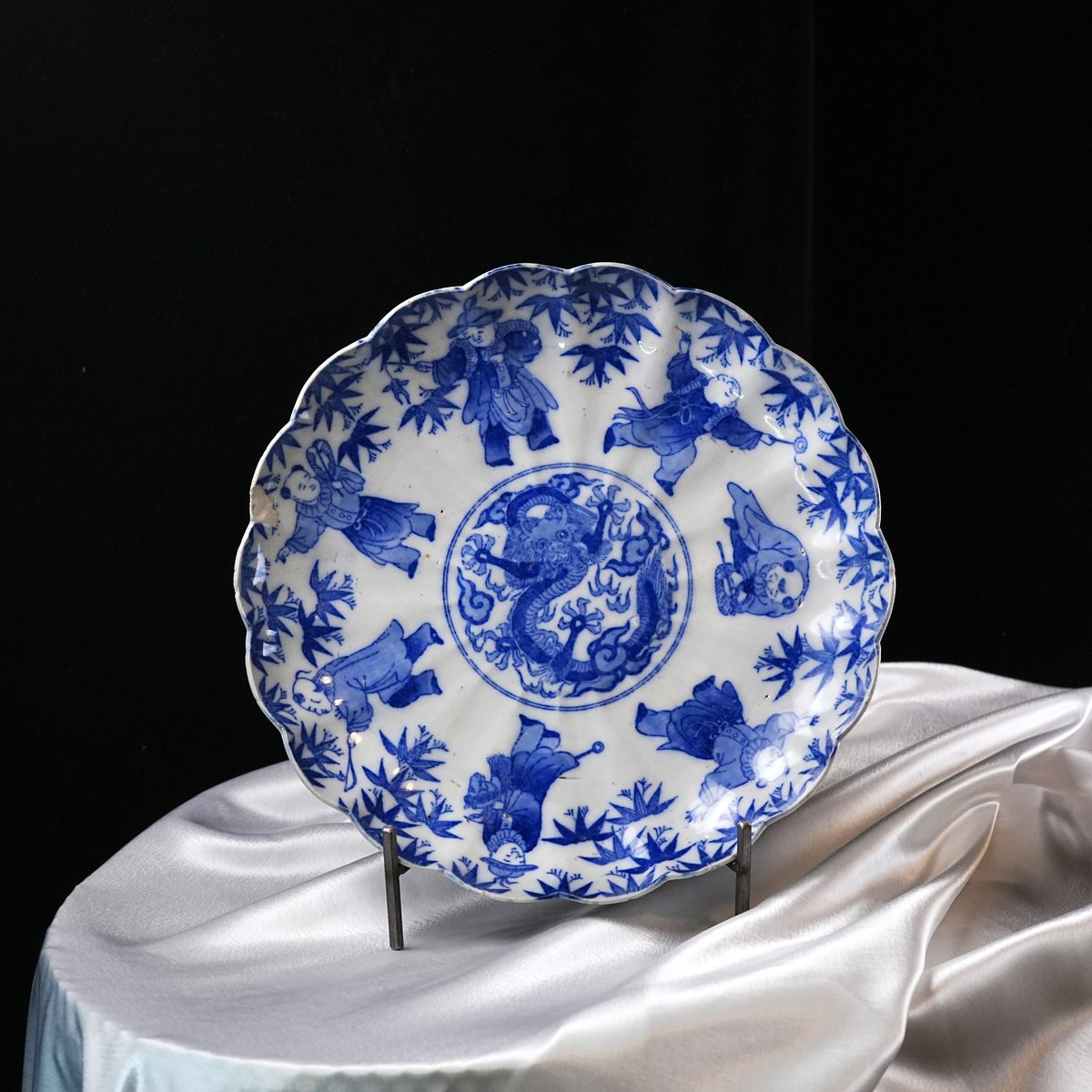
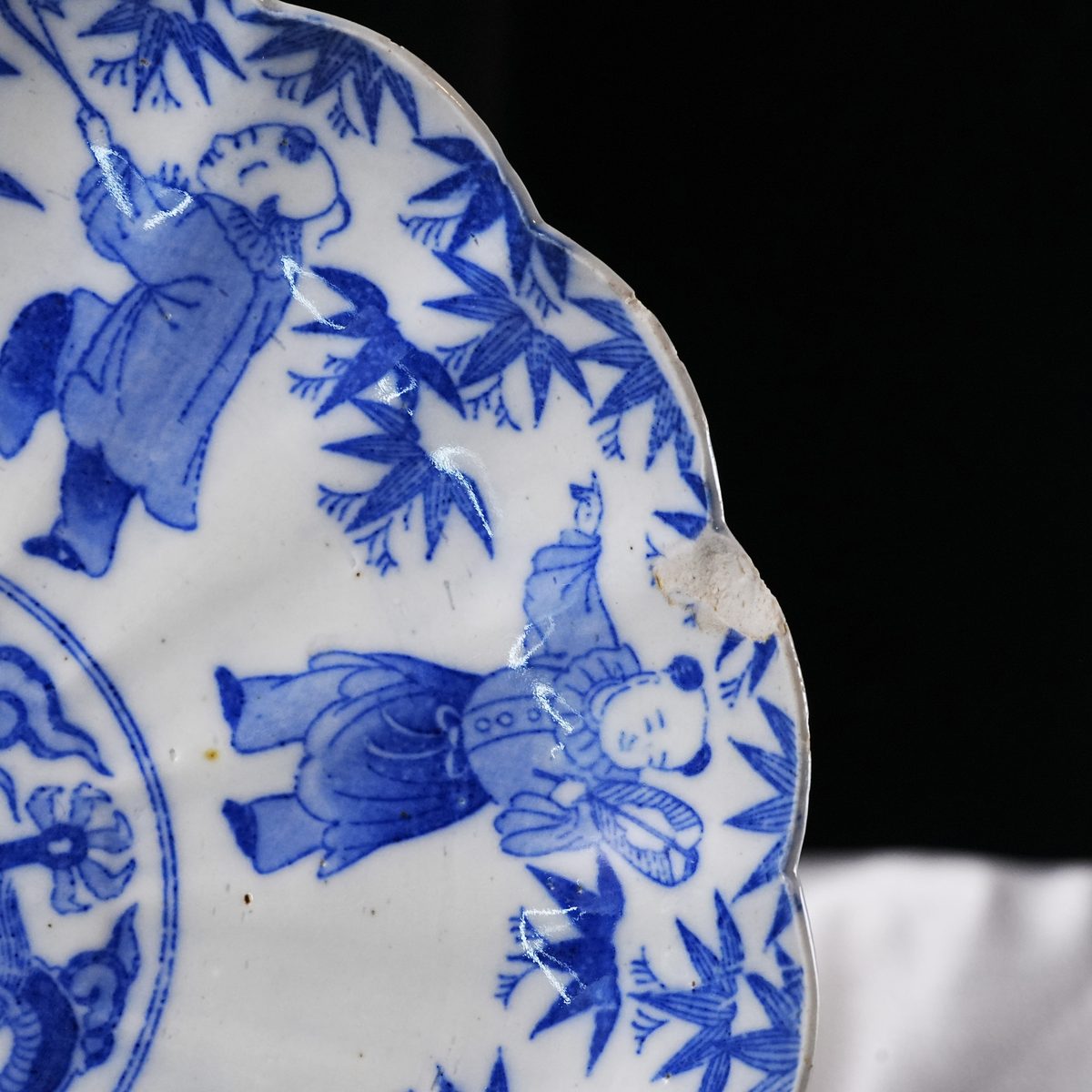
Antique Signed Hizen Arita Shiroiwa Plate – Karako Children & Five-Clawed Imperial Dragon, Meiji Blue & White, Japan c. 1880s
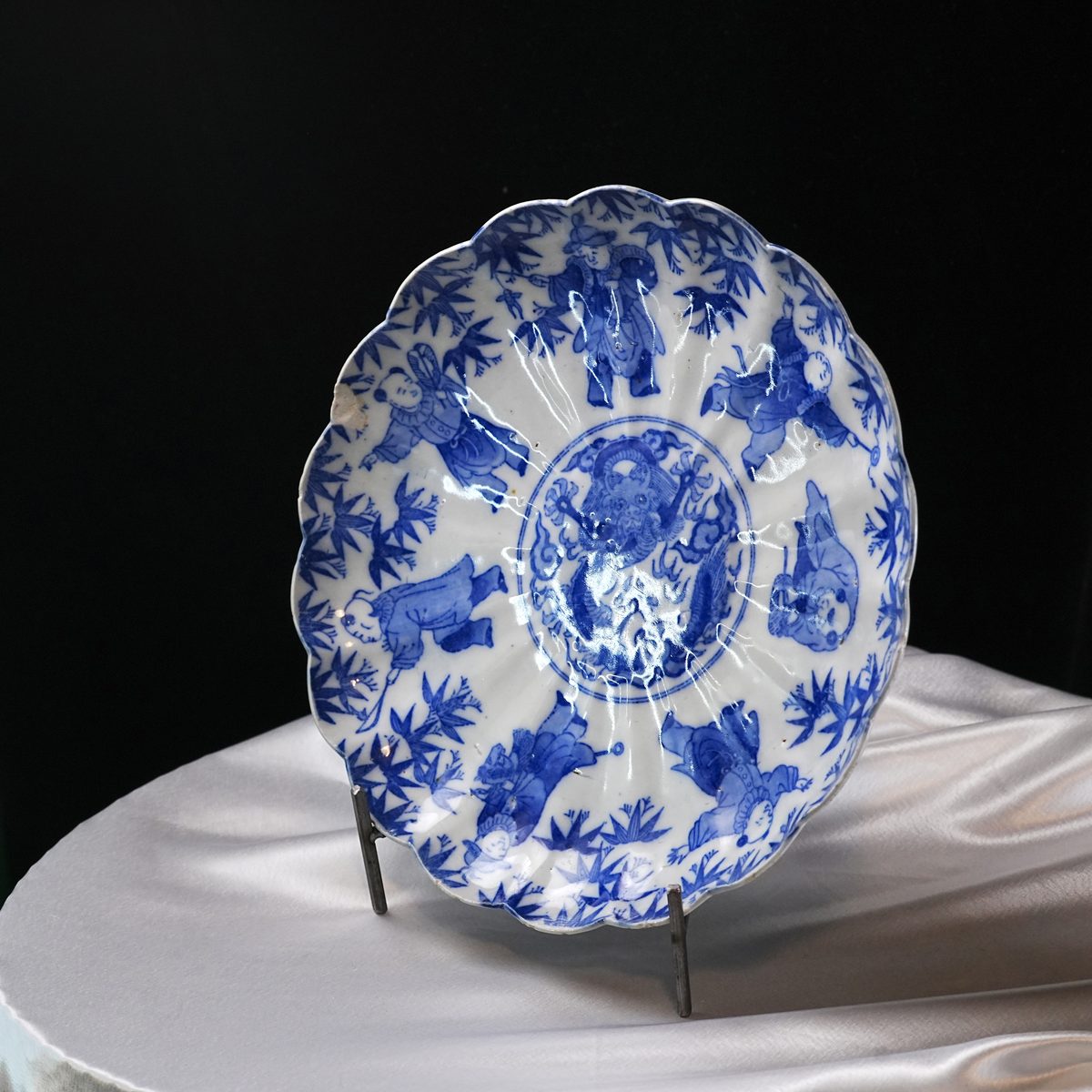
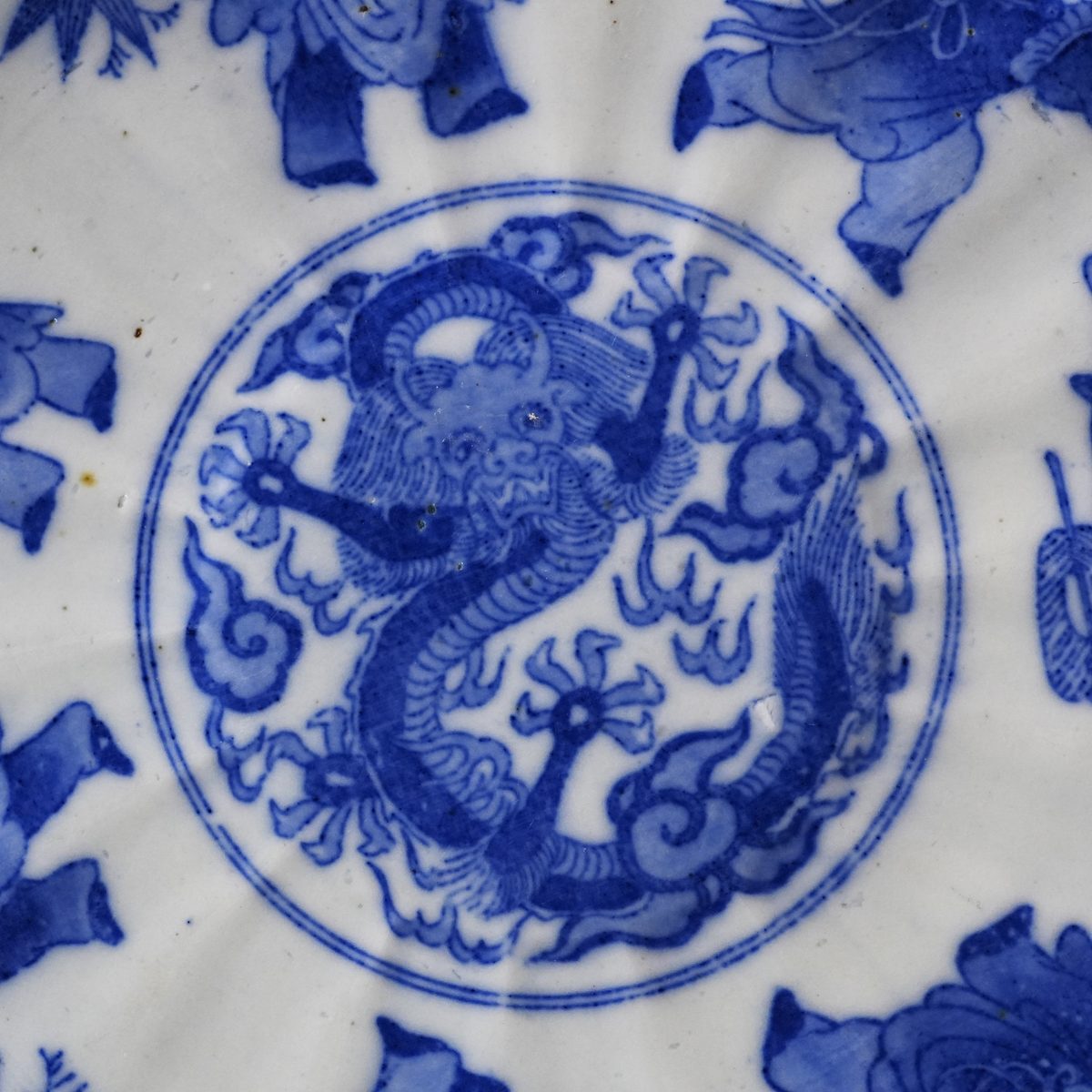
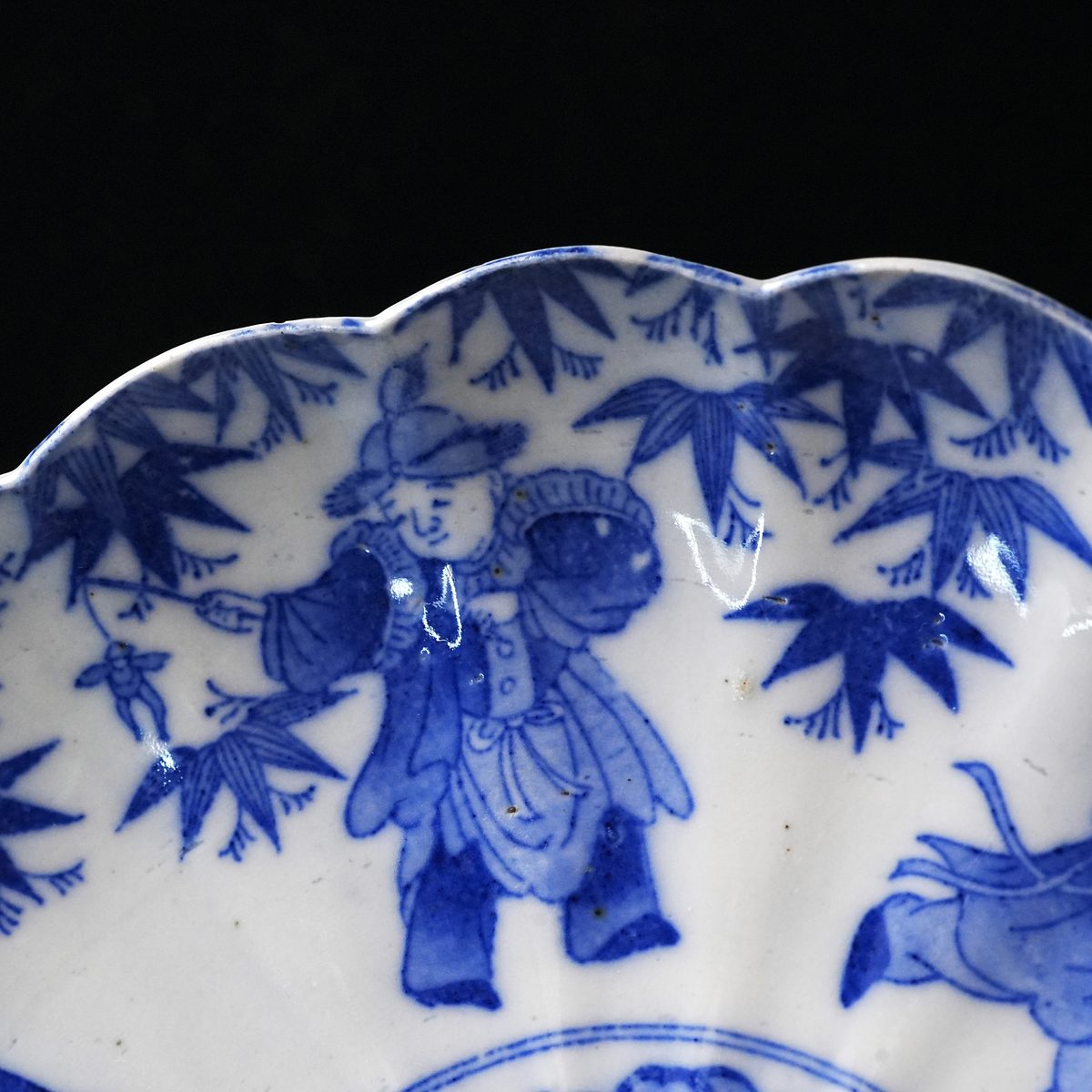
AvailableA signed Meiji-era Arita plate of the highest decorative tier — not an anonymous export piece. Cobalt under-glaze on hard white porcelain, with the kiln mark Hizen Arita Shiroiwa (肥前有田 城岩) stamped on the reverse in the same blue. Look at the centre and the regalia begins: a single five-clawed dragon, coiled in a near-spiral medallion. Five-clawed dragons were the imperial mark in East Asian porcelain — reserved in Ming and Qing China for the emperor's own service, and used by Meiji Japanese painters as a deliberate declaration of "imperial-grade" decoration. Around it, eight small karako — the Chinese-style children in topknots and flowing robes — are scattered through a forest of stylised bamboo, each pair caught in a different bit of play. Around the rim, a continuous bamboo border traces the scalloped wavy edge.
Turn it over for the mark that confirms the maker. A square blue seal in three tiers: 肥前 / 有田 / 城岩 — Hizen Arita Shiroiwa ("Castle Rock" kiln in Arita, Hizen Province). Hizen is the historical province name for the corner of Kyushu where Japanese porcelain was first made in 1616 when the Korean potter Yi Sam-pyeong discovered kaolin at Arita. Arita is the porcelain town itself, the heart of Japanese ceramics for four centuries. Shiroiwa is the specific kiln — a Meiji-era Arita workshop whose work appears occasionally on the international antiques market, recognisable by exactly this combination of imperial dragon medallion + karako + bamboo border + tiered Hizen Arita seal.
Many Meiji-period Imari plates exported to Europe carry a fake Chinese reign mark on the back, to encourage Western collectors to file them alongside Chinese export porcelain. This one keeps its real Japanese name — both more honest and, to a collector, more valuable. It is now genuinely antique — 125 to 145 years old — and reads as a high-tier Meiji Arita on every detail: the slightly grey-blue tone of the porcelain body, the soft cobalt under-glaze, the bamboo border, the karako and five-clawed-dragon subjects, the scalloped lobed rim, and the Shiroiwa kiln signature on the back.
A piece for the Japanese antique collector building a signed-Arita shelf, for the dragon-motif collector after the imperial five-claw, for the chinoiserie / Japandi interior, or as the cabinet anchor among any blue-and-white plate collection. Photographs beautifully against linen, dark wood, or unornamented surfaces — anywhere the blue can do its work. A direct comparable currently asks CAD $660 on eBay; this set is priced honestly at a fraction of that, with the same age-appropriate rim chip openly disclosed.
Details
- Type
- Antique Decorative Wall / Cabinet Plate
- Maker
- Signed Hizen Arita Shiroiwa (肥前有田 城岩) — Arita kiln, Saga Prefecture, Japan
- Era
- Circa 1880s–1900s (Meiji period, 1868–1912)
- Pattern
- Karako children at play among bamboo, central five-clawed imperial dragon medallion, bamboo rim border
- Shape
- Round with scalloped lobed rim
- Size
- ~8.5" / 22 cm diameter
- Material
- Hard-paste Arita porcelain
- Decoration
- Hand-painted cobalt under-glaze, no enamel, no gilt
- Markings
- Square blue seal-mark on reverse — 肥前 / 有田 / 城岩 (Hizen Arita Shiroiwa kiln signature)
Backstamp & Pattern
- Maker
- Signed Hizen Arita Shiroiwa (肥前有田 城岩) — Arita kiln, Saga Prefecture, Japan
- Pattern
- Karako children at play among bamboo, central five-clawed imperial dragon medallion, bamboo rim border
- Era
- Circa 1880s–1900s (Meiji period, 1868–1912)
- Mark on base
- Square blue seal-mark on reverse — 肥前 / 有田 / 城岩 (Hizen Arita Shiroiwa kiln signature)
The base carries the maker's printed mark; the wording — especially “England” versus “Made in England” versus “Bone China” — together with any pattern or registration number are the main clues to its age.
Read the full backstamp & pattern guide →